



A legal charge on property is a registered security interest that gives a lender enforceable rights over your home if you default on a loan. Formally titled a “charge by way of legal mortgage,” it is the standard mechanism behind most UK mortgages and secured loans. The charge is recorded at HM Land Registry, making it visible to any buyer, solicitor, or lender who searches the title. Understanding what it means for your rights, your obligations, and your ability to deal with your property is not optional. It is the foundation of every secured borrowing decision you will make.
What is a legal charge on property?
A legal charge is a formal security interest registered at HM Land Registry that grants a lender specific rights over your property until the debt is repaid. It does not transfer ownership to the lender. You remain the registered proprietor throughout. What it does transfer is a bundle of legal powers the lender can exercise if you stop making payments.
Those powers are significant. The lender gains the right to take possession of the property and sell it to recover the outstanding debt. These rights arise automatically under the Law of Property Act 1925, without the lender needing to prove the debt separately in court. That automatic enforceability is what makes a legal charge so valuable to lenders and so consequential for borrowers.

The charge appears in the Charges Register section of your title at HM Land Registry. Any person can inspect it for a small fee. This public visibility is not incidental. It is the mechanism that gives the charge its legal force against third parties, including future buyers and other creditors.
How is a legal charge created and registered?
Creating a valid legal charge follows a defined legal process. Each step matters. Missing one can undermine the charge entirely.
- Sign the mortgage deed or legal charge document. The borrower signs a formal deed that sets out the loan terms, the property being charged, and the lender’s rights. This document must comply with the Law of Property Act 1925 to be legally valid.
- Submit to HM Land Registry for registration. The charge only takes full legal effect once it is registered against the property title. Until registration is complete, the lender’s interest is equitable only, which carries weaker protections.
- For company-owned properties, register at Companies House within 21 days. Under Sections 859A–Q of the Companies Act 2006, any charge over company property must be filed at Companies House within 21 days of creation. Missing this deadline voids the charge against liquidators and creditors.
- Receive confirmation of registration. HM Land Registry updates the title and issues confirmation. The charge is now enforceable against the world, not just the borrower.
- Review any restrictions added to the title. Lenders often add a restriction to the proprietorship register, requiring their consent before any dealing with the property can be registered.
Failure to register at Companies House does not just weaken the charge. It voids the charge entirely in an insolvency scenario, leaving the lender as an unsecured creditor. That is a catastrophic outcome for any lender and a significant risk for company directors who assume registration happened automatically.
Pro Tip: If your property is held in a limited company, confirm with your solicitor that the charge has been filed at Companies House within the 21-day window. Do not assume your lender has done this on your behalf.
What rights and powers does a lender hold under a legal charge?
A registered legal charge gives a lender a clear set of enforcement tools. These are not theoretical. They are exercisable without returning to court to prove the debt.
- Power of possession. The lender can take physical possession of the property on default. This right exists under the Law of Property Act 1925 and arises the moment the mortgage is created, not just when you miss payments.
- Power of sale. The lender can sell the property and use the proceeds to repay the outstanding loan. Any surplus goes to the borrower. Any shortfall remains the borrower’s liability.
- Priority over unsecured creditors. Lenders holding registered legal charges rank ahead of unsecured creditors in any insolvency or enforcement scenario. This priority is automatic and does not require a court order.
- Appointment of a receiver. In commercial lending, lenders can appoint a receiver to manage or sell the property without going through the courts directly.
- Negative pledge clauses. Most legal charges include a clause that restricts further charges, refinancing, or sale without the lender’s written consent. This locks the equity in the property until the loan is repaid.
The negative pledge clause is the detail most borrowers overlook. You may own your home outright in equity terms, but if a legal charge with a negative pledge is registered, you cannot grant a second charge or sell without your first lender’s approval. That restriction has real consequences when you need to raise further funds or move quickly on a sale.
Pro Tip: Read the negative pledge clause in your charge document before signing. Ask your solicitor to explain exactly which dealings require lender consent. Knowing this upfront prevents delays later.
How do legal charges differ from equitable charges and other property liens?
Not all charges on property carry the same weight. The distinction between a legal charge and an equitable charge is one of the most practically important in UK property law.
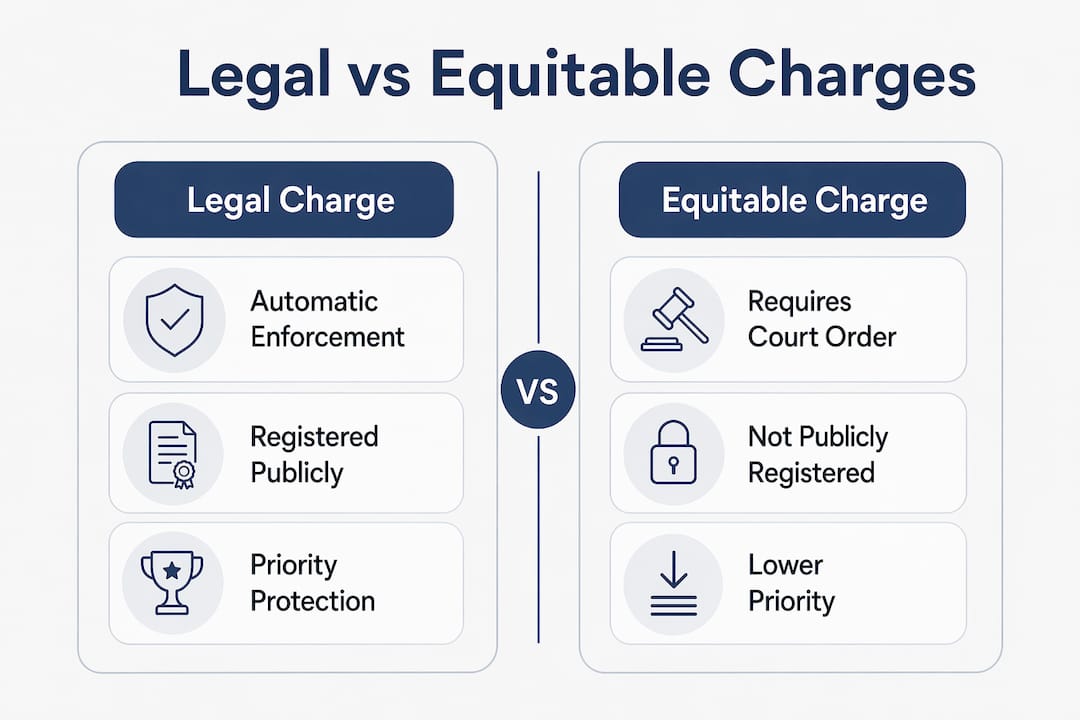
Legal charges give automatic enforcement rights. An equitable charge, by contrast, requires a court order to enforce and does not transfer any title interest to the lender. That difference in enforcement speed and certainty is why lenders almost always insist on a legal charge rather than an equitable one.
Registration is the other critical difference. Registered legal charges provide public notice to all parties. An equitable charge that is not registered is vulnerable to a bona fide purchaser who buys the property without notice of it. That purchaser takes the property free of the equitable charge. A registered legal charge cannot be defeated this way.
Other property lien types also exist in UK law. A charging order, granted by a court after a judgment debt, converts an unsecured debt into a charge over the debtor’s property. HMRC can also register statutory charges for unpaid tax. These sit alongside or behind registered mortgages in the priority queue, depending on when they were registered.
| Charge type | How it arises | Enforcement route | Priority protection |
|---|---|---|---|
| Legal charge | Deed and Land Registry registration | Automatic under Law of Property Act 1925 | Strong. Registration gives public notice |
| Equitable charge | Agreement without full legal formalities | Court order required | Weaker. Vulnerable to purchasers without notice |
| Charging order | Court judgment | Court process | Ranks by registration date |
| HMRC statutory charge | Tax debt | Statutory powers | Depends on registration timing |
The practical implication for buyers is clear. Always search the Charges Register before purchasing. A charging order or HMRC statutory charge sitting on a title can survive a sale if not discharged beforehand, and mortgage fees vary by lender partly because of how lenders price the risk of competing charges on a title.
What should homeowners and buyers know about managing property charges?
Understanding a charge exists is one thing. Knowing how to manage it is another. These are the practical steps every homeowner and buyer should take.
- Check the title before buying. Search the Charges Register at HM Land Registry for a small fee. Any registered charges, restrictions, or charging orders will appear here. Never rely on the seller’s word alone.
- Understand the impact on selling. A registered charge must be discharged before or at completion of a sale. Your conveyancing solicitor will arrange this, but you need to know the outstanding balance and any early repayment charges before you commit to a sale price.
- Discharge the charge after repayment. Paying off your loan does not automatically remove the charge from your title. A formal discharge application using Form DS1 must be submitted to HM Land Registry. Discharge typically takes 5–15 working days after repayment. Until it is removed, the charge remains visible on your title.
- Watch for unexpected charges. Court judgment debts and HMRC liabilities can result in charges being registered against your property without your direct involvement in a mortgage transaction. Check your title periodically, especially if you have had financial difficulties.
- Get lender consent before dealing with the property. Homeowners remain registered proprietors after granting a charge but face significant restrictions requiring lender consent for dealings such as granting a lease or taking out a second charge. Acting without consent can put you in breach of your mortgage terms.
Borrowers consistently underestimate these restrictions. The charge does not just sit quietly in the background. It actively constrains what you can do with your property until the debt is cleared.
Key takeaways
A legal charge on property is a registered security interest that gives a lender automatic enforcement rights, priority over unsecured creditors, and control over how you deal with your property until the loan is repaid.
| Point | Details |
|---|---|
| Registration is mandatory | A legal charge only takes full effect once registered at HM Land Registry, or at Companies House for company-owned property. |
| Automatic enforcement rights | Lenders can take possession and sell without a separate court order, unlike equitable charges which require one. |
| Negative pledge restrictions | Most charges prevent further borrowing, refinancing, or sale without the lender’s written consent. |
| Discharge is not automatic | After repayment, you must submit Form DS1 to HM Land Registry to remove the charge from your title. |
| Check before you buy | Search the Charges Register for a small fee to identify any existing charges, charging orders, or HMRC statutory charges on a property. |
Why most homeowners sign first and read later
I have seen this pattern repeatedly. A homeowner agrees to a secured loan, signs the charge document at the solicitor’s office, and walks away thinking the paperwork is just formality. Six months later, they want to remortgage to a better rate and discover their existing charge includes a negative pledge clause. The lender will not consent without a fee. The better rate disappears.
The legal charge is not just security for the lender. It is a set of obligations for you. The moment you sign, your freedom to deal with your property changes. That is not a reason to avoid secured borrowing. Secured loans, including second charge mortgages, are often the most cost-effective way to raise funds against property equity. But the terms of the charge matter as much as the interest rate.
My honest advice is to read the charge document before you sign it, not after. Ask your solicitor to walk you through the negative pledge clause, the consent requirements, and the discharge process. Five minutes of questions upfront saves weeks of frustration later. And always check that any charge is properly discharged after repayment. I have seen titles carrying charges from loans repaid years ago simply because nobody submitted Form DS1. That oversight can delay a sale or a remortgage at the worst possible moment.
— kevin
Secured loans with Loanable: clear terms, no surprises
Understanding a legal charge is the first step. Choosing the right lender is the second.

Loanable specialises in secured homeowner loans for UK residents, with CeMAP-qualified advisors who explain exactly what a legal charge means for your property before you commit. Loanable has funded over £53 million in loans and holds 5-star ratings from clients who needed clear guidance alongside competitive rates. Whether you are consolidating debt or funding home improvements, Loanable works with a wide network of lenders to find terms that fit your situation. Check your eligibility today and get a clear picture of what a secured loan would mean for your property.
FAQ
What is a legal charge on a property?
A legal charge is a registered security interest on your property that gives a lender the right to take possession and sell if you default. It is formally known as a “charge by way of legal mortgage” and is recorded at HM Land Registry.
Does a legal charge mean I no longer own my property?
No. You remain the registered proprietor throughout the life of the charge. The lender holds security rights over the property, not ownership, until the loan is fully repaid.
How do I remove a legal charge after repayment?
Repaying the loan does not remove the charge automatically. You or your solicitor must submit Form DS1 to HM Land Registry. The process typically takes 5–15 working days after repayment.
What is the difference between a legal charge and an equitable charge?
A legal charge is registered at HM Land Registry and gives automatic enforcement rights. An equitable charge requires a court order to enforce and offers weaker protection against third-party purchasers.
Can a lender register a charge on my property without my knowledge?
A standard mortgage charge requires your signature on a deed. However, a court can grant a charging order against your property to secure a judgment debt, which can be registered without a new mortgage agreement.