



A debt consolidation secured loan lets you combine multiple debts into one monthly repayment, using your property as collateral. You borrow a lump sum, pay off existing creditors, and repay the new loan at a single interest rate. Eligibility requires UK residency, homeownership, an active mortgage, and sufficient equity in the property.
Key features at a glance:
- One monthly repayment replaces multiple creditor payments
- Your home secures the loan, reducing lender risk and often lowering your rate
- Suitable for consolidating credit cards, overdrafts, personal loans, and store cards
- Bad credit borrowers may find approval easier than with unsecured options
- Failure to repay puts your home at risk of repossession
How does a secured consolidation loan differ from an unsecured one?
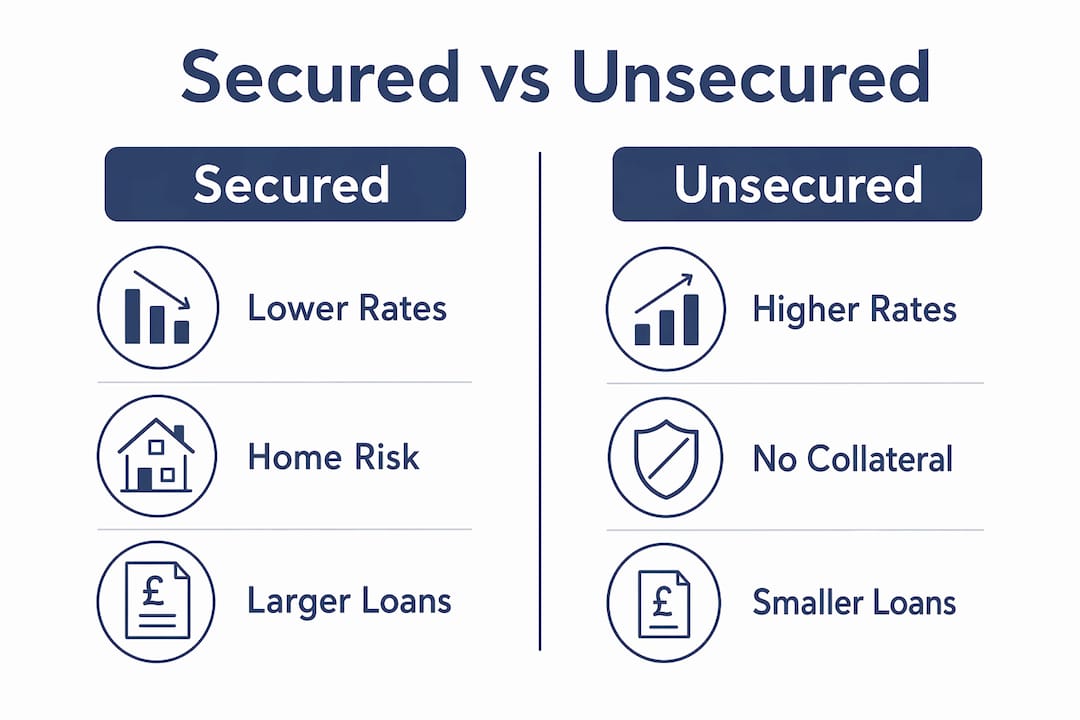
The core difference is collateral. An unsecured debt consolidation loan relies entirely on your credit profile and income. A secured loan uses your property, which gives the lender a safety net and typically produces a lower interest rate for you.
- Secured loans: Lower rates, higher borrowing limits, accessible with poor credit, but your home is at risk
- Unsecured loans: No asset at risk, faster to arrange, but stricter credit requirements and generally higher APRs
- Credit score impact: Both types affect your credit file; missed payments on either cause damage
- Homeownership: Required for secured loans; unsecured loans are open to renters
Poor credit borrowers may find secured loans more accessible, but lenders still charge higher rates and offer smaller amounts when credit history is weak. The trade-off is real: easier approval comes with greater personal risk.
What are the benefits and risks of a secured debt consolidation loan?
Benefits:
- Lower interest rate compared to credit cards and unsecured loans
- Single monthly payment simplifies budgeting
- Timely repayments can improve your credit score over time
- Access to larger borrowing amounts than unsecured alternatives
- May reduce total monthly outgoings
Risks:
- Your home can be repossessed if you default
- Missed payments damage your credit rating significantly
- Spreading debt over a longer term increases total interest paid
- Converting unsecured debt to secured debt shifts risk directly to your property
Pro Tip: Financial experts at MoneyHelper warn that securing unsecured debts against your home moves the risk from the lender to you. Seek free debt advice before proceeding.
What do secured debt consolidation loans typically cost in the UK?
APRs vary considerably depending on your credit score, loan size, and lender. Novuna Personal Finance, for example, advertises loans from 6.7% APR representative on amounts between £7,500 and £25,000 over five years. At the other end, personal loan APRs can be very high for borrowers with weaker credit profiles.
Beyond the headline rate, watch for these fees:
- Arrangement fees: Charged by some lenders to set up the loan
- Valuation fees: Required to assess your property’s current value
- Early repayment charges (ERCs): Payable if you settle the loan ahead of schedule
ERCs on your existing debts deserve particular attention. Always obtain settlement figures from all creditors before consolidating, because high exit charges can wipe out any interest saving the new loan delivers.
Fixed rates give predictable monthly payments. Variable rates may start lower but can rise, making long-term budgeting harder. A longer repayment term reduces monthly payments but increases the total interest paid over the life of the loan.
| Cost element | Typical range |
|---|---|
| Representative APR (good credit) | 6.7%–12% |
| Representative APR (poor credit) | From higher rates depending on credit quality |
| Arrangement fee | Varies by lender, sometimes no fees |
| Valuation fee | Typically required, varies by property |
| Early repayment charge | Can be several months’ interest, varies |
How to apply for a secured debt consolidation loan in the UK, including details about the application process, required documentation, and typical lender credit checks for secured loans
Preparation matters more than speed here. Rushing an application without knowing your settlement figures or credit position wastes time and can result in a hard credit search you did not need.
Steps to follow:
- List all debts: Record each creditor, balance, interest rate, and monthly payment
- Check for ERCs: Contact each lender for a settlement figure including any exit penalty
- Check your credit report: Use Experian, Equifax, or TransUnion to spot errors before applying
- Use a soft credit check: Many UK lenders offer eligibility checks that do not affect your credit score
- Gather documents: Proof of income, mortgage statement, photo ID, and recent bank statements
- Compare total repayable cost: Not just the monthly payment or headline APR
- Submit your application: Once you have chosen a lender, a full application triggers a hard credit search
Lenders typically require you to be over 18, a UK resident, a homeowner with an active mortgage, and to have sufficient equity in the property. The minimum equity threshold varies by lender.
Pro Tip: Check your eligibility using a soft search tool before committing to a full application. It gives you a realistic picture of available rates without leaving a mark on your credit file.

Comparing leading UK providers of secured debt consolidation loans
Each provider below takes a different approach to secured and homeowner consolidation lending. The table covers the key dimensions for comparison.

| Provider | Rep. APR | Loan amounts | Loan term | Credit requirements | Unique features | Rating |
|---|---|---|---|---|---|---|
| Zable | — | Not publicly listed | Not publicly listed | Accepts range of credit profiles | Award-winning mobile app; credit building tools; Moneyfacts 2026 winner | 4.8★ (thousands of reviews) |
| Ocean Finance | Not publicly listed | Not publicly listed | Not publicly listed | Accepts poor credit via broker network | FCA-regulated broker; 35 years’ experience; rated Exceptional on Feefo | 4.6★ (674 reviews) |
| Norton Finance | Not publicly listed | Not publicly listed | Not publicly listed | Accepts poor credit; specialist secured lender | Soft credit checks; access to hundreds of secured loan products; dedicated support | 4.6★ (297 reviews) |
| Novuna Personal Finance | 6.7% rep. (£7,500–£25,000 over 5 yrs) | — | Not publicly listed | Good credit typically required | UK’s Best Personal Loan Provider for 12 consecutive years (YourMoney.com) | 4.7★ (201 reviews) |
Zable suits borrowers who want to manage their finances in one place. Its mobile app combines credit building, spend tracking, and debt consolidation tools, and it won the Moneyfacts award in 2026 and Smart Money People’s best credit building product in 2025. The representative APR on personal loans reflects its broader credit profile acceptance.
Ocean Finance operates as an FCA-regulated credit broker, meaning it searches across multiple lenders rather than lending directly. Its 35 years of experience and Feefo “Exceptional” rating make it a practical starting point for borrowers who want to compare offers without approaching lenders individually.
Norton Finance is the specialist secured lender on this list. It focuses specifically on secured loans and remortgages, offering access to hundreds of products and running soft credit checks as standard. For homeowners with complex credit histories, that combination of product breadth and low-impact eligibility checking is genuinely useful.
Novuna Personal Finance is the strongest option for borrowers with good credit who want a straightforward, low-cost personal loan. Its 6.7% representative APR and 12 consecutive years as UK’s best personal loan provider by YourMoney.com reflect consistent performance at the affordable end of the market. Note that Novuna offers unsecured personal loans, not secured homeowner loans, so it suits those who qualify on credit alone.
Expert advice on choosing the right secured consolidation loan
Choosing the wrong loan costs more than the interest rate suggests. These are the considerations that matter most.
- Calculate total repayable cost: Monthly payments are easy to compare; total cost over the full term is what actually matters
- Factor in all ERCs: A consolidation that saves £50 per month but costs £2,000 in exit fees takes over three years to break even
- Seek independent advice first: Free services such as StepChange, Citizens Advice, and MoneyHelper can assess whether consolidation is the right route for your situation
- Maintain repayments without fail: Credit scores improve with consistent on-time payments; a single missed payment on a secured loan causes disproportionate damage
- Avoid adding new debt: Consolidating existing balances only works if spending habits change alongside it
Pro Tip: Secured loans should not be the first option if you are already in financial distress. A debt management plan or individual voluntary arrangement may carry less risk to your home. Talk to a debt charity before committing.
The best consolidation deal balances interest rate, total repayable amount, and term flexibility. A lower monthly payment achieved by extending the term to 20 years may cost far more overall than a slightly higher payment over seven years.
How long does a secured debt consolidation loan take in the UK?
The timeline from application to funds in your account typically runs two to six weeks for a secured loan, longer than an unsecured personal loan because property valuation adds time. Here is a rough breakdown:
- Day 1–3: Eligibility check and initial offer (soft search, no credit impact)
- Day 3–7: Full application submitted with supporting documents
- Week 1–2: Property valuation arranged and completed
- Week 2–4: Underwriting, legal checks, and formal offer issued
- Week 4–6: Funds released and existing debts settled
Complex cases, such as those involving adverse credit or properties requiring a more detailed valuation, can extend this to eight weeks or beyond. Lenders vary, and some specialist brokers can accelerate parts of the process. Having all documents ready at the point of application is the single most effective way to avoid delays.
Loanable: a specialist route to secured debt consolidation
Loanable works differently from the direct lenders and brokers compared above. Rather than offering a single product, Loanable’s CeMAP-qualified advisors search across a network of lenders to find a secured loan matched to your specific circumstances, including borrowers with poor credit histories who may have struggled elsewhere.
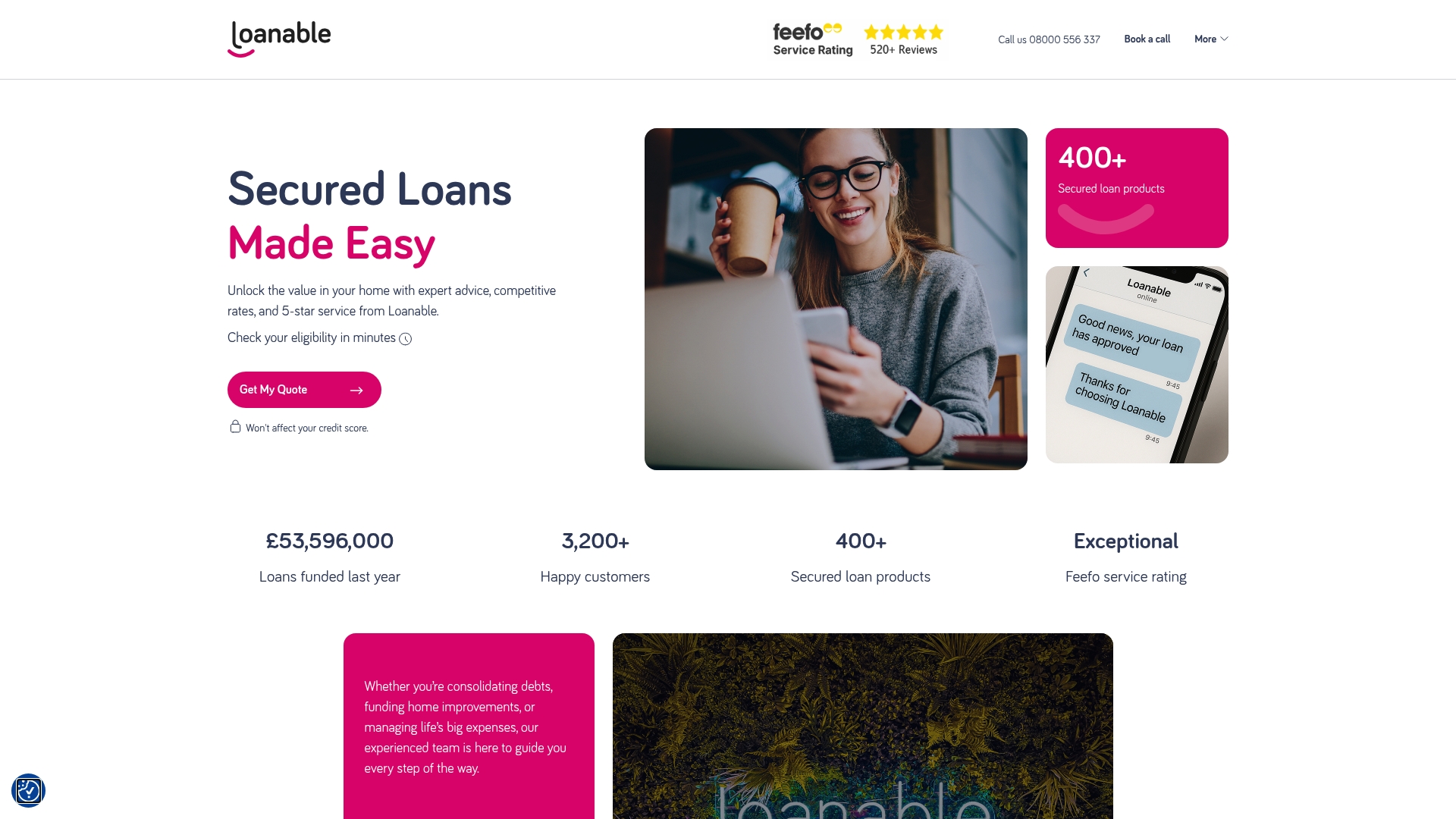
Loanable has facilitated over £53 million in secured loans for UK homeowners. Its eligibility check uses a soft credit search, so you can see realistic options without affecting your credit file. For borrowers who want personal guidance rather than a comparison website result, that adviser-led approach is a practical alternative to applying direct.
If you are ready to see what is available for your situation, check your eligibility with Loanable or explore the full range of secured debt consolidation loans on offer.
Key takeaways
A secured debt consolidation loan can reduce monthly outgoings and simplify repayments, but the risk to your home makes total cost evaluation and independent advice non-negotiable steps before applying.
| Point | Details |
|---|---|
| Collateral is the core difference | Secured loans use your property, offering lower rates but putting your home at risk if you default. |
| APR range is wide | Representative APRs run from 6.7% for strong credit profiles to much higher rates for weaker ones, depending on lender and individual circumstances. |
| ERCs can cancel savings | Always get settlement figures from existing creditors before consolidating to check whether exit fees wipe out interest savings. |
| Timeline is two to six weeks | Property valuation adds time; having documents ready at application speeds the process. |
| Loanable offers adviser-led access | CeMAP-qualified advisors search across lenders using a soft credit check, with over £53 million funded to date. |