



Debt consolidation for homeowners means combining multiple debts into a single secured loan, using your property as collateral. The result is one monthly payment, often at a lower interest rate than credit cards or personal loans. Most UK lenders require 15%–20% equity in your property to qualify, with borrowing typically capped at 80%–85% of the property’s market value including any existing mortgage. The main product types are home equity loans, home equity lines of credit (HELOCs), remortgages, and second charge mortgages. Providers such as Evolution Money, Selina Finance, and Debt Consolidation Loans each offer distinct routes depending on your credit profile and borrowing needs.
Key eligibility points at a glance:
- Minimum equity: 15%–20% of your property value, with borrowing capped at 80%–85% of the market value including your existing mortgage
- Credit score: generally mid-600s or above, though some lenders accept lower
- Debt-to-income ratio: preferably below 43%
- Stable, provable income
- Clean mortgage repayment history
The core risk is clear: defaulting on a secured loan can lead to repossession. Unsecured debts like credit cards carry no such threat to your home.
Pro Tip: Before applying, write out a month-by-month repayment plan. Experts at MoneySavingExpert recommend this step specifically to prevent borrowers from accumulating new unsecured debts after consolidation, which can worsen overall financial health.

What types of secured consolidation loans are available to UK homeowners?
Three main products cover most homeowner consolidation needs in the UK.
| Loan type | Typical amount | Rate type | Repayment term | Best for |
|---|---|---|---|---|
| Home equity loan | Loans with varied amounts | Fixed | Terms vary, typically spanning multiple years | Known lump-sum payoff |
| HELOC | Loans with varied amounts | Variable | Terms vary, typically spanning multiple years | Uncertain or phased payoff |
| Second charge / remortgage | Loans with varied amounts | Fixed or variable | Terms vary, typically spanning multiple years | Keeping existing mortgage rate |
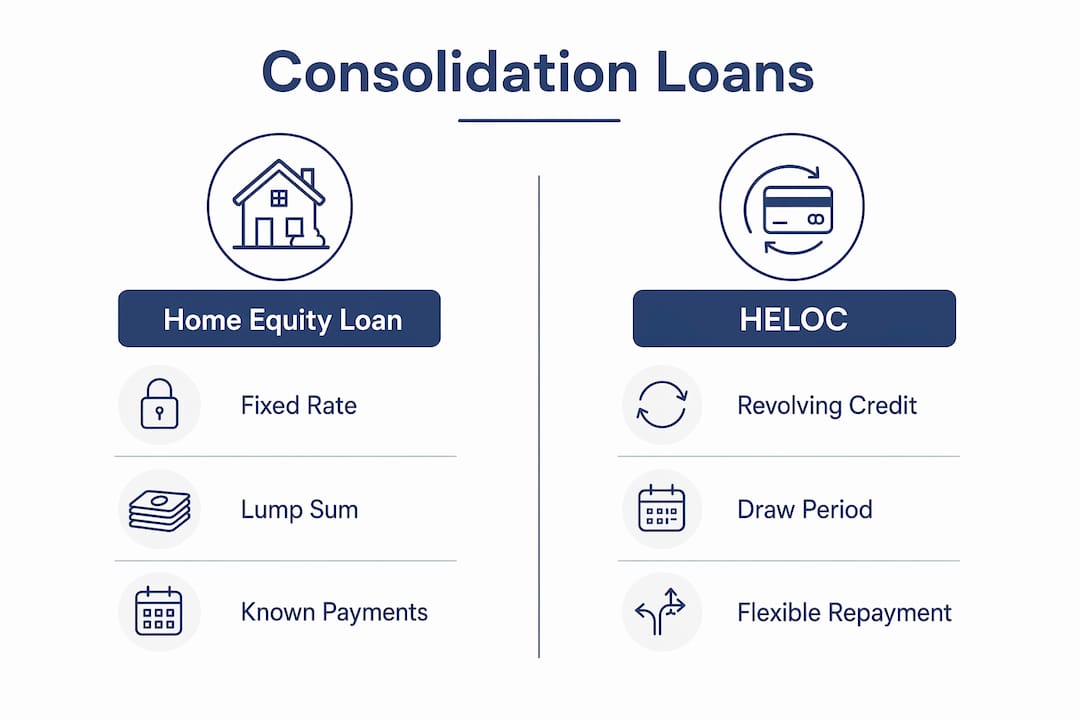
Home equity loans pay out a lump sum at a fixed rate. You know exactly what you owe each month, which makes budgeting straightforward. Interest rates for secured loans generally range from 5.89% to 27.87% variable, with representative APRCs typically between 8% and 22% depending on credit profile and loan size.
HELOCs work more like a revolving credit facility. You draw funds as needed during a draw period, then repay over a set term. HELOC rates start near 7% but move with the base rate plus a lender margin, and repayment terms usually run 10–20 years. They suit borrowers who are unsure of the exact total they need to clear.
Second charge mortgages sit behind your existing mortgage as a separate loan secured on the same property. Remortgaging to release equity is an alternative: you replace your current mortgage with a larger one and use the difference to clear other debts. Both routes carry arrangement fees and, in the case of remortgaging, possible early repayment charges on your existing deal.
Pros and cons by product type:
- Home equity loan: predictable payments, fixed rate, but closing costs and reduced equity
- HELOC: flexible drawdown, pay interest only on what you use, but variable rate risk
- Second charge mortgage: preserves existing mortgage rate, but adds a second monthly commitment
- Remortgage: potentially the lowest rate, but early repayment charges may apply
What are the pros and cons of using home equity to consolidate debt?
The main advantage is cost. Secured loans carry lower rates than unsecured credit because your property backs the debt. Replacing several high-rate credit card balances with a single secured loan can cut monthly outgoings and simplify payment management to one date and one amount.
Longer repayment terms are where the maths can turn against you. Spreading £20,000 of credit card debt over 15 years at a lower rate can still produce a higher total interest bill than paying it off aggressively over three years at a higher rate. Financial experts consistently highlight the importance of comparing total cost over the loan’s life, not just the monthly reduction.
The key trade-off: consolidating unsecured debt into a secured loan moves the risk from your credit score to your home. Credit card default damages your credit file; secured loan default can cost you your property.
The credit score impact cuts both ways. Paying off multiple accounts improves your credit utilisation ratio and simplifies your payment history. Missing a payment on the consolidated loan, however, carries more serious consequences than missing a credit card minimum.
Pro Tip: Run the numbers on total interest paid, not just monthly savings. If the total cost of the consolidated loan exceeds what you would pay clearing debts individually within two to three years, consolidation may not save you money.
How should UK homeowners choose the right consolidation option?
The right product depends on five factors: available equity, credit score, income stability, total debt amount, and how long you can realistically sustain repayments.
Start with these questions before approaching any lender:
- How much equity do I have? (Property value minus outstanding mortgage)
- What is my current credit score, and does it meet typical lender thresholds?
- Can I afford the new monthly payment if interest rates rise?
- What fees apply: arrangement fees, valuation costs, early repayment charges?
- Does the lender carry FCA authorisation?
Red flags to watch for:
- Upfront fees demanded before any loan is agreed
- Lenders not registered with the FCA
- Pressure to borrow more than you need
- No clear APRC stated in writing
- Vague or verbal-only terms
When comparing lenders, look at the APRC rather than the headline rate. The APRC includes fees and gives a true annual cost. A loan with a low headline rate but high arrangement fees can cost more than a slightly higher-rate product with no fees.
Debt Consolidation Loans operates as a fee-free FCA-authorised broker, which means it searches multiple regulated lenders on your behalf at no upfront cost. That model suits borrowers who want independent comparison without paying for it.

Pro Tip: Use a CeMAP-qualified broker rather than going direct to a single lender. Brokers with access to a wide lender panel, like those at Loanable, can match your credit profile to the most suitable product rather than fitting you to whatever one lender offers.
Which UK secured loan providers suit homeowner debt consolidation?
Three FCA-regulated providers cover the main segments of the UK homeowner consolidation market.
| Provider | Loan range | Rate | APRC | Product types | Credit requirements | Best for | Rating |
|---|---|---|---|---|---|---|---|
| Evolution Money | £5,000–£105,000 | 5.89%–27.87% variable | 21.82% rep. | Secured loan | Poor to good credit | Bad credit borrowers | 4.5★ (492) |
| Selina Finance | £5,000–£500,000 | From 5.89% | 8.05% rep. | Secured loan, HELOC | Good to excellent | High loan amounts, HELOC | 4.8★ (124) |
| Debt Consolidation Loans | Depends on lender | Depends on lender | Depends on lender | Broker: multiple types | Bad or limited credit | Broker-assisted search | 5★ (1) |
Evolution Money is a certified B Corporation and holds the Feefo Platinum Trusted Service Award 2026. It lends from £5,000 to £105,000 over 3–20 years, with a representative APRC of 21.82%. Lending decisions go beyond credit score, making it one of the few direct lenders that will consider borrowers with poor credit histories for secured consolidation loans.
Selina Finance covers the higher end of the market, with secured loans and HELOCs up to £500,000. Its representative example is £100,000 over 25 years at 6.89% fixed, reverting to 3.95% above the Bank of England base rate, with an APRC of 8.05%. Arrangement fees of £3,000 and a product fee of £995 apply, so it suits borrowers with larger consolidation needs where the fee cost is proportionate.
Debt Consolidation Loans charges no broker fees and accesses multiple UK-regulated lenders. Rates and terms vary by lender, so the APRC is not fixed at the broker level. It works best for borrowers with unsecured debts and limited or poor credit who want a broker to handle lender matching without upfront cost.
What does the debt consolidation application process look like?
The timeline from initial enquiry to funds in your account typically runs four to eight weeks for a secured loan. Here is how it breaks down:
- Week 1: Assessment. Check your equity, credit score, and total debt. Gather payslips, bank statements, and mortgage statements.
- Week 1–2: Application. Submit to a lender or broker. An eligibility check at this stage should not affect your credit score.
- Week 2–3: Underwriting. The lender reviews income, credit history, and debt-to-income ratio. A property valuation is ordered.
- Week 3–5: Valuation and offer. A surveyor values the property. The lender issues a formal offer if satisfied.
- Week 5–8: Legal and completion. Solicitors handle the charge on the property. Funds are released and existing debts are cleared.
- Ongoing: Repayment. Single monthly payment begins. Set up a direct debit immediately to avoid missed payments.
The valuation stage is where delays most often occur. Booking a surveyor quickly after the lender requests one keeps the process on track.
What are the total costs of a secured consolidation loan?
The headline interest rate is only part of the cost. A full picture includes:
- Arrangement or product fee: Selina Finance charges £3,000 arrangement and £995 product fee on its representative example. Evolution Money includes product and lending fees within its APRC.
- Valuation fee: typically £150–£500 depending on property value and lender.
- Legal or solicitor fees: usually £200–£500 for registering the charge.
- Early repayment charges (ERCs): if you clear the loan before the agreed term, most lenders apply a penalty, often calculated as a percentage of the outstanding balance or a set number of months’ interest.
- Broker fees: Debt Consolidation Loans charges nothing. Some brokers charge 1%–2% of the loan amount, so confirm this before proceeding.
Total costs on a £50,000 loan over 10 years can vary by several thousand pounds depending on fees alone. Always request a full cost illustration, including all fees, before signing.
Loanable: a CeMAP-advised route to secured consolidation
Loanable offers a different starting point to going direct to a single lender. As a secured loan specialist with CeMAP-qualified advisors and a wide lender panel, Loanable matches your credit profile and equity position to the most suitable product across the market, rather than fitting you to one lender’s criteria.
Loanable has facilitated over £53 million in secured homeowner loans, including for borrowers with poor credit histories who found direct lender routes closed to them. The eligibility check does not affect your credit score, so you can see where you stand before committing. For homeowners who want to consolidate multiple debts into one manageable payment and need advice on which product fits their situation, checking eligibility with Loanable is a practical first step.
Key takeaways
Secured debt consolidation for UK homeowners works best when equity is sufficient, repayments are affordable, and no new unsecured debt is added after consolidation.
| Point | Details |
|---|---|
| Equity requirement | Most UK lenders require 15%–20% equity, capping borrowing at 80%–85% of the property’s market value including any existing mortgage. |
| Rate advantage | Secured loan rates start from 5.89%, well below typical credit card rates. |
| Repossession risk | Defaulting on a secured consolidation loan can lead to loss of your property. |
| Total cost check | Longer terms reduce monthly payments but can increase total interest paid over the loan’s life. |
| Loanable | CeMAP-qualified advisors match borrowers to suitable secured consolidation products across a wide lender panel, with no credit-score impact on the eligibility check. |