



Second charge mortgage rates in the UK typically run higher than first-charge rates, usually by 1 to 3 percentage points depending on your circumstances. The exact figure depends on your combined loan-to-value (LTV), credit history, and the lender you use.
- Combined LTV bands (up to 60%, 60 to 75%, 75 to 85%, above 85%) set the starting price.
- The Bank of England base rate moves variable and tracker pricing directly; fixed rates track swap rates instead.
- APRC, not the headline rate, is the number that actually tells you what a deal costs once fees are added.
If you want a figure that means something for your own property, get a personalised eligibility check rather than relying on advertised rates.
Key Takeaways
Second charge mortgage rates run higher than first-charge rates because of junior lending risk, but combined LTV banding and APRC comparison are what actually determine your real cost.
| Point | Details |
|---|---|
| Rates sit above first charges | Junior legal position drives a typical premium, so compare APRC rather than headline rate alone. |
| LTV bands drive pricing | Combined LTV thresholds around 60%, 75%, and 85% each trigger a step up in rate. |
| Fees change the true cost | Arrangement, valuation, legal, and early repayment fees can outweigh a low headline rate. |
| Alternatives exist | Remortgaging, further advances, unsecured loans, and equity release each suit different goals. |
| Get a personalised quote | Loanable’s no-impact eligibility check and CeMAP-qualified advisers turn generic rates into a real figure. |
Table of Contents
- What is a second charge mortgage and how does it differ from a remortgage?
- What determines your second charge mortgage rate?
- How much does LTV banding actually move the rate?
- What fees and charges affect the true cost of a second charge mortgage?
- When does a second charge mortgage make sense, and what are the alternatives?
- How do you get an accurate personalised rate?
- How long does a second charge mortgage application take?
- How Loanable can help you find the right second charge deal
- Frequently asked questions
- Sources
What is a second charge mortgage and how does it differ from a remortgage?
A second charge mortgage is a loan secured against your home that sits behind your existing mortgage at HM Land Registry. Your current lender holds the first charge. A second charge lender registers a legal charge that ranks below it, which is why the product is sometimes called a second mortgage.
That ranking matters if things go wrong. If your home is repossessed and sold, the first charge lender gets paid in full before the second charge lender sees a penny. This junior position is the main reason second charge mortgage rates sit above first-charge pricing: the lender is taking on more risk for a smaller slice of the safety net.
You’ll come across two broad formats:
- Lump-sum secured loans pay out one amount upfront, repaid over a fixed term, similar to how a standard mortgage works.
- Flexible drawdown facilities let you borrow in stages, which suits homeowners funding a phased renovation rather than a single lump cost.
Most UK homeowners choosing between these two want to keep their existing mortgage deal intact, and a legal charge on your property works well precisely because it leaves your first mortgage untouched.
What determines your second charge mortgage rate?
Lenders price second charge loans against five things: your combined LTV, your credit history, how you’re paid, what kind of property you own, and whether you want a fixed or variable rate. Change any one of these and the number on your offer moves.
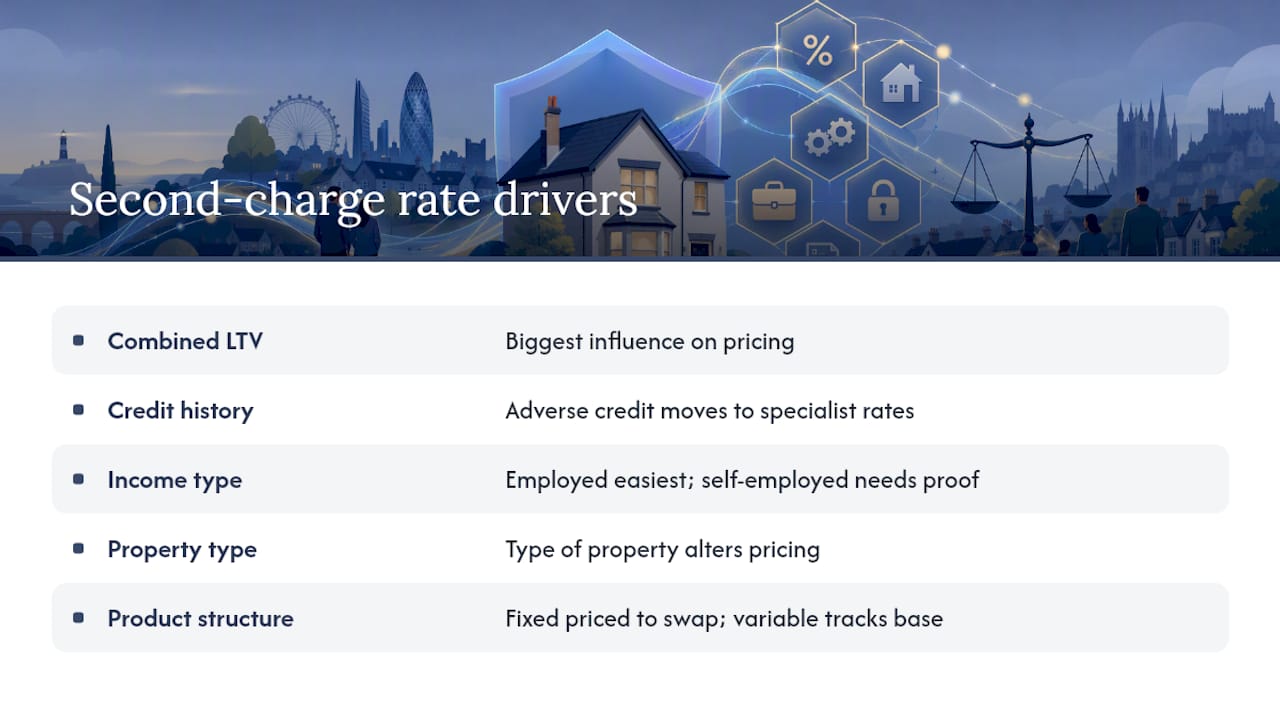
Combined LTV is the biggest lever. It’s your first mortgage balance plus the new second charge loan, expressed as a percentage of your property’s value. A homeowner borrowing to 55% combined LTV will see meaningfully better pricing than one pushing to 88%, because the lender’s exposure at the point of repossession is smaller.
Your credit profile does a lot of the remaining work. CCJs, defaults, or a past IVA typically move an application out of mainstream pricing and into specialist territory, where rates run higher to reflect the added risk. Income type matters too: employed applicants with payslips are usually the simplest cases to underwrite, while self-employed and contractor applicants often need additional proof of income, which can affect both approval speed and price.
Product structure closes the loop. Variable and tracker rates move with the Bank of England base rate, while fixed-rate second charge products are priced against swap rates, which reflect where the market expects interest rates to head over the fixed term.
Pro Tip: If your combined LTV sits just above a pricing band, even a small overpayment or a slightly reduced loan request can drop you into the band below, which often unlocks a noticeably better rate.
How much does LTV banding actually move the rate?
Lenders group applications into LTV bands rather than pricing every case individually, and shifting between bands often has a bigger effect on your rate than a change in your credit score. Lenders commonly use thresholds around 60%, 75%, and 85% combined LTV, with pricing stepping up at each one.
| Combined LTV band | Typical rate premium vs best pricing | Borrower profile |
|---|---|---|
| Up to 60% | Lowest available | Prime, strong equity position |
| 60% to 75% | Small increase | Prime to near-prime |
| 75% to 85% | Moderate increase | Mixed credit, higher gearing |
| Above 85% | Highest premium | Specialist, adverse credit |
Two examples show the range in practice. A homeowner with a clean credit file borrowing to 55% combined LTV will typically see rates close to prime pricing, with a correspondingly low APRC. A market update from United Trust Bank showed rate cuts of up to 60 basis points alongside a return to 90% LTV lending, which is a reminder that lender appetite at the higher bands does shift over time.
What fees and charges affect the true cost of a second charge mortgage?
APRC, not the headline rate, is what actually tells you what a second charge mortgage will cost you. APRC bundles the interest rate together with the fees, giving you one number you can genuinely compare across offers.
The fees that push APRC above the headline rate include:
- Arrangement fee, charged by the lender, sometimes added to the loan rather than paid upfront.
- Broker fee, charged for sourcing and arranging the loan.
- Valuation fee, covering the cost of assessing your property.
- Legal and postponement fee, covering the legal work needed to register the charge at HM Land Registry behind your existing mortgage.
- Early repayment charges, which apply if you clear the loan before the end of a fixed term.
Watch out: a loan advertised at a lower headline rate but carrying a hefty arrangement fee can end up costing more overall than a slightly higher-rate product with no fee at all. Always ask for the APRC before comparing two offers side by side.
Spreads between mainstream and specialist second charge pricing typically run 1 to 3 percentage points, which on a large loan adds up to a substantial difference in monthly cost.
When does a second charge mortgage make sense, and what are the alternatives?
Homeowners typically turn to a second charge mortgage for three reasons: consolidating multiple debts into one payment, funding home improvements, or raising capital without disturbing their existing mortgage deal. That last point matters more than people expect. If you’re on an attractive fixed rate with your first mortgage, remortgaging to release equity could mean giving that rate up entirely, which a second charge avoids.
That said, a second charge isn’t the only route to extra funds. Worth weighing up:
- Remortgaging with capital raised works well if your current deal is ending anyway or if the new blended rate still beats a second charge.
- A further advance from your existing lender can be quicker and cheaper if your lender offers competitive terms on top-up borrowing.
- An unsecured personal loan suits smaller amounts, and second mortgages generally carry lower rates than unsecured borrowing or credit cards once you’re looking at larger sums.
- Equity release is worth considering for older homeowners who don’t need or want to make monthly repayments.
If preserving your first mortgage rate is your priority, a second charge usually wins. If your first mortgage deal is ending soon anyway, a remortgage with capital raised may work out cheaper once fees are compared properly.
How do you get an accurate personalised rate?
Generic adverts and comparison tables can’t tell you what you’ll actually be offered. Only a personalised quote, based on a current valuation and your real combined LTV, gives you a number worth acting on.
Follow this sequence to get there:
- Calculate your combined LTV using your outstanding first mortgage balance and an up-to-date estimate of your property’s value.
- Gather proof of income, whether that’s payslips or, for self-employed applicants, tax returns and accounts.
- Check your credit file and correct any errors before you apply, since a fixable mistake can needlessly push you into a higher pricing tier.
- Consider reducing the loan amount slightly if you’re close to an LTV band threshold.
- Get a recent valuation where your property has risen in value since your last mortgage review, since this can improve your LTV position.
- Use a whole-of-market broker so your application reaches lenders across mainstream and specialist panels, not just one.
Borrowing Calculator
See how much you could potentially borrow against your home, subject to status.
Please enter a property value that's higher than your outstanding mortgage balance.
Based on your figures, the amount available is below our typical minimum loan of £25,000. Get in touch and we'll talk through your options.
Get my free, no-obligation quoteIllustrative only, based on a maximum combined loan-to-value of 75%. This is not a loan offer or a quote, and your actual rate, borrowing amount and monthly payment will depend on your circumstances, credit profile and the lender's criteria. Think carefully before securing other debts against your home. Your home may be repossessed if you do not keep up repayments on your mortgage or any other debt secured on it.
Working through that list yourself takes time, and getting it wrong on the first application can leave a mark on your credit file. Loanable runs an eligibility check that doesn’t affect your credit score, and its CeMAP-qualified advisers have helped homeowners access more than £53 million in funding, so you get a realistic picture before you commit to anything.
How long does a second charge mortgage application take?
A quick indicative quote can arrive within hours. From there, a full underwriting decision typically takes 1 to 4 weeks, and full completion, including legal work, usually takes 4 to 8 weeks or longer depending on how busy the legal and postponement queue is at HM Land Registry.
The main stages run in this order:
- Eligibility check to confirm affordability without affecting your credit score.
- Valuation of your property to confirm its current market value.
- Underwriting where the lender assesses your income, credit history, and combined LTV in detail.
- Legal completion and postponement at HM Land Registry, registering the second charge behind your existing mortgage.
- Drawdown, when funds are released to you.
Pro Tip: If you’re funding a time-sensitive renovation or an urgent debt consolidation, a specialist lender with an expedited legal pack can sometimes complete faster than a high-street option, even if the headline rate is a touch higher.
A note from Loanable
Working with homeowners across the UK on secured lending has taught us that the right second charge mortgage depends entirely on the individual case, not the advertised rate. Our CeMAP-qualified advisers focus on matching your combined LTV and credit position to lenders who will actually offer competitive terms, backed by over £53 million funded and 5-star customer ratings.
How Loanable can help you find the right second charge deal
Loanable works as a secured loan broker for UK homeowners, running eligibility checks that never touch your credit score before you commit to anything. That matters because shopping around for second charge rates the traditional way, applying to multiple lenders one at a time, can itself damage your credit file through repeated hard searches.

What you get with Loanable:
- CeMAP-qualified advisers who understand combined LTV pricing and lender criteria across mainstream and specialist panels.
- Over £53 million funded for UK homeowners, including many with complex credit histories.
- 5-star customer ratings built on straightforward advice rather than pushy sales tactics.
- A no-impact eligibility check that gives you a realistic rate picture before you apply anywhere.
If you’re ready to see what a second charge mortgage might actually cost you, start with a secured loan eligibility check and get a personalised answer instead of a generic advertised rate.
Frequently asked questions
Are second charge mortgage rates always higher than first mortgage rates?
Almost always, yes. The second lender’s junior legal position means more risk if the property is repossessed, so pricing reflects that from the outset.
What credit score do I need for a good second charge mortgage rate?
There’s no single threshold, since lenders weigh your full credit history alongside combined LTV and income type. A clean file with low combined LTV gets you close to prime pricing; CCJs or defaults typically move you into specialist tiers.
Does the Bank of England base rate affect second charge mortgage rates?
Yes, directly for variable and tracker products. Fixed-rate second charge deals move with swap rates instead, which reflect where the market expects rates to head over the fixed term.
Can I get a second charge mortgage with bad credit?
Often, yes, through specialist lenders who price for higher risk. Expect a higher rate and possibly a lower maximum LTV than a borrower with a clean credit file.
Is a second charge mortgage regulated in the UK?
Yes. Second charge mortgages fall under Financial Conduct Authority mortgage regulation, which requires lenders to run affordability checks before offering a loan, giving borrowers similar protections to a first mortgage.
This article is general information, not a substitute for advice from a qualified financial advisor. Consult a qualified financial professional about your own circumstances before acting on anything here.
Sources
- Second charge mortgage — Forbes UK Advisor
- Second mortgage rates UK 2026 — Kael Tripton
- UTB reintroduces 90% LTV lending and makes rate cuts of 60bps — Mortgage Solutions
- Second mortgages explained — Chase