



Most UK secured loans complete in three to six weeks, though specialist lenders using automated valuations and digital legal packs can complete in 10–14 days, and complex cases can stretch to eight weeks or more. The four factors that most determine where your case lands in that range are:
- Valuation type — automated valuation model (AVM) or physical survey
- First-charge lender consent — your existing mortgage lender must agree to the new charge
- Document readiness — incomplete packs are the most common cause of avoidable delay
- Underwriting complexity — employed income with clean credit clears faster than self-employed or adverse cases
This article covers second-charge mortgages and homeowner secured loans for UK residents. The timelines below do not apply to unsecured personal loans.
Key takeaways
Most UK secured loans complete within a few weeks, with valuation type and first-charge consent being key factors influencing timeline length.
| Point | Details |
|---|---|
| Typical approval range | Most cases complete in 2–6 weeks; fastest cases with AVM and clean credit finish in 10–14 days. |
| Biggest single bottleneck | First-charge lender consent can take several working days and is outside the borrower’s direct control. |
| Document readiness | A complete pack uploaded on day one prevents the most common source of avoidable delay. |
| Reflection period | After a formal offer, a reflection period may apply before drawdown can be requested. |
| Loanable’s role | Loanable’s CeMAP-qualified advisors manage document triage, lender sourcing, and consent chasing to shorten the process. |
Table of Contents
- What is a secured loan in the UK?
- How long does each stage of a secured loan take?
- What speeds up approval and what causes delays?
- Documents you need to prepare before applying
- Fees and costs that affect the timeline
- How long between a formal offer and funds in your account?
- How a specialist broker can shorten your timeline
- What to prioritise when you need funds quickly
- Loanable helps UK homeowners move faster
- Sources
What is a secured loan in the UK?
A secured loan, also called a second charge mortgage or homeowner loan, is a loan secured against your property. It sits behind your existing mortgage (the first charge) in priority order.
That security changes the process significantly compared with an unsecured loan:
- A property valuation is required to confirm the asset’s value and the lender’s risk
- A legal charge must be registered against the property at HM Land Registry
- Your existing mortgage lender must give consent for the new charge to be placed
All of this takes time and involves third parties outside the lender’s direct control. That is why secured loan processing time is measured in weeks, not hours.
Lenders and brokers operating in this market are regulated by the Financial Conduct Authority, which sets standards for responsible lending, fair treatment, and firm authorisation. Checking that your lender or broker is FCA-authorised before you proceed is straightforward and worth doing.
How long does each stage of a secured loan take?
The table below maps each stage of a typical secured loan application timeline, from initial enquiry through to funds in your account.
| Stage | Typical duration | Key activity |
|---|---|---|
| Decision in principle | Within a few days | Lender runs a soft credit search and confirms indicative terms |
| Full application and documents | 1–3 working days | Borrower uploads ID, income proof, mortgage statements |
| Property valuation | 2–10 working days | AVM: 1–2 days; physical survey: 5–10 days |
| Underwriting and formal offer | Several working days | Manual review of income, credit, and property data |
| Legal work and first-charge consent | Varies from several days to a few weeks | Solicitor acts; first-charge lender gives written consent |
| Completion and drawdown | 1–3 working days | Solicitor schedules completion; funds transfer to borrower |
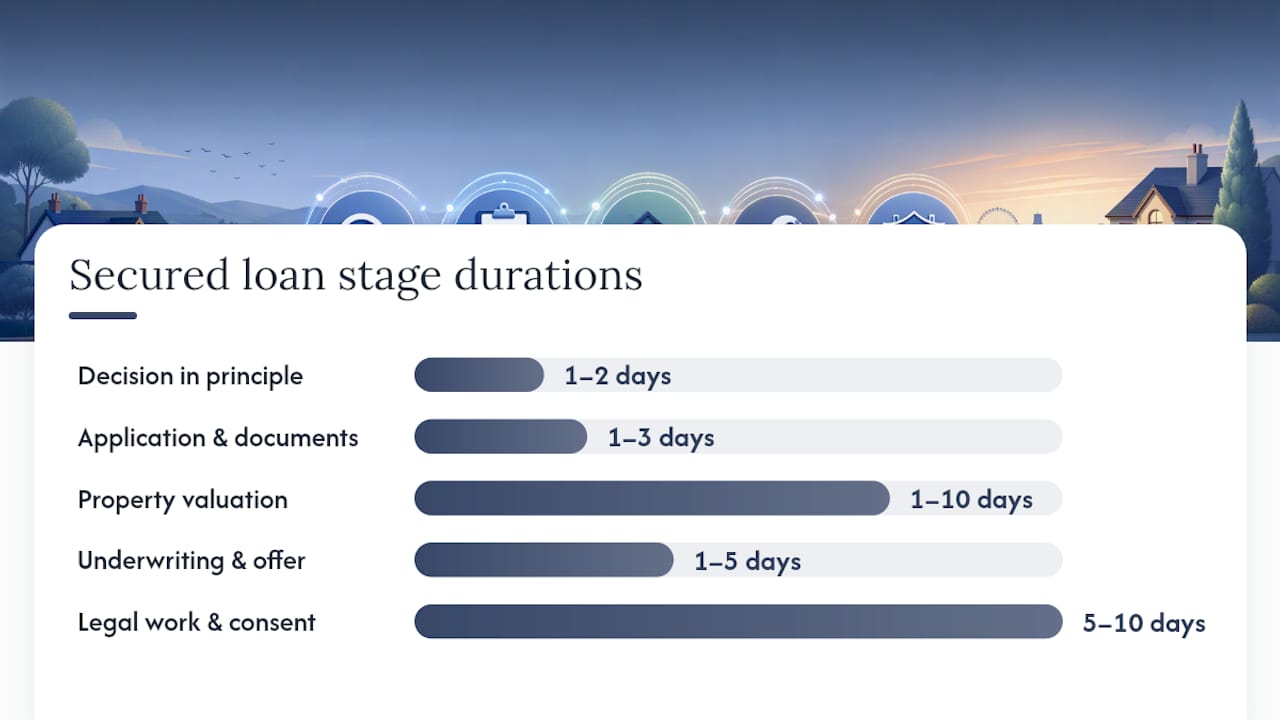
According to Celtic Finance’s timescales guide, a decision in principle typically arrives within one to two days, the application and document stage takes one to three days when the borrower is prepared, and underwriting runs one to five days. Most mainstream cases finish within two to four weeks.
The valuation stage is where the range widens most sharply. Automated valuation models and desktop valuations can cut the appraisal stage to one or two working days for standard properties. A physical survey, required for unusual or higher-value properties, typically adds five to ten working days.
First-charge consent is frequently the longest single variable. Major high-street banks often return consent in 5–10 working days; building societies typically take 7–14 working days; some specialist lenders take longer or, in rare cases, decline. Your broker or solicitor can check your lender’s published service levels before you apply, which removes a common source of surprise.
Fastest cases (10–14 days): AVM-eligible property, employed borrower, clean credit, complete documents uploaded on day one, and a high-street first-charge lender with a fast consent process.
Slowest cases (8+ weeks): Physical survey required, self-employed income needing manual review, building society first-charge lender with a 14-day consent window, and solicitor scheduling delays.
What speeds up approval and what causes delays?
Steps that genuinely shorten the process
- Upload a complete document pack on the day you apply. Incomplete submissions trigger information requests that each add two to five working days.
- Choose a property that qualifies for an AVM or desktop valuation. Standard construction, mainstream location, and a loan-to-value ratio within the lender’s AVM threshold all help. See how LTV affects underwriting timescales for more detail.
- Apply with clean credit and straightforward employed income. Both reduce the likelihood of manual underwriting referral.
- Use a broker who can source AVM-friendly lenders and who knows which first-charge lenders have the fastest consent turnaround.
Where delays commonly occur
Third-party checks control the calendar in secured lending. Collateral verification and first-charge consent are the two most common timeline killers, and neither is within the borrower’s direct control once the application is submitted.
Solicitor availability is a secondary but real bottleneck. If your solicitor is unavailable to schedule completion promptly after the offer is issued, the case sits idle. Instructing a solicitor early, before the formal offer arrives, removes that wait.

Manual underwriting referrals add time. A low credit score, recent missed payments, or self-employed income without two years of accounts will typically trigger a manual review rather than an automated decision.
Pro Tip: Ask your broker which first-charge lenders have published consent service level agreements before you choose a lender. Selecting a lender whose first-charge bank has a five-day consent window rather than a fourteen-day one can save over a week with no other change to the application.
Documents you need to prepare before applying
Assembling a complete pack before you submit is the single most controllable way to reduce secured loan approval time. Lenders will not progress an application with missing documents.
Identity and address
- Valid passport or UK driving licence (photo ID)
- Proof of address dated within the last three months: utility bill, council tax statement, or bank statement
Income evidence
- Employed: last three months’ payslips and last three months’ bank statements showing salary credits
- Self-employed: last two years’ SA302s (HMRC tax calculations) and corresponding tax year overviews; some lenders also require two years of certified accounts. Full guidance on self-employed documentation is available in Loanable’s self-employed secured loan guide.
- Additional income: pension letters, rental income statements, or benefit award letters where applicable
Property and mortgage information
- Most recent mortgage statement showing outstanding balance and lender details
- Schedule of any existing charges on the property
- Property details: approximate floor area, construction type, tenure (freehold or leasehold), and lease length if leasehold
- Details of any recent significant works (extensions, structural changes)
Submission format
Upload documents via the lender’s or broker’s secure portal rather than posting physical copies. Scanned PDFs are universally accepted; photographs of documents are often rejected for legibility reasons. The Information Commissioner’s Office provides guidance on how firms must handle personal data submitted through online portals, so you can be confident that reputable lenders and brokers have data-handling obligations they must meet.
Pro Tip: Name your files clearly before uploading — for example, “Smith_J_Payslip_March2026.pdf” rather than “scan001.pdf”. Lenders processing high volumes of applications can locate and match named files faster, which reduces the chance of a document being marked as missing.
Fees and costs that affect the timeline
Several fees appear in a standard secured loan workflow. Understanding which are paid up front and which are deducted at completion helps you plan.
- Valuation fee: charged by the lender or a third-party surveyor. For an AVM, this is often included in the lender’s product fee or waived entirely. A physical survey typically costs between £150 and £1,500 depending on property value and location, and is usually paid up front before the survey is instructed.
- Solicitor/legal fees: the borrower’s solicitor charges for legal work on the charge registration. Fees vary but are commonly in the range of £300 to £800 for a standard case. Some lenders instruct their own solicitors and pass the cost to the borrower.
- Land Registry registration fee: paid by the solicitor on completion and typically added to the completion statement.
- Lender arrangement fee: often added to the loan rather than paid up front, though some lenders offer a lower rate in exchange for a fee paid on application.
Does paying more speed things up?
For the valuation stage, yes. Paying for a physical survey to be prioritised, or choosing a lender whose product includes an AVM, can cut several working days from that stage. For legal work, instructing a solicitor who specialises in secured lending and has capacity to act quickly is more effective than simply paying a premium to a general practice firm.
Paying a higher arrangement fee or a higher interest rate to access a lender with a faster operational process can be worth considering when speed is the priority. The cost of a faster completion needs to be weighed against the cost of waiting, particularly if the funds are needed for a time-sensitive purpose such as a property purchase or debt consolidation.
How long between a formal offer and funds in your account?
After a formal offer is issued, some borrowers have a seven-day reflection period before they can request drawdown. This is a regulatory requirement for certain regulated mortgage contracts and gives borrowers time to reconsider without penalty.
Once the reflection period has passed, the sequence is:
- Borrower confirms acceptance of the offer to the solicitor
- Solicitor completes legal checks: title searches, confirmation of first-charge consent, and registration of the new charge
- Completion date is scheduled: typically one to three working days after the solicitor confirms all conditions are met
- Lender transfers funds to the solicitor on the completion date
- Solicitor transfers net funds to the borrower on the same day or the next working day, after deducting any fees or charges shown on the completion statement
In practice, the offer-to-funds window is usually five to ten working days when the solicitor is already instructed and first-charge consent is in place. Borrowers who instruct a solicitor early, before the formal offer arrives, reduce this window considerably. Industry guidance indicates that the reflection period and solicitor scheduling often introduce predictable waits — preparing early removes the most avoidable of them.
Funds typically arrive via Faster Payments or CHAPS. You will receive a completion statement from your solicitor showing the loan amount, fees deducted, and net sum transferred.
How a specialist broker can shorten your timeline
[loanable_borrowing_calculator]
A broker does more than find a lender. At each stage of the secured loan application timeline, an active broker reduces friction in ways a borrower acting alone cannot easily replicate.
At enquiry and DIP stage: a broker assesses your property type, income, credit profile, and existing mortgage lender to identify which lenders are likely to approve quickly. That means matching you to lenders whose AVM criteria your property meets and whose first-charge consent process is known to be fast.
At application and document stage: a broker reviews your document pack before submission, catching gaps that would otherwise trigger information requests. One round of corrections before submission saves more time than several rounds of back-and-forth after.
At valuation and legal stage: brokers who actively manage the solicitor and first-charge consent process reduce average timelines by several working days compared with borrower-led chasing. Knowing who to contact, when, and with what information is a practical skill that comes from volume.
Loanable uses CeMAP-qualified advisors and a network of lenders to place secured loans for UK homeowners, including those with complex income or adverse credit. The firm has funded over £53 million in loans and holds 5-star ratings from clients who have gone through the process.
Loanable’s advisors handle document triage, lender sourcing, valuation coordination, and first-charge consent chasing — the four stages where most delays occur. Borrowers who use a specialist broker consistently report shorter timelines than those who approach lenders directly, because the broker removes the information asymmetry at every step.
For joint applications, the document requirements and underwriting complexity increase. Loanable’s joint secured loan guide covers what to prepare for two-applicant cases.
What to prioritise when you need funds quickly
Speed in a secured loan comes down to two things you control and one you do not. You control your document readiness and your property’s eligibility for an AVM. You do not control your first-charge lender’s consent timeline.
The practical implication: spend your preparation time on the two controllable factors before you apply. A complete document pack and an AVM-eligible property will do more to shorten your secured loan approval duration than any other single action.

On the rate-versus-speed trade-off: accepting a slightly higher rate to access a lender with a faster operational process is often rational when the funds are needed for a specific date. The difference between a 2-week and a 6-week completion can outweigh a modest rate premium, particularly on larger loans or time-sensitive purposes.
Coordinate your solicitor early. Instruct them before the formal offer arrives, confirm they have capacity to act within your target window, and set a clear target completion date from the outset. Solicitors who know a borrower’s timeline in advance schedule accordingly. Those who receive instructions without a deadline tend to work to their own.
Loanable helps UK homeowners move faster
Loanable places secured loans for UK homeowners across a wide range of purposes, from debt consolidation to home improvements, including cases with adverse credit. CeMAP-qualified advisors assess your situation, match you to the right lender, and manage the valuation, consent, and legal stages on your behalf.

The result is a faster, more predictable process than applying direct. Loanable’s lender network includes options with AVM-eligible criteria and fast first-charge consent processes, which are the two factors that most compress the timeline for straightforward cases.
Check your eligibility without affecting your credit score at Loanable, or speak to an advisor directly to get a clear picture of your likely timeline before you commit.
Sources
This article provides general information about secured loan timescales in the UK. It is not financial advice. Confirm current eligibility criteria, rates, and regulatory requirements with your lender, broker, or a qualified financial adviser before proceeding.
This article is general information, not a substitute for advice from a qualified financial advisor. Consult a qualified financial professional about your own circumstances before acting on anything here.