



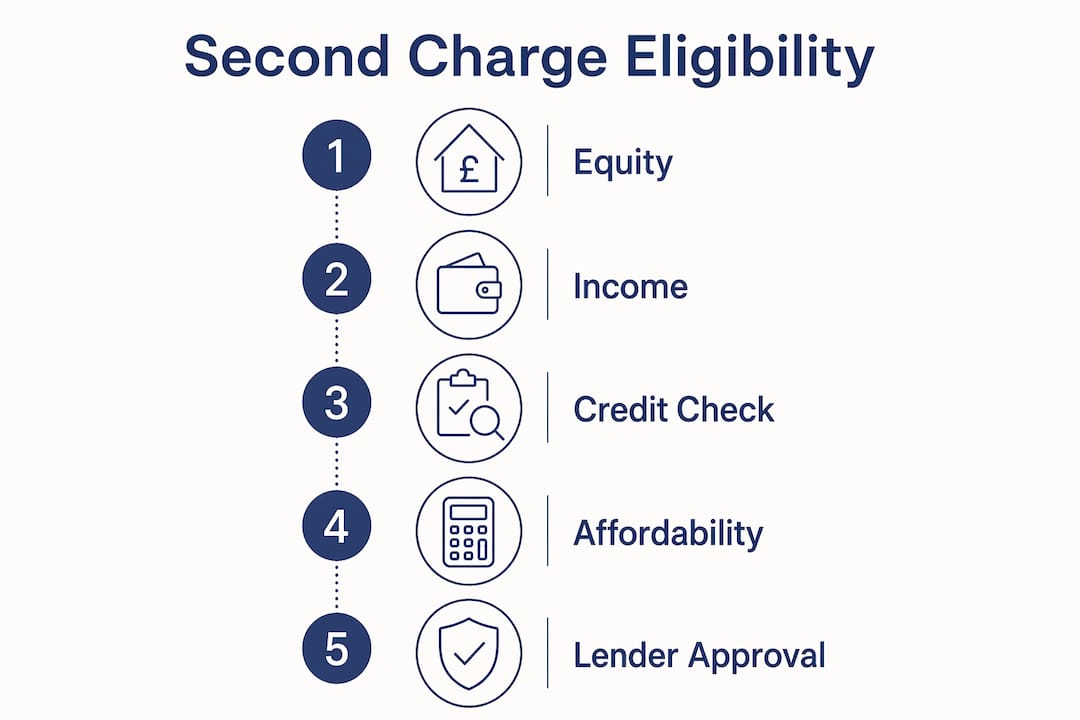
Most UK homeowners with sufficient equity, a stable income, and a property in reasonable condition will meet the basic criteria for a second charge mortgage. The decisive factors are equity (typically at least 15–20% remaining after borrowing), affordability of both mortgage payments, and an acceptable credit history.
Quick self-assessment checklist:
- You own a UK residential property with an existing mortgage
- You have meaningful equity built up (the more, the better)
- You can demonstrate stable income sufficient to cover both mortgage payments
- You are aged 18 or over (many lenders set a minimum of 21)
- You have the right to reside in the UK
- Your property is standard residential construction (not a listed building or unusual structure)
- Your credit history has no recent serious defaults or unsatisfied county court judgments (CCJs)
Immediate next steps:
- Run a no-obligation eligibility check with Loanable — it does not affect your credit score.
- If your situation is complex (poor credit, unusual property, high existing debt), speak directly to a CeMAP-qualified adviser before approaching any lender.
Table of Contents
- How second charge mortgages work in practice
- How much can you borrow with a second charge?
- Who actually qualifies for a second charge?
- Costs and risks you must weigh before applying
- Alternatives to a second charge and when they make more sense
- How to apply: documents, timeline, and what lenders check
- Loanable’s view: when a second charge beats remortgaging
- Key takeaways
- A practical note on what borrowers often overlook
- Check your second charge eligibility with Loanable
- Useful sources and further reading
How second charge mortgages work in practice
A second charge mortgage is a secured loan that uses your property as collateral, but sits behind your existing first mortgage on the title. The first lender always has priority. If your property is sold or repossessed, the first mortgage is repaid in full before the second charge lender receives anything.
That priority order has real consequences. If the sale price falls short, the second charge lender may pursue you for any outstanding balance. The charge also remains registered on the title until it is fully repaid, which means you cannot sell or remortgage without clearing it first. When you sell, your solicitor will request a redemption statement from the second charge lender, and the balance is settled at completion.
Second charge mortgages represent less than 4% of regulated mortgage sales, yet customers in this market are often financially vulnerable. The FCA expects firms and intermediaries to focus on suitability and actively consider consumer vulnerability before recommending this product.
That small market share matters. Because second charge borrowers are disproportionately in financially stretched positions, the FCA places a high burden on advisers to confirm the product is genuinely suitable, not merely available. Getting advice from a regulated intermediary is not optional formality — it is the mechanism that protects you.
How much can you borrow with a second charge?
Your borrowing limit depends on two things: how much equity you hold and how much of that equity a lender will release.

The basic formula:
Property value − outstanding first mortgage balance = available equity
Lenders then apply a combined loan-to-value (LTV) limit across both the first and second charge. According to MoneyHelper, a combined LTV of around 75% is a useful planning benchmark, though some lenders will go higher depending on the borrower’s profile and product.
| Combined LTV limit | Typical scenario |
|---|---|
| Typical combined LTV range | Around 75% is the standard benchmark for most borrowers |
| Medium range | Common among many lenders |
| Higher range | In some specific circumstances, combined LTVs can approach 85–90%, but these are less common and rates are typically higher |
Worked example 1 — straightforward position:
- Property value: £300,000
- Outstanding first mortgage: £150,000
- Available equity: £150,000 (50% LTV)
- At 75% combined LTV, maximum total borrowing: £225,000
- Maximum second charge: £225,000 − £150,000 = £75,000
Worked example 2 — tighter position:
- Property value: £250,000
- Outstanding first mortgage: £175,000
- Available equity: £75,000 (70% LTV)
- At 75% combined LTV, maximum total borrowing: £187,500
- Maximum second charge: £187,500 − £175,000 = £12,500
The second example shows why a professional valuation matters. If your property is worth less than you assume, the available second charge shrinks quickly. An independent valuation, rather than an online estimate, gives lenders and you a reliable figure to work from.
- A combined LTV of around 75% is the most commonly available limit, though some lenders will consider applications up to 85–90% combined LTV in specific situations, often at higher rates.
Who actually qualifies for a second charge?
Second charge lending criteria vary by lender, but the core underwriting points are consistent across the market.
Core eligibility requirements:
- Homeowner status. You must own a UK residential property with an existing mortgage registered against it.
- Minimum age. Most lenders require applicants to be at least 21, though some accept from 18.
- UK residency. You must have the right to reside in the UK.
- Property type. Standard residential construction is straightforward. Non-standard construction (timber frame, thatched roof, steel frame), listed buildings, or properties above commercial premises can restrict lender choice significantly.
- Minimum equity. Lenders generally want at least 15–20% equity remaining after the second charge is added.
Affordability:
Lenders will stress-test your ability to meet both your existing mortgage payment and the new second charge payment simultaneously. You will need to show stable income through payslips, tax returns (if self-employed), or pension statements. Bank statements covering the past three to six months are standard. Lenders also check your total debt-to-income ratio, so existing credit card balances, car finance, and personal loans all count against you.

Credit history:
Past defaults, CCJs, or mortgage arrears do not automatically disqualify you, but they narrow lender choice and push rates up. A broker with access to a wide panel of lenders, including those who specialise in adverse credit, can identify options that a direct application to a high-street lender would miss. Satisfied CCJs are treated more favourably than unsatisfied ones; recent arrears on the existing mortgage are the most damaging factor.
Existing mortgage terms:
If your current mortgage carries high early repayment charges (ERCs), breaking it to remortgage could cost thousands. That is precisely when a second charge becomes worth considering — you keep the existing deal intact and borrow separately. Lenders will also check whether you are in arrears on the first mortgage; active arrears usually result in a declined application.
Common rejection reasons:
- Insufficient equity after applying the lender’s maximum LTV
- Income too low or too irregular to pass the stress test
- Non-standard property type with no specialist lender on the panel
- Recent serious adverse credit (bankruptcy, IVA, or unsatisfied CCJ within the last two years)
- Active arrears on the first mortgage
Pro Tip: Before applying, pull your credit report from Experian, Equifax, or TransUnion. Dispute any errors and check that all satisfied debts are marked correctly. A clean report, even with some historic issues, is far easier to present to a lender than one with unresolved discrepancies.
Costs and risks you must weigh before applying
Second charge mortgages carry costs beyond the headline interest rate. Understanding the full picture before you commit is straightforward — the numbers just need to be laid out clearly.
Typical fees:
- Arrangement fee: charged by the lender, often added to the loan balance
- Valuation fee: an independent valuation of your property, usually required by the lender
- Legal fees: your solicitor and the lender’s solicitor both charge for the conveyancing work
- Broker fee: some intermediaries charge a fee; others are paid by the lender via commission
Interest rates on second charge products are typically higher than first-charge rates, reflecting the lender’s subordinate position on the title. The rate you receive depends on your LTV, credit profile, and the loan term.
ERC implications:
If your first mortgage has significant ERCs, a second charge can be the cheaper route even at a higher interest rate. The calculation is straightforward: compare the total cost of the second charge over its term against the ERC plus the cost of a new first-charge deal. A broker can model both scenarios for you.
The FCA requires firms to take account of the costs of increasing the repayment period and to assess whether it is appropriate to secure previously unsecured debt. Consolidating credit card balances into a secured loan can reduce monthly payments but increase total interest paid over the life of the loan — sometimes substantially.
Principal risks:
- Repossession. If you cannot maintain payments on either mortgage, both lenders have the right to pursue repossession. The second charge lender can initiate proceedings independently of the first.
- Shortfall on sale. If property values fall and the sale proceeds do not cover both charges, you remain liable for the shortfall.
- Remortgaging complexity. Moving to a new first-charge deal while a second charge is registered requires the second charge lender’s consent, which is not guaranteed.
- Debt consolidation risk. Securing previously unsecured debt against your home increases the consequences of non-payment. The FCA specifically flags this as an area where suitability must be carefully assessed.
Alternatives to a second charge and when they make more sense
A second charge is not always the right answer. The alternatives below are worth considering before you commit.
- Remortgage to a larger loan. If your existing deal has low or no ERCs and you can access a competitive rate, remortgaging to release equity is usually cheaper overall. The downside: you lose your current rate and restart the mortgage term.
- Further advance from your existing lender. Your current mortgage lender may offer additional borrowing on top of your existing balance. Rates are often competitive and the process is simpler, but the lender’s criteria apply and they may not offer the amount you need.
- Unsecured personal loan. For smaller amounts (typically under £25,000), an unsecured loan avoids putting your home at risk. Rates are higher, but the term is shorter and there is no charge on the title.
- Credit card consolidation. Only suitable for smaller, short-term balances. A 0% balance transfer card can reduce interest costs, but does not address the underlying affordability issue and carries no security risk.
- Equity release. For homeowners aged 55 and over, a lifetime mortgage or home reversion plan can release equity without monthly repayments. The compound interest effect means the total cost can be significant, and it affects inheritance. Regulated advice is mandatory.
When a second charge is the sensible choice:
- Your existing first mortgage carries a very low fixed rate and high ERCs, making remortgaging expensive
- You need capital for a specific purpose (home improvement, debt consolidation) and want to keep the first mortgage intact
- Your existing lender will not offer a further advance at a competitive rate
When it is usually not:
- You have unstable or irregular income that makes stress-testing difficult
- You are already in arrears on the first mortgage
- The purpose is short-term spending rather than a defined capital need
MoneyHelper guidance is consistent on this point: a second charge should generally be considered only when remortgaging is genuinely unsuitable.
How to apply: documents, timeline, and what lenders check
The application process for a second charge follows a clear sequence. Knowing what to prepare in advance speeds things up considerably.
Documents you will typically need:
- Proof of identity (passport or driving licence)
- Proof of address (utility bill or bank statement, dated within three months)
- Proof of income: last three payslips (employed) or two years’ SA302 tax calculations (self-employed)
- Three to six months’ bank statements
- Most recent mortgage statement for the first charge
- Details of any other outstanding credit commitments
Typical timeline:
- Initial enquiry and eligibility check — same day to 48 hours
- Affordability assessment and credit check — two to five working days
- Property valuation — arranged by the lender, typically within one to two weeks
- Underwriting and formal offer — five to ten working days after valuation
- Legal work and completion — two to four weeks, depending on solicitor speed
The FCA requires a reflection period before completion on regulated mortgage contracts. Check with your adviser that this has been factored into the timeline.
Broker versus direct lender:
Applying directly to a single lender limits you to that lender’s criteria and rates. A CeMAP-qualified broker with access to a wide panel, such as those at Loanable, can match your profile to the most suitable lender, including those who accept adverse credit or non-standard properties. For borderline applicants, this difference in access can be decisive. You can also verify any lender or adviser on the FCA register before proceeding.
Practical tips to improve your application:
- Clear any minor arrears or disputed balances before applying
- Avoid large unexplained cash withdrawals in the three months before application
- Collate all income evidence in advance, including any rental income or benefits
- Check your credit report and correct errors before the lender runs a hard search
[loanable_borrowing_calculator]
Loanable’s view: when a second charge beats remortgaging
The core trade-off is straightforward. If your existing first mortgage carries a rate you cannot replicate today, breaking it to remortgage costs you twice: the ERC and the higher rate on the new deal. A second charge lets you keep the first mortgage intact and borrow the additional capital separately.
Loanable’s CeMAP-qualified advisers typically recommend a second charge when ERCs make remortgaging materially expensive, or when a borrower needs a relatively modest additional sum and the first-charge terms are worth protecting. The higher rate on the second charge is often the cheaper option once the ERC is factored in.
Loanable has facilitated over £53 million in secured homeowner loans, working with borrowers across a range of credit profiles and property types. The adviser team’s access to a wide lender panel means that applicants who would be declined by a single high-street lender often find a suitable product through a broker route.
The eligibility check at Loanable does not affect your credit score, which makes it a practical first step even if you are unsure whether you qualify. If your situation involves complex credit history, a non-standard property, or an unusual income structure, a direct conversation with an adviser before any formal application saves time and avoids unnecessary hard searches on your credit file.
Trigger points for contacting a broker:
- Your available equity is close to the lender’s minimum threshold
- You have historic adverse credit (defaults, CCJs, or missed payments)
- Your property is non-standard construction or leasehold with a short remaining term
- You are self-employed and your income is variable or structured across multiple sources
Pro Tip: Ask your broker to model the total cost comparison between a second charge and a remortgage before you decide. The monthly payment on a second charge may look manageable, but the total interest over the full term is the figure that matters.
Lenders and advisers operating in this space must be FCA-regulated. Always confirm registration on the FCA register before proceeding. For additional context on how lenders assess suitability and terms, Lending Gurus’ terms and conditions outline the standard responsibilities advisers carry in this process.
Key takeaways
Most UK homeowners with at least 15–20% equity remaining after borrowing, a stable income, and no active mortgage arrears will meet the basic second charge eligibility requirements.
| Point | Details |
|---|---|
| Equity is the starting point | Lenders typically require at least 15–20% equity to remain after the second charge; combined LTV of 75% is the standard benchmark. |
| Affordability covers both charges | Lenders stress-test your ability to pay both the first and second mortgage simultaneously — income evidence is mandatory. |
| Credit history affects rate, not always eligibility | Past defaults or CCJs narrow lender choice and raise rates, but a broker with a wide panel can often find a suitable product. |
| Repossession risk is real | Failure to maintain payments on either charge can lead to repossession; securing unsecured debt increases the consequences of non-payment. |
| Loanable offers a no-impact eligibility check | Loanable’s CeMAP-qualified advisers can assess your position without affecting your credit score, with access to a wide lender panel. |
This article is general information, not financial advice. Confirm your own position with a qualified adviser or the FCA register before proceeding.
A practical note on what borrowers often overlook
Most people who contact an adviser about a second charge have already spent time comparing headline rates online. That is a reasonable starting point, but the rate is rarely the deciding factor.
The two things that consistently catch borrowers out are the combined LTV calculation and the ERC on the first mortgage. Borrowers often overestimate their property’s current value — an online estimate from a property portal is not what a lender’s surveyor will produce. A modest downward revision to the valuation can push the combined LTV above the lender’s limit and reduce the available second charge significantly. Running the numbers on a conservative valuation before you apply avoids that disappointment.
On ERCs: many borrowers assume remortgaging is always cheaper because the rate is lower. It frequently is not, once the ERC is added to the comparison. A broker conversation early in the process, before any formal application, is the most efficient way to establish which route is genuinely cheaper over the full term.
Check your second charge eligibility with Loanable
Loanable provides a no-obligation eligibility check that does not affect your credit score. If you meet the basic criteria — homeowner, sufficient equity, stable income — the check takes minutes and gives you a clear picture of what you could borrow.

For straightforward cases, the online check is the fastest route. For complex situations — adverse credit, non-standard property, self-employed income, or a leasehold with complications — Loanable’s CeMAP-qualified advisers can work through the detail with you directly, matching your profile to the most suitable lender from a wide panel. Loanable has facilitated over £53 million in secured loans for UK homeowners, including borrowers with challenging credit histories who found better terms through the broker route than through a direct lender approach.
Check your eligibility now or visit the debt consolidation loans page if consolidation is your primary goal.
Useful sources and further reading
- FCA: Second charge mortgages — improving outcomes for consumers — the FCA’s detailed guidance on suitability, consumer vulnerability, and firm obligations
- MoneyHelper: Second charge or second mortgages — impartial explainer on how second charges work, when to consider them, and what to watch for
- FCA register — verify that any lender or adviser you use is authorised and regulated
- Loanable: Second charge mortgages — Loanable’s overview of second charge products and eligibility
- Loanable: Check my eligibility — no-obligation eligibility check with no credit score impact
- Loanable: Secured homeowner loans — full product detail for secured lending options