



For most UK homeowners planning a full bathroom refit, a secured homeowner loan is the most practical route. It offers larger sums, longer terms, and lower rates than unsecured alternatives. Loanable specialises in arranging these loans through an FCA-regulated lender network, including for borrowers with challenged credit histories. CeMAP-qualified advisers are available to guide you through the process.
Key points up front:
- A secured loan (remortgage, further advance, or second-charge) suits most full bathroom refits, particularly where the project cost exceeds £10,000.
- Smaller jobs under roughly a moderate budget, or borrowers who can repay quickly, may prefer an unsecured personal loan or a 0% purchase credit card.
- Check your eligibility now with a soft search that leaves no mark on your credit file, or request a callback from a CeMAP-qualified adviser.
Table of Contents
- Which bathroom renovation finance route suits you?
- What does bathroom renovation finance actually cost?
- Can you get finance with poor or patchy credit?
- How to choose the right finance option for your bathroom project
- What is the application process and how long does it take?
- Key risks and safer alternatives
- Key takeaways
- A practical view on bathroom renovation finance
- How Loanable can help you fund your bathroom refit
- Useful UK sources to check
Which bathroom renovation finance route suits you?
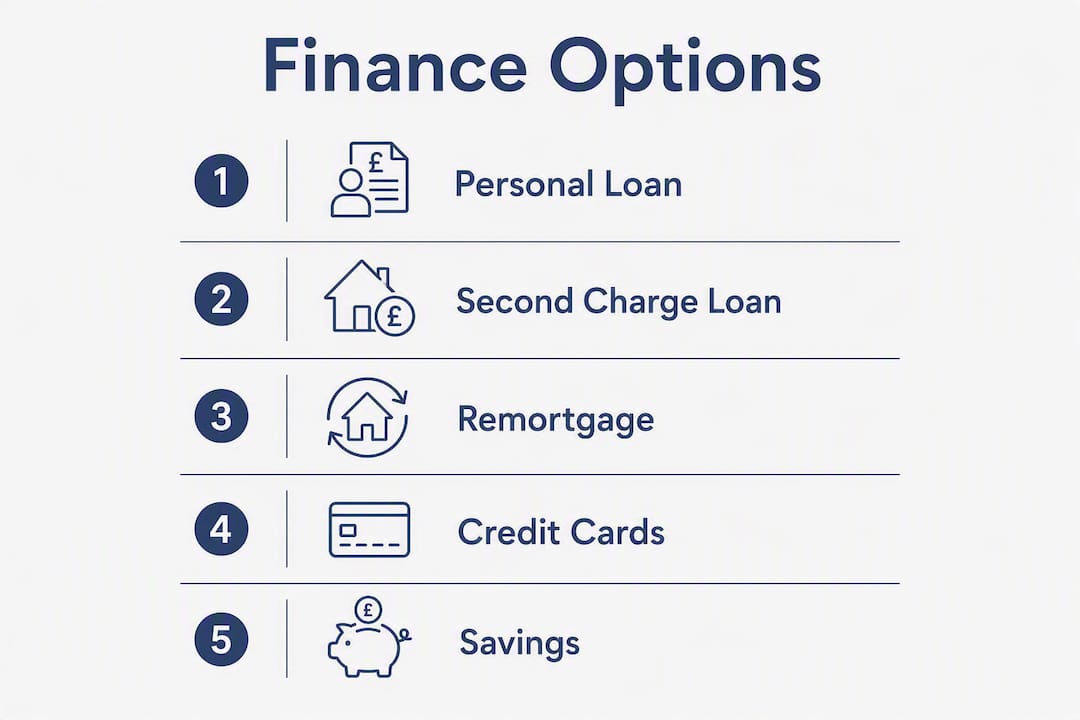
The table below covers the six main routes for financing home improvements in the UK.

| Route | Best for | Typical loan size | Typical term | Indicative APR | Poor credit? | Security |
|---|---|---|---|---|---|---|
| Remortgage with capital raise | Large projects; low existing rate | £10,000+ | 10–25 years | Mortgage rates | Harder | First charge |
| Further advance (existing lender) | Mid-to-large projects; staying with lender | £10,000+ | 5–25 years | Slightly above mortgage rate | Possible | First charge |
| Second-charge secured loan | Any size; keeping existing mortgage | £10,000+ | 5–25 years | ~8%–15% (poor credit) | Yes | Second charge |
| Unsecured personal loan | Smaller jobs under £25,000 | — | 1–5 years | 5%–30%+ | Possible (higher rate) | None |
| Credit card (0% purchase) | Minor works under ~£5,000 | Up to card limit | 12 months promo | 0% then 20%+ | Harder to qualify | None |
| Savings / phased work | Any; no debt preferred | N/A | N/A | 0% | N/A | None |
When to choose each route:
- Remortgage: only worth it if your current mortgage rate is already high or your deal is ending soon; switching costs can outweigh the savings otherwise.
- Further advance: straightforward if your existing lender offers competitive rates, but always compare against a second-charge option.
- Second-charge secured loan: the most flexible secured route for homeowners who want to keep their current mortgage deal intact.
- Unsecured personal loan: faster to arrange but rates climb sharply for imperfect credit profiles.
- 0% credit card: useful for minor cosmetic work only; the revert rate after the promotional period is high.
- Savings: the cheapest option overall, but depleting your emergency fund to fund a refit carries its own risk.
Pro Tip: Always compare APRC (Annual Percentage Rate of Charge), not just the headline interest rate. APRC is the FCA-regulated total cost figure under MCOB 10A and includes arrangement, valuation, and legal fees. Two loans with the same headline rate can have very different total costs.
Key fees to check on any quote: arrangement fee, valuation fee, legal/conveyancing fee, early repayment charge, and any admin fee for staged payments.
What does bathroom renovation finance actually cost?
Project budget bands
| Project type | Typical cost (UK) | Recommended contingency |
|---|---|---|
| Cosmetic refresh (fixtures, tiling, paint) | £5,000–£8,000 | 10% |
| Mid-range refit (full replacement, same layout) | — | 15% |
| High-end refit (layout changes, premium finishes) | — | 15% |
For a bathroom refit, lenders recommend a 15% contingency to cover hidden plumbing issues, permit fees, or material overruns. Borrow that contingency upfront. A mid-project top-up loan is slower and typically carries additional arrangement fees.
Worked repayment examples
Scenario 1: Cosmetic refresh, unsecured personal loan
Loan example for a cosmetic refresh includes a personal loan over a short term with moderate interest and corresponding monthly repayments.
Scenario 2: Mid-range refit, second-charge secured loan
Loan example for a mid-range refit involves secured borrowing over a longer term with moderate interest and monthly repayments.
Scenario 3: High-end refit, remortgage capital raise
Additional borrowing example for a high-end refit involves remortgaging over an extended term at typical mortgage rates with corresponding monthly payments.
These figures are illustrative. Use the calculator below to test your own numbers.
[loanable_borrowing_calculator]
Fee checklist for any quote:
- Arrangement fee (lender admin)
- Valuation fee (required for secured loans)
- Legal/conveyancing fee
- Early repayment charge (ERC) terms
- Staged-payment admin fee (if funds released in milestones)
Can you get finance with poor or patchy credit?
Yes. The cheapest routes will usually be secured borrowing. When a loan is secured against your property, the lender’s risk is lower, which means they can offer better rates even to borrowers with defaults, missed payments, or a thin credit file.
Documents lenders commonly request:
- Valid photo ID (passport or driving licence)
- Proof of income: recent payslips or, if self-employed, SA302 tax calculations
- Most recent mortgage statement
- Bank statements (typically three months)
- Contractor quotes for larger projects
Improving your secured loan eligibility before you apply can make a material difference to the rate you receive.
Options for challenged credit:
- Specialist second-charge lenders: these lenders price for risk rather than declining outright; secured APRs for poor credit typically sit around 8%–15% depending on equity and term.
- Brokered secured route: a specialist broker with access to multiple lenders, such as Loanable, can present your case with supporting affordability evidence to lenders with suitable appetite.
- Bad-credit unsecured lenders: available, but APRs can reach 15%–49% for poor credit profiles. Significantly more expensive than a secured alternative.
- Guarantor loans: a guarantor reduces lender risk, but APRs are often high and the guarantor’s finances are at risk if you default.
Pro Tip: A brokered secured route often finds more competitive rates for challenged credit than going direct to a single specialist lender. CeMAP-qualified advisers can present your case with the supporting evidence lenders need.
Secured borrowing puts your home at risk if you cannot keep up repayments. That is the principal trade-off for the lower rate.
How to choose the right finance option for your bathroom project
Work through these steps before you apply:
- Define your total budget. Add the project cost plus 15% contingency. That is your minimum loan amount.
- Gather three contractor quotes. Lenders may ask for these on larger applications, and they anchor your borrowing to reality.
- Set your maximum monthly payment. Be honest. Factor in other outgoings and a buffer for rate changes.
- Check your available equity. Secured lending typically requires a minimum 20%–25% combined loan-to-value after the new borrowing.
- Pre-qualify with soft searches. Use eligibility checkers that do not leave a hard footprint on your credit file.
Questions to ask each lender:
- What is the total amount repayable (APRC)?
- What are the arrangement, valuation, and legal fees?
- What are the early repayment rules?
- Can funds be released in stages tied to project milestones?
- Does the eligibility check use a soft or hard credit search?
Red flags to avoid:
- Unexplained high fees not itemised in the quote
- Lenders unwilling to confirm in writing what the loan can be used for
- Any offer that demands an upfront payment to “secure” a rate before a formal agreement is signed
What is the application process and how long does it take?
Typical timescales:
- Unsecured personal loan: 24–72 hours from application to funds
- Second-charge secured loan or further advance: 3–6 weeks
- Remortgage with capital raise: 6–12 weeks
Step-by-step process:
- Pre-qualify. Run a soft eligibility check. No hard search, no credit file impact.
- Full application. Submit income documents, ID, and mortgage statement. Underwriting begins.
- Valuation. For secured loans, a surveyor values the property. Instructing a solicitor at this stage saves time.
- Legal work. Solicitors confirm the charge and title. This is the main variable in the timeline.
- Completion and fund release. Funds are released as a lump sum or, for larger projects, in stages tied to milestones.
Documents to have ready:
- Photo ID
- Last three months’ payslips or SA302 (self-employed)
- Mortgage statement
- Three months’ bank statements
- Builder’s written quotes
Having accurate builder quotes ready at the point of application is one of the most reliable ways to speed up underwriting.
Key risks and safer alternatives
The main risk of secured borrowing is losing your home if you cannot keep up repayments. The most common causes of default are job loss, long-term illness, and underestimating the project cost.
Risk checklist:
- Stress-test affordability at a rate 2–3% higher than the offer rate
- Keep a reserve fund separate from the contingency built into the loan
- Check the lender’s hardship policy and whether payment breaks are available
- Never borrow more than the project requires
Safer alternatives to consider first:
- Phased work from savings: tackle the project in stages, funding each phase before starting the next.
- Smaller unsecured loans for minor works: faster and no home at risk for jobs under £5,000–£8,000.
- Government grants: the Disabled Facilities Grant can provide up to £30,000 for eligible adaptations. Check your local council for current availability and eligibility criteria.
- 0% credit cards for short-term spending: only where you can clear the balance within the promotional period.
Key takeaways
A secured homeowner loan is the most practical route for most UK bathroom refits, particularly for borrowers with challenged credit who have sufficient equity.
| Point | Details |
|---|---|
| Add 15% contingency | Budget your project cost plus 15% and borrow that total upfront to avoid costly mid-project top-ups. |
| Secured beats unsecured for poor credit | Secured APRs for poor credit typically sit at 8%–15%, versus 15%–49% for bad-credit unsecured loans. |
| Compare APRC, not headline rate | APRC is the FCA-regulated total cost figure; it includes all fees and is the only fair basis for comparison. |
| Timescales vary significantly | Unsecured loans fund in 24–72 hours; second-charge secured loans take 3–6 weeks; remortgages take 6–12 weeks. |
| Loanable for challenged credit | Loanable’s CeMAP-qualified advisers and FCA-regulated lender network specialise in arranging secured loans for borrowers with patchy credit histories. |
A practical view on bathroom renovation finance
Most homeowners approaching this decision focus on the monthly payment. That is understandable, but it is the wrong starting point. The more useful question is: what is the total amount repayable, and what happens if circumstances change before the loan is cleared?
Secured borrowing is genuinely the better option for most full refits. The rate difference between a secured loan at 10% and a bad-credit unsecured loan at 35% is not marginal over a ten-year term. It is thousands of pounds. For homeowners with equity, using it is rational.
The risk is real and should be stated plainly: your home is collateral. That is why stress-testing affordability at a higher rate, and keeping a separate reserve fund, matters more than finding the lowest headline rate. A loan that is affordable at 10% but unmanageable at 13% is a risk that should be priced into the decision before you sign.
The other thing most guides understate is the value of a broker for challenged credit cases. A direct application to a single lender gives you one decision. A brokered application, presented with the right supporting evidence to lenders with genuine appetite for your profile, gives you options. That difference is worth the time it takes to make a call.
How Loanable can help you fund your bathroom refit
Homeowners with challenged credit often assume their options are limited to high-rate unsecured lenders. Loanable’s position is different: access to an FCA-regulated network of secured lenders, with CeMAP-qualified advisers who present cases with the supporting evidence that gets decisions made.
Loanable has funded over £53 million in secured loans and holds 5-star customer reviews. Eligibility checks use soft searches only, so checking your options leaves no mark on your credit file. Advisers can discuss second-charge options, further advances, and where relevant, consolidating higher-cost debt into a single secured facility as part of a renovation plan.
To get started, check your eligibility or request a callback from a CeMAP-qualified adviser. No hard search, no commitment, no pressure.
This article is general information, not financial advice. Confirm current rates, eligibility criteria, and your personal circumstances with a qualified adviser or the FCA register before proceeding.
Useful UK sources to check
- Financial Conduct Authority (FCA): the regulator for all UK credit and mortgage activity; use the FCA register to verify any lender or broker before you apply.
- MoneyHelper: free, impartial budgeting tools and guidance on loans, mortgages, and home improvement finance from the government-backed service.
- KaelTripton: secured loan home improvements guide: detailed breakdown of secured routes, timescales, and contingency guidance for UK homeowners.
- GiltEdge: secured vs unsecured loans: clear explanation of product differences, typical loan sizes, and repossession risk.
- Cashfacts: financing home improvements with poor credit: practical options and APR ranges for borrowers with challenged credit histories.