



Yes, you can get a home improvement loan with bad credit in the UK, but the route matters more than the search term suggests. Unsecured personal loans are largely off the table once your file shows defaults, CCJs or an IVA — lenders that do approve them charge steep rates for small amounts. The realistic paths are a secured homeowner loan (second-charge mortgage), a remortgage with capital raised, or a further advance from your existing lender. A specialist broker like Loanable can access adverse-credit lenders that don’t deal directly with the public.
- Secured/second-charge loans are the most accessible route for adverse credit, using your home equity as security.
- Remortgaging or a further advance can work if your existing lender will still lend and your fixed rate isn’t locked in.
- Expect higher rates than mainstream borrowing, and remember your property is at risk if repayments are missed.
- Check the lender is FCA-regulated before signing anything.
Key Takeaways
Bad credit rarely stops UK homeowners funding renovations; the equity in the property, not the credit score alone, is usually what decides whether a lender says yes.
| Point | Details |
|---|---|
| Secured loans are the realistic route | Second-charge mortgages accept adverse credit far more readily than unsecured lending. |
| Combined LTV drives pricing | Lenders typically cap combined LTV around 75% to 85%, and lower LTV means better rates. |
| Second charge protects your first mortgage | Completion takes roughly 3 to 6 weeks and avoids breaking a low fixed-rate deal. |
| Preparation changes outcomes | Correcting credit report errors and running a soft-search check improves approval odds before you apply. |
| Specialist brokers reach intermediary-only lenders | Loanable’s CeMAP-qualified advisors package adverse-credit cases for lenders you can’t approach directly. |
Table of Contents
- Which home improvement bad credit routes actually work?
- How do lenders assess bad credit home improvement applications?
- What will a bad credit renovation loan cost you?
- How can you improve your chances before applying?
- What are the risks and better alternatives to secured borrowing?
- How does Loanable help homeowners with bad credit find a lender?
- What UK homeowners with adverse credit get wrong about renovation finance
- Ready to check your eligibility with Loanable?
- Frequently asked questions
- Sources
Which home improvement bad credit routes actually work?
Homeowners searching for a home improvement loan bad credit route usually have three realistic options, and each suits a different situation.
- Unsecured personal loan. Technically available, but adverse-credit lenders in this space tend to cap amounts low and price them high. If you’ve had a default in the last two years, approval odds drop sharply and the numbers rarely work for a full renovation.
- Secured homeowner loan (second-charge mortgage). This sits behind your existing mortgage at the Land Registry as a second claim on the property. Because the loan is secured against equity rather than your credit score alone, lenders are far more willing to look past past credit problems. It’s the default choice for most bad credit renovation loan applicants.
- Remortgage with capital raised, or a further advance. If your current deal has ended, or your lender will lend more on top of your existing mortgage, this can sometimes beat a second charge on rate. The catch: it usually means renegotiating your whole mortgage, and if you’re mid fixed-term, you could face early repayment charges.
Second-charge loans typically complete in around 3 to 6 weeks, against 6 to 12 weeks for a full remortgage, which matters if your building work has a start date.
How do lenders assess bad credit home improvement applications?
Lenders assessing adverse-credit applications for secured home improvement loans work through a fairly consistent checklist, and knowing it in advance saves you wasted applications.
- Combined loan-to-value (combined LTV). Most specialist lenders cap this around 75% to 85%, meaning your first mortgage plus the new loan can’t exceed that share of your property’s value.
- Affordability under MCOB rules. Lenders stress-test your income against your outgoings, similar to a first-charge mortgage application, not just a quick credit score glance.
- Age and severity of adverse credit. A satisfied CCJ from four years ago reads very differently to an unsatisfied default from last month. Discharged IVAs and older bankruptcies are viewed more leniently than fresh, unresolved issues.
- Property type and equity. Standard construction homes with clear title tend to get the widest choice of lenders; flats above commercial premises or non-standard builds narrow the field.
Statistic Callout: Specialist lenders in this space cap combined LTV at roughly 85% for adverse-credit cases, so the more equity you hold, the more lenders will consider your application.
Many of the lenders willing to look past adverse credit are intermediary-only, meaning you can’t apply to them directly. That’s why brokers who package cases for manual underwriting, rather than automated scoring, tend to get better outcomes for borrowers with a patchy file.
What will a bad credit renovation loan cost you?
Pricing on secured home improvement loans depends heavily on how adverse your credit is and how much equity sits behind the loan.
- Market commentary places rates at roughly 6% to 9% for strong credit, 9% to 12% for mid-tier credit, and higher again once defaults, CCJs or an IVA appear on file.
- Always compare the APRC, not just the headline rate. Arrangement fees, valuation fees, solicitor costs and any early repayment charges (ERCs) on your existing mortgage all feed into the true cost.
- A higher combined LTV and a longer term both push the rate up, since the lender is carrying more risk for longer.
Statistic Callout: Adverse-credit secured loan pricing regularly sits above mainstream mortgage rates, which is why comparing the APRC across a handful of lenders, rather than accepting the first offer, usually pays for itself.
Say you’re on a fixed first mortgage at 3.5% with three years left and a hefty ERC for breaking it. A second-charge loan lets you raise £20,000 for renovations without touching that deal. Remortgaging the whole balance to release the same sum could mean losing your fixed rate and paying the ERC, which often costs more than the second charge’s higher interest over a shorter term. Check current home improvement loan rates before deciding either way.
How can you improve your chances before applying?
Preparation changes outcomes more than most homeowners expect, and it costs nothing but time.
- Pull your files from Experian, Equifax and TransUnion, and dispute any error you find. Incorrect defaults or wrongly recorded accounts are more common than people assume, and correcting one can shift you into a better lending tier.
- Pay down unsecured balances where you can, and stop applying for new credit in the months before you apply. Multiple hard searches in a short window make lenders nervous.
- Gather proof of income, bank statements and contractor quotes for the renovation work itself. A clear eligibility checklist beforehand speeds up underwriting considerably.
- Use a soft-search eligibility check first. It shows likely rates without leaving a mark on your file, and a specialist broker can then match you to lenders before you make a formal application.
Pro Tip: Reducing your combined LTV by even five percentage points, say by paying down £5,000 of your mortgage or choosing a smaller loan, can move you into a materially better rate band with many specialist lenders.
Borrowing Calculator
See how much you could potentially borrow against your home, subject to status.
Please enter a property value that's higher than your outstanding mortgage balance.
Based on your figures, the amount available is below our typical minimum loan of £25,000. Get in touch and we'll talk through your options.
Get my free, no-obligation quoteIllustrative only, based on a maximum combined loan-to-value of 75%. This is not a loan offer or a quote, and your actual rate, borrowing amount and monthly payment will depend on your circumstances, credit profile and the lender's criteria. Think carefully before securing other debts against your home. Your home may be repossessed if you do not keep up repayments on your mortgage or any other debt secured on it.
What are the risks and better alternatives to secured borrowing?
A second-charge mortgage sits legally behind your first mortgage at the Land Registry, so if the property is sold or repossessed, your original lender is paid first and the second-charge lender only recovers what’s left. That priority matters because it’s also why second-charge lenders price adverse credit more cautiously than a first-charge lender would.
- Your home is at risk if repayments are missed. This isn’t a small print warning; it’s the mechanism that makes secured lending accessible with bad credit in the first place, since collateral is what offsets the lender’s risk.
- Watch for two sets of early repayment charges if you’re restructuring both your first mortgage and adding a second charge, and check what rate you fall onto if a deal ends without you remortgaging.
- Rolling existing unsecured debts into a secured loan removes the Section 75 protection that credit cards carry, so weigh that trade-off carefully.
- Before committing, free advice is available from StepChange, MoneyHelper, and Citizens Advice, and some local authorities offer grants for specific accessibility or energy-efficiency works.
How does Loanable help homeowners with bad credit find a lender?
Loanable works as a broker, not a direct lender, which matters because many of the specialist lenders willing to approve a home improvement loan for bad credit only accept applications through intermediaries. Going direct to the high street simply won’t reach them.
- Advice comes from CeMAP-qualified advisors, the recognised UK mortgage advice qualification.
- Loanable has funded over £53 million in loans, with a track record specifically in adverse-credit cases.
- Access spans a wide panel of lenders rather than a single provider’s rate card, which matters when your file needs manual underwriting.
- Client feedback sits at 5 stars across review platforms.
Homeowners with defaults, CCJs or an IVA are often declined by automated systems before a human ever reviews the file. Broker packaging exists precisely to get a case in front of an underwriter who can weigh equity and circumstances, not just a credit score.
An eligibility check typically takes a few minutes, uses a soft search that leaves no mark on your file, and gives you an indication of likely rates and lenders within the same day.
What UK homeowners with adverse credit get wrong about renovation finance
Most advice on this topic focuses on the wrong variable. Homeowners fixate on their credit score when the number that actually decides their outcome is combined LTV.
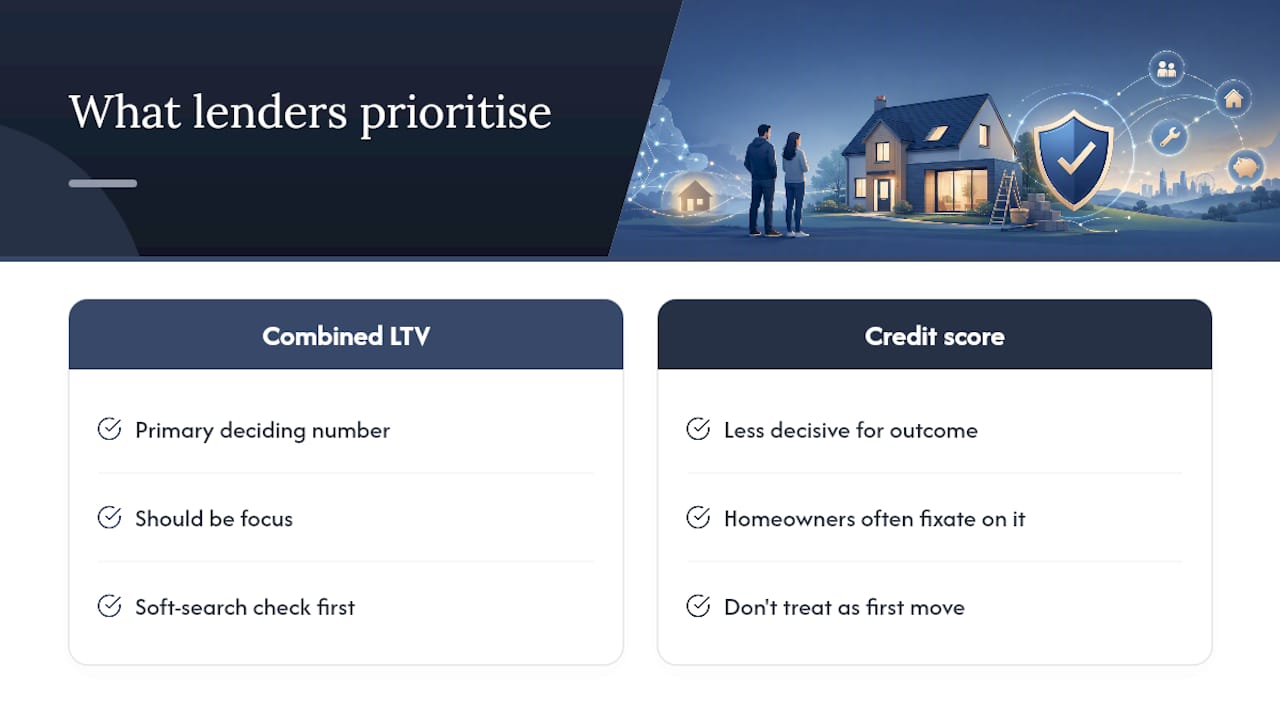
The other mistake is treating remortgaging as the obvious first move. It’s often the expensive one. If you’re locked into a competitive fixed rate, breaking it to release funds for a kitchen or loft conversion can cost more in early repayment charges than a second-charge loan would cost in interest over the same period. Homeowners rarely run that comparison before applying.
What should come first is the soft-search check, not the application. It costs nothing, reveals your realistic rate band, and stops you wasting a hard search on a lender who was never going to approve your file.
Ready to check your eligibility with Loanable?
If your credit file has a default, a CCJ or an IVA on it, going straight to a mainstream lender’s website is usually a dead end. Loanable exists for exactly this gap: a broker route into the intermediary-only lenders who actually approve adverse-credit cases, without the repeated hard searches that come from trying several lenders yourself.

Working with a broker does typically mean the advice comes with a fee structure, but for many adverse-credit borrowers it’s the difference between an approval and a string of declines. Loanable’s CeMAP-qualified advisors review your equity position and credit history against a wide lender panel, and match you to the lenders most likely to say yes, rather than leaving you to guess. Explore secured homeowner loans or the second-charge mortgage option to see how each fits your renovation budget. The first step is a soft-search eligibility check, which shows likely rates in minutes without touching your credit score.
Frequently asked questions
Can you get a home improvement loan with bad credit in the UK?
Yes, most commonly through a secured homeowner loan or second-charge mortgage, since the property equity offsets the lender’s risk. Unsecured options exist but are limited and expensive once defaults or CCJs appear on file.
Will a CCJ or default stop me getting approved?
Not automatically. Lenders look at how old and how severe the event was, alongside your equity and income, rather than declining every applicant with a mark on their file.
Is a secured loan riskier than an unsecured one?
Yes, in one specific sense: your home is used as security, so missed payments can lead to repossession proceedings. That risk is exactly why secured lending is more accessible to adverse-credit borrowers in the first place.
How much equity do I need for a bad credit renovation loan?
Most specialist lenders want your combined loan-to-value, the first mortgage plus the new loan, to stay under roughly 75% to 85% of your property’s value.
Should I check my eligibility before applying?
Yes. A soft-search check shows your likely rate band without leaving a mark on your credit file, which avoids wasting a hard search on a lender unlikely to approve your case.
This article is general information, not a substitute for advice from a qualified financial advisor. Consult a qualified financial professional about your own circumstances before acting on anything here.
Sources
- Second mortgage UK 2026
- Everything you need to know about second-charge mortgages
- Can you get a secured loan with bad credit? 2025 guide