



A whole of market broker is a mortgage adviser who, within the intermediary channel, considers products from a broad range of UK lenders rather than a limited panel or a single provider. This matters most when your circumstances sit outside a standard high street box: adverse credit, unusual income, or a large secured loan where one lender’s rejection shouldn’t be the end of the road. Two names worth knowing before you go further: the Financial Conduct Authority (FCA), which regulates how brokers operate, and Loanable, whose CeMAP-qualified advisers work across a wide lender base for secured and homeowner loans.
Key Takeaways
A whole of market broker widens your realistic options by searching across most intermediary-channel lenders, but only a written fee disclosure and a named FCA authorisation number confirm that access is genuine.
| Point | Details |
|---|---|
| Definition matters | Whole of market means broad intermediary-channel access, not literally every UK mortgage product. |
| Know the exclusions | Direct-only deals, internal panels, and time-limited exclusives sit outside even wide broker reach. |
| Ask before applying | Request lender numbers, sourcing tool names, and a written fee disclosure before proceeding. |
| Payment shapes trust | Commission, upfront fees, and completion fees all carry different incentives, ask which applies. |
| Loanable’s approach | CeMAP-qualified advisers, over £53 million funded, and written fee disclosure before formal application. |
Useful sources and regulator links
Check any adviser’s authorisation directly on the FCA register. For Loanable’s own approach and credentials, see the broker versus lender guide and CeMAP qualification explainer.
Table of Contents
- What “whole of market” actually means in practice
- Whole of market versus tied and restricted advisers
- Where “whole of market” stops: limits worth knowing
- When broad market access actually changes your outcome
- How UK brokers get paid, and what to ask for in writing
- How to check a broker’s market access before you commit
- How Loanable searches the market for you
- If you want help comparing the market properly
- Frequently asked questions
What “whole of market” actually means in practice
The phrase describes access, not obligation. A whole of market broker can consider most lenders that distribute through the intermediary channel, meaning brokers and advisers, rather than being restricted to a shortlist of “panel” lenders that pay them the best commission. What it doesn’t automatically include is every product a lender sells. Many lenders keep some deals direct-only, sold through their own branches or websites and never distributed to brokers at all.
In practice, brokers reach this pool through lender distribution agreements and whole-market sourcing systems that pull live rates and criteria from dozens of providers simultaneously. A genuine search across this pool typically delivers:
- Wider choice across mainstream and specialist lenders, not just the two or three names on the high street
- Access to products built for adverse credit or unusual income that rarely get advertised publicly
- Occasional intermediary-only rates, deals that never appear on a lender’s own website because they’re only released through brokers
Pro Tip: Ask any broker how many lenders they can place business with. A vague answer like “loads” is a warning sign. A genuine whole of market broker can usually give you a rough number or point you to their sourcing system.
Whole of market versus tied and restricted advisers
Not every adviser works the same way, and the label on the door tells you a lot about the deals you’ll actually see. A tied adviser recommends products from a single lender, often because they’re employed by that lender or a business connected to it. A restricted or multi-tied adviser works from a limited panel, perhaps ten or twenty lenders, chosen by their firm rather than by your circumstances. An independent adviser is expected to consider the whole market and give unbiased recommendations, similar in principle to whole of market but with a stronger regulatory expectation of impartiality attached to the word “independent.”
| Adviser type | Lender scope | How they’re paid | Best suited to |
|---|---|---|---|
| Tied | Single lender | Usually salaried or lender-funded | Simple, standard cases with that lender |
| Restricted / multi-tied | Limited panel | Commission from panel lenders | Straightforward cases where panel fits |
| Whole of market / independent | Broad market access | Commission, fee, or both | Complex, specialist, or credit-challenged cases |
Ask directly: “Do you work from a panel, and if so, how many lenders are on it?” That single question usually separates the three models faster than any marketing page will.
Where “whole of market” stops: limits worth knowing
The phrase gets used loosely, and it’s worth being sceptical of anyone who implies it means literally every mortgage product sold in the UK. It doesn’t. Common exclusions include:
- Direct-only products sold solely through a lender’s branches or website
- Internal lender panels that quietly exclude certain deals from broker distribution
- Time-limited exclusives that expire or get pulled from the intermediary pool
- Eligibility-based exclusions, where a product simply isn’t offered to your circumstances regardless of broker access
None of this makes whole of market access less valuable, it’s still far broader than a tied or restricted panel, but these gaps explain why even a genuinely broad-reaching broker occasionally can’t match a rate you’ve spotted on a lender’s own site.
When broad market access actually changes your outcome
Whole of market search matters most when your case sits outside the standard template. First-time buyers with thin credit files, remortgagers chasing the lowest possible rate, borrowers with adverse or unusual credit histories, complex or self-employed income, buy-to-let cases, and larger secured loans or short-term bridging needs all tend to benefit disproportionately from broader lender access.

Pro Tip: If two or three mainstream lenders have already said no, or the rates you’re being quoted feel high for your credit profile, that’s the moment to prioritise a broker with genuinely wide market reach over a quick high street application.
A borrower with a missed payment eighteen months ago might get automatically declined by a mainstream lender’s credit scoring, yet still qualify for a competitive secured loan through a specialist lender that only accepts applications via brokers. That gap, between what’s advertised and what’s actually available, is where whole of market access earns its keep.
How UK brokers get paid, and what to ask for in writing
Payment models vary, and understanding them tells you a lot about potential conflicts of interest. Common structures include:
- Commission paid by the lender when the loan completes
- An upfront fee charged to you, sometimes non-refundable
- A completion fee, charged only once the loan goes through
- Fee-free-to-client arrangements, where the broker relies solely on lender commission
Regulation expects brokers to set out fees and commissions in writing before you submit a formal application, not buried in small print afterwards. Fees are often refundable if a lender declines your application, though this varies by firm, so ask explicitly. Before proceeding, insist on seeing: the exact fee amount, whether it’s refundable, whether commission is also being earned on top, and when payment is due.
How to check a broker’s market access before you commit
Borrowing Calculator
See how much you could potentially borrow against your home, subject to status.
Please enter a property value that's higher than your outstanding mortgage balance.
Based on your figures, the amount available is below our typical minimum loan of £25,000. Get in touch and we'll talk through your options.
Get my free, no-obligation quoteIllustrative only, based on a maximum combined loan-to-value of 75%. This is not a loan offer or a quote, and your actual rate, borrowing amount and monthly payment will depend on your circumstances, credit profile and the lender's criteria. Think carefully before securing other debts against your home. Your home may be repossessed if you do not keep up repayments on your mortgage or any other debt secured on it.
Verifying a broker’s reach takes minutes and saves potential disappointment later. Work through this sequence:
- Ask how many lenders they can place business with, and whether that number includes specialist or adverse credit lenders.
- Ask whether they use a whole-market sourcing system, and request the name of it if you want to check independently.
- Ask whether they can access intermediary-only products that don’t appear on public comparison sites.
- Ask them to show you a comparison of at least two or three options for your specific case, not just their first recommendation.
Watch for red flags along the way:
- Evasive or vague answers about lender numbers
- Phrases like “we only recommend our partner lenders”
- No written fee disclosure offered before you ask
- Reluctance to show any comparative results
Before applying, request documentary proof: written fee disclosure, the broker’s FCA authorisation number (checkable on the FCA register), confirmation of CeMAP or equivalent adviser qualifications, and either a sample comparison or a plain explanation of which lenders they don’t cover.
How Loanable searches the market for you
Loanable’s advisers are CeMAP-qualified and work across a broad lender base for secured loans, homeowner loans, and debt consolidation, disclosing fees and commission arrangements in writing before any formal application proceeds. That approach is built on the same distinction covered in Loanable’s guide to brokers versus lenders, which sets out exactly how adviser qualifications and lender access work together.
Three points worth knowing: Loanable has funded over £53 million in loans to date, holds 5-star customer ratings backed by genuine testimonials, and has particular experience placing loans for borrowers with challenged credit histories who’ve been turned away elsewhere.
Pro Tip: If you’ve already had one lender say no, that’s not the end of the process, it’s usually the point where a broader search starts paying off. Check your options via Loanable’s eligibility check, which won’t affect your credit score.
A note from an adviser
Transparency on fees and genuine market checking aren’t extras, they’re the whole job. When a broker won’t show you the comparison, ask why.
If you want help comparing the market properly
There are other routes to comparing mortgage and secured loan options: going direct to individual lenders, using comparison websites, or approaching a restricted-panel adviser. Each has its place, but each also means doing the legwork yourself or accepting a narrower shortlist than you might need. Loanable searches broadly across lenders for secured loans, homeowner loans, and debt consolidation, and puts fees and any commission in writing before you commit to anything.

Loanable is FCA registered, and its advisers hold CeMAP qualifications, the same credentials worth asking any broker for. If you’re weighing up whether a secured loan or debt consolidation makes sense for your situation, check your eligibility without it touching your credit score, or look at Loanable’s secured loan options to see what’s realistically available before you apply anywhere.
Frequently asked questions
Is a whole of market broker the same as an independent broker?
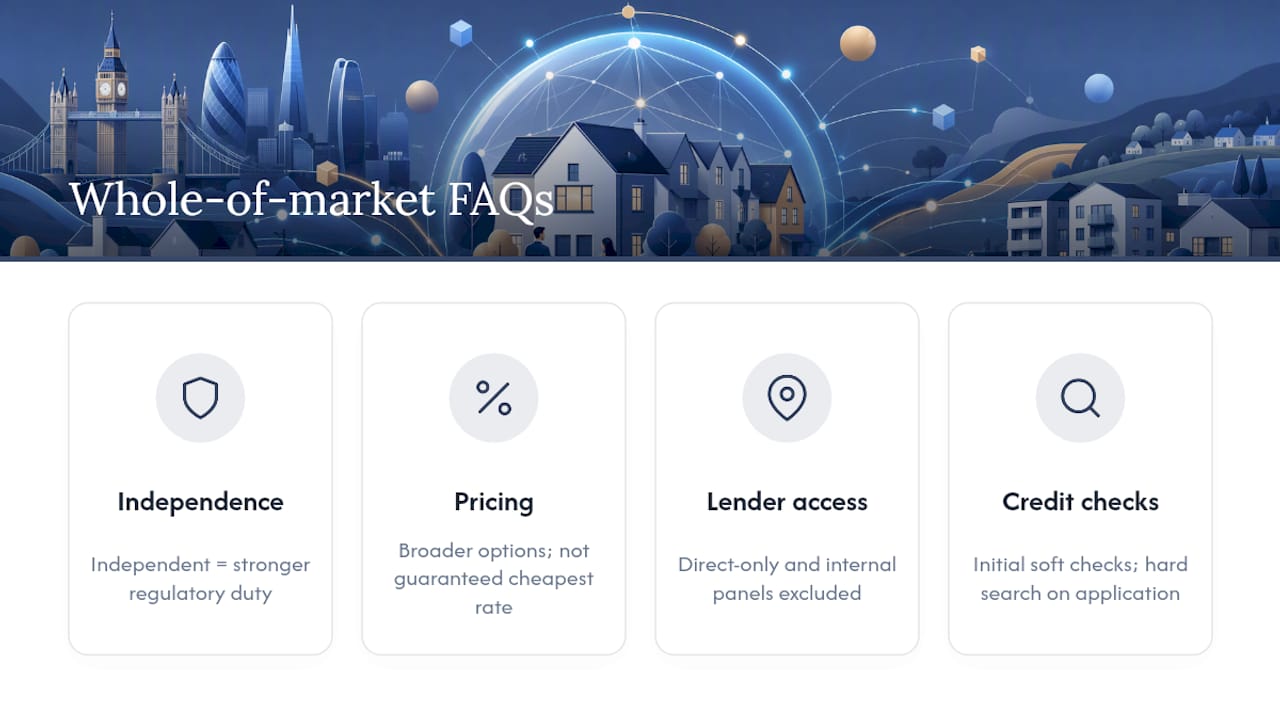
Not quite. Independent carries a stronger regulatory expectation of unbiased advice, while whole of market specifically describes breadth of lender access. In practice, many brokers use both terms to describe similar service levels.
Does whole of market mean I’ll always get the cheapest rate?
No. It means you’ll see a broader pool of options, which improves your odds of finding competitive terms, particularly for complex or credit-challenged cases, but it doesn’t guarantee the single lowest rate on the market.
Can a whole of market broker access every lender in the UK?
No lender relationship is universal. Direct-only products and certain internal lender panels sit outside even the broadest intermediary access, which is why asking for specifics matters more than trusting the label alone.
Will using a broker affect my credit score?
Initial eligibility checks, like the one offered through Loanable, typically use soft searches that don’t affect your credit score. A hard search usually only happens once you proceed to a formal application.
This article is general information, not a substitute for advice from a qualified financial advisor. Consult a qualified financial professional about your own circumstances before acting on anything here.