



For most UK homeowners with anything other than a textbook-simple case, a broker is the better first move. Brokers give you access to multiple lenders, package your application to match underwriting criteria, and can find products a direct application would never reach. Going direct to a lender makes sense when your credit is clean, your income is straightforward, and you already have a strong relationship with that lender. The Financial Conduct Authority (FCA) regulates both routes, so consumer protection applies either way. Loanable’s CeMAP-qualified advisers have substantial experience funding secured loans for UK homeowners, indicating the broker route’s frequent effectiveness.
Table of Contents
- Key takeaways you can act on in 60 seconds
- What does a mortgage or loan broker actually do?
- What a lender is and what to expect when you apply direct
- Broker vs lender: a side-by-side comparison
- How brokers are paid and what fees to expect
- When a broker is likely the better choice
- When going direct to a lender makes sense
- Risks and downsides of each route
- How to check a broker is authorised in the UK
- What to do if you get poor advice or a rejected application
- One-page checklist: broker or direct lender for your mortgage?
- Evidence and expert insight: why brokers often add value for complex UK cases
- Final takeaways: what to decide and what to do next
- Key takeaways
- The case for starting with a broker, not ending with one
- Loanable’s secured loan service: how to get started
- Useful sources and further reading
Key takeaways you can act on in 60 seconds
The choice between a loan broker and a direct lender usually comes down to case complexity, not personal preference.
- Use a broker when you are self-employed, have variable income, a gifted deposit, adverse credit, a buy-to-let property, or are considering a second-charge or secured homeowner loan.
- Go direct when you are doing a straightforward product transfer with your existing lender, your credit profile is clean, and the lender offers a loyalty discount or direct-only product.
- Broker fees vary: many fee-free brokers are paid by lenders via a procuration fee of roughly 0.3–0.4% of the loan; client-paid fees for standard cases typically run £400–£643, rising to £1,000–£2,000 for complex cases.
- Always confirm whether a broker is whole-of-market. A restricted panel can miss the lender that would approve your case.
- Check any broker on the FCA Financial Services Register before you proceed.
What does a mortgage or loan broker actually do?
A broker is an intermediary. They do not lend money themselves. Instead, they search across multiple lenders, assess your eligibility, and package your application before submitting it.
The practical services a broker provides go well beyond finding a rate:
- Whole-of-market search: a whole-of-market broker can access 90 or more lenders, including specialist and broker-only products that are not available on the high street.
- Lender matching: brokers know which lenders are currently accepting cases like yours, including those with non-standard income or adverse credit.
- Document assembly: they gather payslips, bank statements, proof of deposit, and any supporting evidence, then present it in the format each lender’s underwriter expects.
- Application submission and negotiation: the broker submits on your behalf and handles queries from the lender’s underwriting team.
- Case packaging: for complex cases, this is where brokers add the most value. A well-packaged application reduces the chance of a technical rejection.
The distinction between broker types matters. A whole-of-market broker searches the widest possible range of lenders. A restricted or tied broker works from a limited panel, which may exclude the lender best suited to your situation. Always ask which type you are dealing with before you proceed.
What a lender is and what to expect when you apply direct
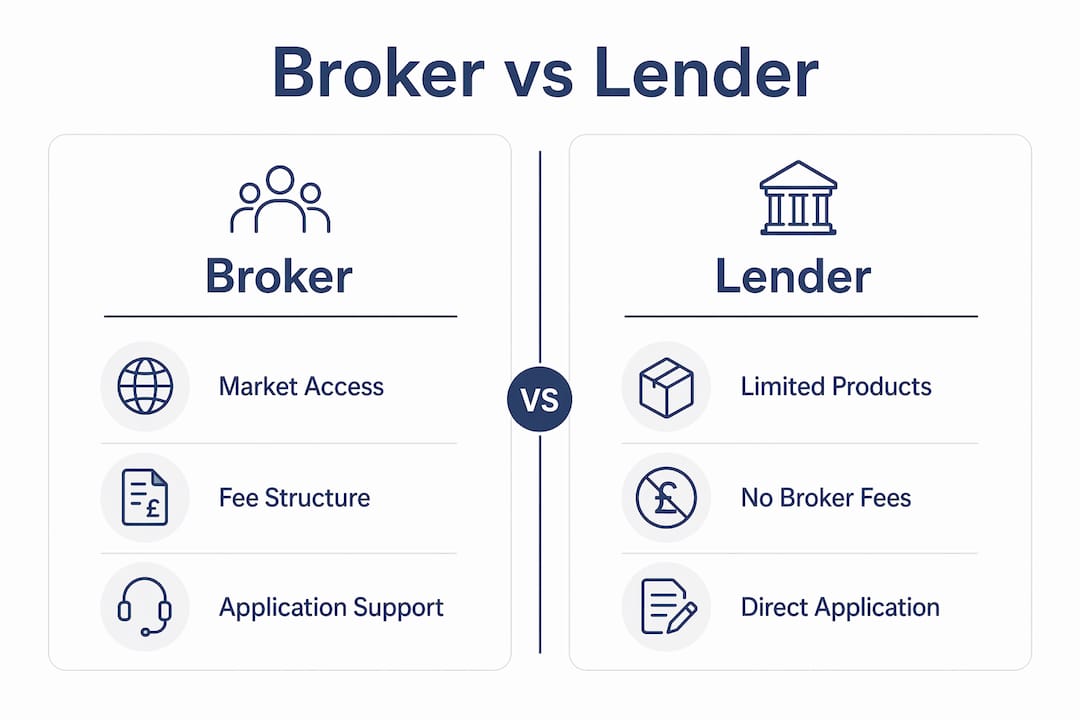
A lender is the institution that actually provides the funds. Banks, building societies, and specialist lenders all fall into this category. When you apply direct, you deal only with that lender’s own products and pricing.
Direct lenders have genuine strengths in the right circumstances:
- Speed for simple cases: a product transfer with your existing lender often involves minimal underwriting because the lender already holds your account history.
- Loyalty discounts: some lenders offer preferential rates to existing customers that are not available through a broker.
- Direct-only products: a small number of lenders reserve certain products for direct applicants. These are worth checking before you assume a broker can access everything.
The limitations are equally clear. A lender’s adviser can only recommend products from that lender’s own range. Their underwriting criteria are fixed, so if your case does not fit their model, the answer is no. Applying to several lenders directly also means multiple hard credit searches, each of which leaves a mark on your credit file.
Broker vs lender: a side-by-side comparison

Experts consistently recommend matching the route to case complexity rather than defaulting to one channel. This table sets out the key dimensions.

| Dimension | Broker | Direct lender |
|---|---|---|
| Market access | Whole-of-market brokers access 90+ lenders, including broker-only products | Single lender’s range only |
| Costs and fees | Procuration fee (paid by lender) plus possible client fee; fee-free options exist | Arrangement fees, valuation fees; no broker fee, but no rate comparison either |
| Speed and convenience | Broker handles paperwork; can be faster for complex cases | Faster for simple product transfers with existing lender |
| Complex cases | Strong advantage: case packaging, specialist lender access, soft-search matching | Limited: fixed in-house criteria; rejection more likely for non-standard cases |
| Control and transparency | Broker discloses fees and commission; you see multiple options | Full visibility of one lender’s terms; no comparison |
| Regulation and protection | FCA-regulated; FOS complaint route applies | FCA-regulated; FOS complaint route applies |
Both routes carry FCA regulation, so consumer protection is not a differentiator. The real difference is market reach and application support.
How brokers are paid and what fees to expect
Understanding broker payment models helps you spot double-charging and compare the true cost of each route.
Three main payment models:
- Procuration fee (lender-paid commission): the lender pays the broker a fee, typically around 0.3–0.4% of the loan amount, on completion. The borrower pays no direct fee. This commission is generally built into lender pricing across the market, so it does not necessarily make your mortgage costlier.
- Client-paid fee: the broker charges you directly. For standard cases, this typically runs £400–£643. For complex cases involving adverse credit, non-standard income, or specialist products, fees can reach £1,000–£2,000.
- Hybrid arrangement: the broker receives a procuration fee from the lender and also charges the borrower a reduced client fee.
Typical broker fee range (2026): standard cases £400–£643; complex cases £1,000–£2,000; procuration fee ~0.3–0.4% of loan (paid by lender, not borrower).
The key question to ask is whether the broker charges both a client fee and receives a procuration commission. That is not automatically wrong, but it must be disclosed. If a broker cannot tell you clearly how they are paid, that is a warning sign.
Pro Tip: Ask for a written fee disclosure before any work begins. A legitimate broker will provide this without hesitation under FCA conduct rules.
When a broker is likely the better choice
The broker route adds measurable value in any situation where your case does not fit a standard lender’s criteria cleanly. These are the most common UK scenarios:
- Self-employed or variable income: lenders assess income differently. A broker knows which lenders use net profit, which use salary plus dividends, and which accept one year’s accounts rather than two.
- Adverse credit: missed payments, defaults, or a previous CCJ do not automatically mean rejection. Specialist lenders exist for these cases, and a broker can match you to the right one without triggering multiple hard searches.
- Gifted deposits: some lenders accept gifted deposits from family members; others do not. A broker filters this at the matching stage.
- Buy-to-let or second-charge loans: these products have their own underwriting rules. A broker with experience in secured homeowner loans and second-charge mortgages can navigate criteria that a high-street branch adviser might not be familiar with.
- Later-life borrowing: age caps and retirement income assessments vary significantly between lenders. A whole-of-market broker can identify those with the most flexible criteria.
- Complex remortgages: if you are releasing equity, consolidating debt, or switching from a residential to a buy-to-let mortgage, the application requires careful structuring.
A good broker does more than chase the headline rate. They align the loan structure with your long-term goals, weighing fixed period, fees, overpayment rights, and early-repayment charges against the headline APR.
Pro Tip: Ask any broker whether they are whole-of-market and request examples of lenders they have placed similar cases with. A broker who hesitates on either question may have a restricted panel.
When going direct to a lender makes sense
Direct applications are not always the inferior option. There are clear situations where they are the faster, simpler choice.
- Straightforward product transfer: if you are coming to the end of a fixed rate with your existing lender and your circumstances have not changed, a product transfer is often quick and involves no new credit search.
- Loyalty discounts: some lenders offer existing customers rates that are not available through any broker. It is worth checking your lender’s retention team before assuming a broker can beat it.
- Direct-only products: a small number of lenders reserve specific products for direct applicants. If you already know the product and the rate is competitive, applying direct removes the broker fee from the equation.
- You have time and confidence to shop around: if your credit profile is clean and your income is straightforward, you can request Decision in Principle quotes from several lenders using soft searches, compare them, and apply to the strongest one.
The limitation is that this approach requires you to know which lenders to approach, understand their criteria, and handle the paperwork yourself. For most borrowers, that is more time-consuming than it sounds.
Risks and downsides of each route
Neither route is risk-free. Knowing the common pitfalls helps you avoid them.
Broker risks:
- Restricted panels: a broker who presents themselves as independent but works from a limited panel may miss the lender best suited to your case. Always ask for written confirmation of whole-of-market status.
- Opaque fees: some brokers charge upfront fees before any work is done, then add further fees at completion. Confirm the full fee structure in writing before you commit.
- Adviser quality: CeMAP qualification is the standard benchmark for mortgage advisers in the UK. Ask for the adviser’s qualification and check their FCA registration individually, not just the firm’s.
- Unauthorised brokers: carrying on regulated credit broking without FCA authorisation is a criminal offence and can render resulting agreements unenforceable. Never proceed with a broker who cannot be found on the FCA register.
Direct lender risks:
- Narrow product exposure: you only see one lender’s range. A better-fit product may exist elsewhere and you will not know about it.
- Multiple hard searches: applying to several lenders in sequence leaves multiple hard enquiries on your credit file, which can reduce your score and make subsequent applications harder.
- Missing broker-only products: some lenders reserve their most competitive products for broker-introduced business. Going direct means those products are simply not available to you.
How to check a broker is authorised in the UK
Verifying a broker takes five minutes and protects you from significant risk. Follow these steps before you sign anything.
- Check the FCA Financial Services Register. Go to the FCA register and search for the firm by name or reference number. Confirm the firm is authorised (not just registered) and that its permissions include credit broking or mortgage arranging.
- Check the individual adviser. The firm may be authorised, but the specific adviser must also be listed as an approved person or appointed representative. Search their name on the same register.
- Confirm their qualifications. Ask for the adviser’s CeMAP certificate or equivalent qualification. CeMAP (Certificate in Mortgage Advice and Practice) is the standard UK benchmark.
- Request the terms of business. A regulated broker must provide a written terms of business document before any advice is given. This sets out their services, fees, and complaint procedure.
- Ask for fee disclosure in writing. The broker must disclose how they are paid, including any procuration commission from lenders, before you proceed.
- Confirm whole-of-market status. Ask directly whether the broker is whole-of-market or restricted. Get the answer in writing.
- Check the complaint route. Confirm that the firm is covered by the Financial Ombudsman Service (FOS) for regulated activities and that they have a written complaints procedure.
If a broker cannot satisfy any of these steps, do not proceed.
What to do if you get poor advice or a rejected application
A rejection or a bad advice outcome is not the end of the road. These steps limit the damage and give you a clear path forward.
- Stop further applications immediately. Each new hard search reduces your credit score. Pause until you understand the exact reason for the rejection.
- Ask for a written explanation. Whether the decision came from a broker or a lender, you are entitled to know the specific reason. Request it in writing.
- Request soft-search alternatives. Ask a whole-of-market broker to run soft-search eligibility checks across their panel. This identifies likely approvals without leaving hard-search marks on your file.
- Raise a formal complaint with the firm. If you believe the advice was unsuitable or the broker failed in their duty, submit a written complaint to the firm. They have eight weeks to respond under FCA rules.
- Escalate to the lender’s or network’s compliance team. If the broker is an appointed representative of a network, the network’s compliance team can also receive complaints.
- Refer to the Financial Ombudsman Service. If the firm does not resolve your complaint within eight weeks, or if you are dissatisfied with their response, refer the case to the Financial Ombudsman Service. The FOS is free to use and can award compensation.
- Protect future borrowing power. Avoid applying anywhere else until you have a clear picture of your credit file. Use a credit reference agency to check your report and identify any errors before your next application.
[loanable_borrowing_calculator]
One-page checklist: broker or direct lender for your mortgage?
Work through these questions before you pick a route.
Decision checklist:
- Is your income straightforward (PAYE, single employer, no gaps)? If not, a broker is likely the better route.
- Is your credit history clean with no missed payments, defaults, or CCJs in the past three years? If not, use a broker.
- Is your deposit from your own savings with no gifted element? If you have a gifted deposit, a broker can filter lenders who accept it.
- Are you doing a like-for-like product transfer with your existing lender? If yes, check the direct rate first.
- Does your existing lender offer a loyalty discount or direct-only product? If yes, compare it against a broker quote before deciding.
- Do you have time to handle the paperwork yourself and shop multiple lenders? If not, a broker saves significant time.
- Is the property non-standard (ex-local authority, unusual construction, short lease)? A broker with specialist lender access is strongly advisable.
Questions to ask any broker:
- Are you whole-of-market or do you work from a restricted panel?
- How are you paid? Do you receive a procuration fee from lenders, and do you also charge a client fee?
- What is your total fee, and when is it payable?
- Who handles the application once submitted?
- Can you provide examples of similar cases you have placed?
Questions to ask a lender’s adviser:
- Do you offer any direct-only discounts not available through brokers?
- What are the arrangement and valuation fees?
- What are the early-repayment charges and overpayment allowances?
- How long does a conditional offer remain valid?
- What happens if my circumstances change between offer and completion?
You can also use a refinance calculator to model the cost difference between routes before you commit to either.
Evidence and expert insight: why brokers often add value for complex UK cases
The evidence on broker value is consistent. Brokers can search multiple lenders and access exclusive broker-only deals that direct applicants cannot reach. For non-standard cases, that market access is the difference between approval and rejection.
The case-packaging function is equally significant. Brokers assemble applications to match each lender’s underwriting criteria precisely, reducing the chance of a rejection on technical grounds. For a self-employed borrower with two years of accounts and a mix of salary and dividends, the way income is presented to the underwriter can determine the outcome.
Fee and outcome comparison by case type:
| Case type | Typical broker fee | Procuration fee | Direct route outcome |
|---|---|---|---|
| Standard PAYE, clean credit | £400–£643 or fee-free | ~0.3–0.4% of loan | Direct often adequate |
| Self-employed, 2+ years accounts | £400–£1,000 | ~0.3–0.4% of loan | Broker advantage: lender matching |
| Adverse credit (defaults/CCJs) | £1,000–£2,000 | ~0.3–0.4% of loan | Broker strongly advisable |
| Second-charge / secured homeowner loan | £400–£1,000 | ~0.3–0.4% of loan | Broker advisable: specialist access |
| Buy-to-let, complex income | £1,000–£2,000 | ~0.3–0.4% of loan | Broker strongly advisable |
Consider a homeowner with a default from three years ago seeking a second-charge mortgage to consolidate unsecured debt. A direct application to a high-street bank would almost certainly be declined. A whole-of-market broker, by contrast, can identify specialist lenders who accept cases with older adverse credit, package the application with a clear explanation of the default’s circumstances, and submit to the lender most likely to approve. The outcome is not guaranteed, but the probability of approval is materially higher.
Final takeaways: what to decide and what to do next
- Start with complexity. If your case is anything other than straightforward PAYE with clean credit and a standard property, a whole-of-market broker is the lower-risk route.
- Verify before you commit. Check any broker on the FCA Financial Services Register and confirm their qualifications (CeMAP or equivalent) before signing anything.
- Understand the fee structure. Ask whether the broker charges a client fee in addition to the procuration commission they receive from the lender. Get the full fee disclosure in writing.
- Do not trigger multiple hard searches. If you are unsure which lender will accept your case, use a broker who starts with soft-search eligibility checks across their panel.
- If your case is complex, contact Loanable. Loanable’s CeMAP-qualified advisers work with a wide network of lenders for secured homeowner loans, debt consolidation, and second-charge mortgages. Run an eligibility check to see your options without affecting your credit score.
Key takeaways
A whole-of-market broker is the stronger choice for most UK homeowners with any complexity in their case; going direct is faster only when the case is genuinely straightforward.
| Point | Details |
|---|---|
| Broker vs direct: the core rule | Match the route to case complexity; brokers add most value for non-standard income, adverse credit, and specialist products. |
| Broker fees | Standard cases: moderate; complex cases: higher; procuration fee paid by lender. |
| Whole-of-market access | A whole-of-market broker can access 90+ lenders, including broker-only products unavailable direct. |
| FCA authorisation | Always verify any broker on the FCA Financial Services Register before proceeding. |
| Loanable | Loanable’s CeMAP-qualified advisers have funded over £53 million in secured loans; run a free eligibility check for complex or secured loan cases. |
The case for starting with a broker, not ending with one
The conventional framing of this decision treats the broker as an optional add-on: try direct first, use a broker if you get stuck. That framing gets it backwards for most homeowners.
A broker’s value is front-loaded. The lender matching, soft-search eligibility checks, and application packaging all happen before you submit anything. By the time a direct applicant has collected a rejection and the hard-search mark that comes with it, a broker-led applicant may already have a conditional offer. The cost of getting it wrong is not just inconvenience; it is a damaged credit file that makes the next application harder.
The fee objection is also weaker than it appears. A procuration fee is built into market pricing regardless of whether you use a broker. And a client fee of £400–£643 for a standard case is modest against the cost of a rate that is 0.25% higher than the best available, compounded over a two or five-year fixed term.
Where I would go direct without hesitation: a product transfer with an existing lender, clean credit, no change in circumstances, and a competitive retention rate on the table. That is a narrow set of conditions. For everything else, the broker route is the more defensible starting point.
Loanable’s secured loan service: how to get started
Loanable is a specialist broker for UK homeowners seeking secured loans, second-charge mortgages, and debt consolidation loans. CeMAP-qualified advisers work with a wide network of lenders, including those who accept adverse credit and non-standard income. Over £53 million in loans funded gives a concrete measure of that experience.

The eligibility check does not affect your credit score. If your case involves complex income, an older adverse credit event, or a secured loan for home improvements or debt consolidation, Loanable’s advisers can identify suitable lenders and package the application correctly from the start. Visit Loanable to run a free eligibility check or speak to an adviser about your options.
This article is general information, not financial advice. Confirm your own situation with a qualified adviser or the relevant regulatory body before making any borrowing decision.
Useful sources and further reading
These are the primary sources to consult when verifying broker credentials, checking complaints procedures, or reading further on UK mortgage regulation.
- FCA Financial Services Register: the authoritative tool for checking whether a broker or lender is authorised by the FCA. Search by firm name or reference number before proceeding with any broker.
- Financial Ombudsman Service (financialombudsman.org.uk): the free, independent service for escalating unresolved complaints about regulated financial firms, including brokers and lenders.
- MoneyHelper (moneyhelper.org.uk): the UK government-backed guidance service covering mortgages, secured loans, and debt consolidation; useful for impartial explanations of product types and borrower rights.
- Citizens Advice (citizensadvice.org.uk): practical guidance on financial rights, complaint procedures, and debt options for UK consumers.
- Loanable eligibility check: for homeowners considering a secured loan or second-charge mortgage, Loanable’s eligibility tool provides a no-impact credit check to identify available options.