



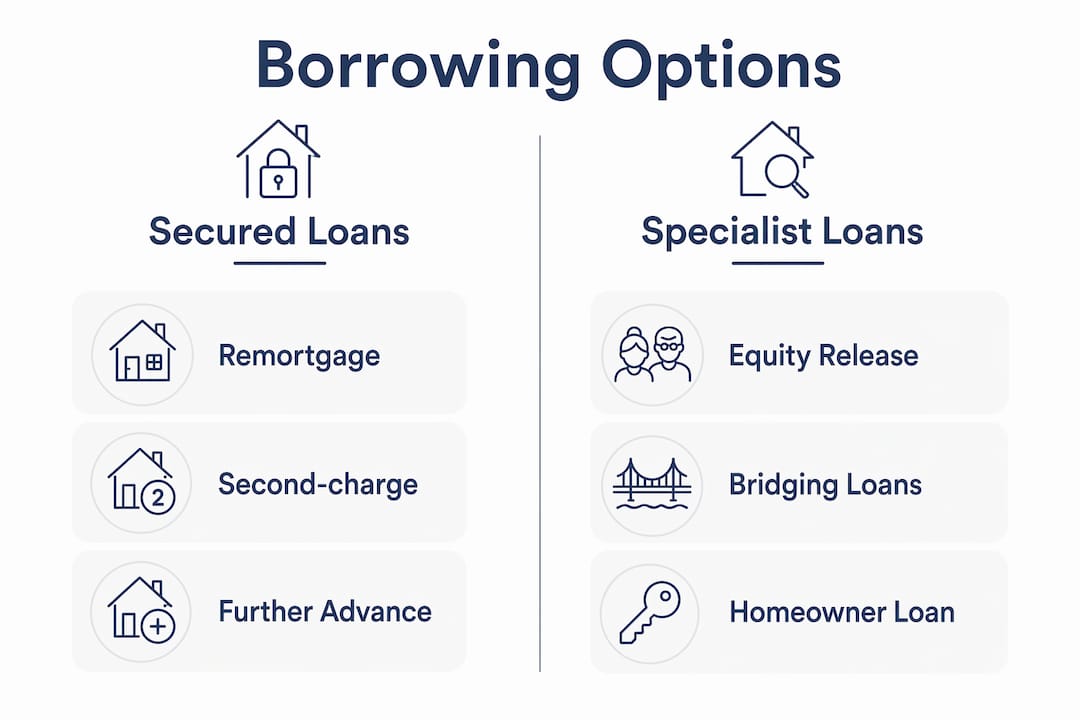
Most UK homeowners can borrow against their home, using the equity they have built up as security for a loan. The main routes are a remortgage (cash-out), a second-charge or homeowner loan, a further advance from your existing lender, or equity release if you are aged 55 or over. Your home is at risk if you cannot keep up repayments, so understanding the options before you apply matters.
The Financial Conduct Authority regulates all these products in the UK. MoneyHelper provides free, impartial guidance on each route. Loanable, as a specialist secured loan broker, can help you compare options across a wide panel of lenders, including specialist lenders for adverse credit cases. Lenders typically cap combined loan-to-value (LTV) at a high percentage, meaning the total of your mortgage plus any new secured borrowing cannot usually exceed most lenders’ limits of your property’s value.
The three main borrowing routes at a glance:
- Remortgage (cash-out): Replace your existing mortgage with a larger one and take the difference as cash. Suits borrowers whose fixed rate is ending or who want a single payment.
- Second-charge / homeowner loan: A separate secured loan sitting alongside your existing mortgage. Suits borrowers who want to keep their current mortgage deal.
- Further advance: Additional borrowing from your existing mortgage lender, added to your current mortgage. Suits borrowers happy with their lender and wanting simplicity.
- Equity release (lifetime mortgage): Available to homeowners aged 55 and over. No monthly repayments required, but interest rolls up and reduces the estate.
Table of Contents
- What does ‘borrowing against your home’ mean and how is equity calculated?
- What are the main ways to borrow against your property?
- How much can you borrow against your home?
- What costs and fees should you expect?
- Who qualifies for secured borrowing and what do lenders check?
- What are the benefits and risks of securing borrowing on your home?
- How do you apply and what is the typical timeline?
- How Loanable can help you access secured borrowing
- Key takeaways
- A practical note on borrowing against your home
- Loanable: secured lending support for UK homeowners
- Further reading and authoritative sources
What does ‘borrowing against your home’ mean and how is equity calculated?
Borrowing against your home means using the ownership stake you hold in your property as security for a loan. If you default, the lender can enforce a legal charge on your home.
Equity is the difference between your property’s current market value and the total of any outstanding secured borrowing against it.
Worked example:
- Property value: £350,000
- Outstanding mortgage: £200,000
- Equity: £150,000
Not all of that equity is available to borrow. Lenders use combined LTV to set the maximum they will lend. If a lender caps combined LTV at 80%, the most you could borrow in total (mortgage plus new loan) is £280,000. With £200,000 already owed, the maximum additional borrowing would be £80,000.
Key terms:
- Equity: The share of your property’s value you own outright, after deducting secured debts.
- Combined LTV: The ratio of all secured borrowing (existing mortgage plus any new loan) to the property’s current market value, expressed as a percentage.
The higher your equity and the lower your LTV, the more options you will have and the better the rates you are likely to be offered.
What are the main ways to borrow against your property?
Each product works differently and suits a different set of circumstances. Here is a plain comparison.
| Product | Best for | Typical LTV range | Typical term | Main drawback |
|---|---|---|---|---|
| Remortgage (cash-out) | Borrowers whose fixed rate is ending; larger sums | Up to 85% combined | 2–30 years | Early repayment charges on existing deal; longer process |
| Second-charge / homeowner loan | Keeping an existing mortgage deal; adverse credit | Up to 85% combined | 3–25 years | Higher rate than a first-charge mortgage |
| Further advance | Simplicity; staying with existing lender | Up to 85% combined | Matches mortgage term | Limited to one lender’s rates |
| Equity release (lifetime mortgage) | Homeowners aged 55+; no monthly repayments | Varies by age/product | Lifetime | Interest rolls up; reduces inheritance |
| Bridging loan | Short-term funding gaps; property purchase | Up to 75% combined | 1–24 months | Expensive; must have a clear exit strategy |
Remortgage (cash-out)
A remortgage replaces your current mortgage with a new, larger one. You receive the difference between the old balance and the new loan as cash. It works well when your fixed-rate deal is ending and you want to avoid early repayment charges (ERCs). For home refinancing purposes, it can also consolidate other secured debts into one payment. The main drawback: if you are mid-deal, ERCs can make this expensive.

Second-charge / homeowner loan
A second-charge mortgage sits alongside your existing mortgage as a separate loan. Because it does not disturb your first mortgage, it is the right choice when your current rate is competitive and breaking it would cost more than the benefit of a lower second-charge rate. Lenders can typically advance loans starting from around £5,000 up to £500,000, subject to combined LTV limits set by the lender. Specialist lenders on panels like Loanable’s also consider applicants with CCJs, defaults or mortgage arrears, because the property security reduces their risk.
When to choose a second-charge loan:
- You have a low fixed rate you do not want to lose.
- You need funds quickly, with many lender completions possible within a few weeks.
- You have adverse credit and need a specialist lender.
Further advance
Your existing mortgage lender lends you more money, usually at a rate linked to their current product range. It is the simplest route administratively, but you are limited to one lender’s criteria and pricing. If their rates are not competitive, a second-charge loan or remortgage will likely be cheaper.
Equity release (lifetime mortgage)
Available only to homeowners aged 55 and over. No monthly repayments are required; instead, interest compounds and is repaid when the property is eventually sold. The long-term cost can be significant. Always take independent financial advice before proceeding, and check that the product carries the Equity Release Council’s standards.
Bridging loans
Short-term, high-cost finance typically used to bridge a gap between buying and selling a property. Terms run from one to 24 months. They require a clear, credible exit strategy (usually a sale or remortgage). Not suitable for general borrowing needs.
How much can you borrow against your home?

The maximum is set by two things: your combined LTV and your affordability.
The formula:
Maximum total secured borrowing = property value × lender’s LTV cap
Maximum new loan = maximum total secured borrowing − existing mortgage balance
Lenders also stress-test affordability by adding roughly 3–5 percentage points to the product rate when calculating whether you can sustain repayments. Passing that test is as important as having sufficient equity.
Two worked examples
Example 1: Larger property, moderate mortgage
- Property value: £400,000
- Lender’s combined LTV cap: 80%
- Maximum total secured borrowing: £320,000
- Existing mortgage balance: £180,000
- Maximum additional loan: £140,000
Example 2: Smaller property, higher mortgage
- Property value: £220,000
- Lender’s combined LTV cap: 75%
- Maximum total secured borrowing: £165,000
- Existing mortgage balance: £140,000
- Maximum additional loan: £25,000
| Example 1 | Example 2 | |
|---|---|---|
| Property value | £400,000 | £220,000 |
| LTV cap | 80% | 75% |
| Max total secured borrowing | £320,000 | £165,000 |
| Existing mortgage | £180,000 | £140,000 |
| Max new loan | £140,000 | £25,000 |
Figures you need before you apply:
- Current market value (get a recent estate agent valuation or use a surveyor).
- Exact outstanding mortgage balance (from your latest mortgage statement).
- Your target LTV (check what lenders in your credit tier typically accept).
- Monthly income and outgoings (for affordability checks).
Lenders also require a minimum post-loan equity of around 15–25% after the new borrowing is in place. That minimum equity buffer is a separate constraint from the LTV cap and can reduce the usable figure further.
Borrowing Calculator
See how much you could potentially borrow against your home, subject to status.
Please enter a property value that's higher than your outstanding mortgage balance.
Based on your figures, the amount available is below our typical minimum loan of £25,000. Get in touch and we'll talk through your options.
Get my free, no-obligation quoteIllustrative only, based on a maximum combined loan-to-value of 75%. This is not a loan offer or a quote, and your actual rate, borrowing amount and monthly payment will depend on your circumstances, credit profile and the lender's criteria. Think carefully before securing other debts against your home. Your home may be repossessed if you do not keep up repayments on your mortgage or any other debt secured on it.
What costs and fees should you expect?
Secured borrowing against your home carries several layers of cost. Understanding each one before you sign prevents surprises.
Typical cost categories:
- Interest rate / APRC: The Annual Percentage Rate of Charge (APRC) includes compulsory fees and gives the most accurate like-for-like comparison between products.
- Arrangement fee: Typically £495–£1,995 depending on the product and lender.
- Valuation fee: The lender will instruct a valuation of your property; costs vary by property value.
- Legal fees: A solicitor registers the new charge at HM Land Registry. Some lenders offer a free legal service; others require you to instruct your own.
- Broker fee: Some brokers charge a fee on completion; others are paid by commission from the lender. Confirm this upfront.
- Early repayment charges (ERCs): If you repay or refinance before the end of a fixed-rate period, ERCs can add thousands to the cost.
- Exit fees: Some products charge an administration fee on full repayment.
Why term length matters:
A longer repayment term reduces your monthly payment but increases the total interest paid. On a £50,000 loan, stretching from a 10-year to a 20-year term can roughly double the total interest cost, even at the same rate. Match the term to the purpose: a home improvement that adds lasting value may justify a longer term; a short-term cash need generally should not be spread over 20 years.
Who qualifies for secured borrowing and what do lenders check?
Eligibility checklist:
- Homeowner status: You must own a property in the UK with a registered title.
- Minimum age: Typically 18; equity release requires age 55 or over.
- Sufficient equity: Lenders require a minimum of around 15–25% equity to remain after the new loan is added.
- Proof of income: Payslips, self-assessment tax returns, pension statements or other evidenced income sources.
- Affordability: Lenders assess income against outgoings and stress-test repayments at a higher rate.
- Property type and location: Standard construction residential properties in England, Wales, Scotland or Northern Ireland are accepted by most lenders. Non-standard construction (e.g. timber frame, prefabricated) may restrict your options.
- Credit history: Clean credit profiles attract the best rates. Adverse credit (CCJs, defaults, arrears) is accepted by specialist lenders at higher rates.
Common reasons applications fail
- Insufficient equity after accounting for the new loan.
- Income that cannot be evidenced or is too irregular to pass affordability checks.
- Property in poor condition or of non-standard construction.
- Outstanding legal charges or disputes on the title.
- Debt-to-income ratio too high after stress-testing.
Pro Tip: Gather your last three months’ payslips or your most recent two years’ self-assessment returns, your latest mortgage statement, a recent bank statement, and a form of photo ID before you approach a lender or broker. Having these ready cuts processing time significantly.
What are the benefits and risks of securing borrowing on your home?
Benefits
- Lower rates than unsecured borrowing: Because the lender holds a charge on your property, rates are typically lower than on personal loans or credit cards for equivalent sums.
- Access to larger amounts: Homeowner loans can range from around £5,000 to £500,000, far beyond typical unsecured limits.
- Longer repayment terms: Repayment terms can extend over many years, which reduces monthly payments.
- Accessible for adverse credit: Specialist lenders accept applicants with CCJs or defaults because the property reduces their risk.
Risks
- Repossession: If you cannot keep up repayments, the lender can take possession of your home. This is the most serious risk and applies to every secured product.
- Total interest cost: Longer terms mean more interest paid overall, even at a lower rate.
- Effect on inheritance: Secured borrowing reduces the equity your beneficiaries will receive.
- Impact on benefits: Releasing equity may affect means-tested benefits. Check with an adviser before proceeding.
- Fees and charges: ERCs, arrangement fees and legal costs add to the true cost of borrowing.
Warning: Your home may be repossessed if you do not keep up repayments on a mortgage or any other debt secured on it. If you are struggling with debt, contact StepChange or National Debtline for free advice before taking on additional secured borrowing.
Pro Tip: If your project has a short horizon (under three years), compare the total cost of a personal loan against a secured loan before committing. A personal loan at a higher rate over three years can cost less in total than a secured loan stretched over ten, once fees are included.
Using home equity for investment purposes, such as a buy-to-let deposit, increases your leverage and requires careful stress-testing of rental yields and mortgage coverage ratios before proceeding.
How do you apply and what is the typical timeline?
Step-by-step application process
- Check your equity. Use your latest mortgage statement and a current property valuation to calculate your available equity and likely LTV.
- Choose a product type. Decide whether a second-charge loan, remortgage, further advance or equity release best fits your circumstances.
- Use an eligibility check. A soft-search eligibility check (which does not affect your credit file) lets you see likely options before a full application.
- Instruct a broker or apply directly. A broker with access to a wide lender panel, such as Loanable, can compare rates across multiple lenders simultaneously.
- Formal application and valuation. The lender instructs a valuation of your property and carries out full credit and affordability checks.
- Legal charge registration. A solicitor registers the lender’s charge at HM Land Registry. Some lenders provide a free legal service for straightforward cases.
- Funds released. Once the charge is registered and all conditions are met, funds are transferred.
Typical timelines
- Second-charge / homeowner loan: 2–4 weeks for straightforward cases; some lenders can complete in as few as 10 working days.
- Remortgage (cash-out): Typically 4–8 weeks, depending on lender workload and property complexity.
- Equity release: Generally longer; allow 6–12 weeks, as independent financial advice is mandatory.
Delays most commonly arise from slow property valuations, title issues, or incomplete documentation from the applicant.
Questions to ask your lender or broker
- What is the full APRC, including all compulsory fees?
- Are there early repayment charges, and if so, for how long?
- Does the lender accept my credit profile?
- Will the eligibility check or full application affect my credit file?
- Can you provide a full written cost illustration before I commit?
Documents to prepare:
- Photo ID (passport or driving licence).
- Proof of address (utility bill or bank statement, dated within three months).
- Latest mortgage statement.
- Three months’ payslips or two years’ self-assessment tax returns.
- Three months’ bank statements.
- Details of any county court judgements (CCJs) or outstanding charges on the title.
How Loanable can help you access secured borrowing
Loanable is a specialist broker for secured homeowner loans and second-charge mortgages in the UK. Its role is to match your circumstances to the right lender from a wide panel, including specialist lenders who consider applicants with adverse credit histories such as CCJs, defaults or mortgage arrears.
That track record is relevant when your case is not clean-cut. A CeMAP-qualified adviser understands how different lenders price risk, which means they can identify realistic options rather than sending you to lenders likely to decline.
Pro Tip: Use Loanable’s eligibility check before submitting a full application. It uses a soft search that does not leave a mark on your credit file, so you can gauge your options without affecting your score.
Practical next steps with Loanable:
- Run an eligibility check to see likely options without affecting your credit file.
- Prepare the documents listed in the application section above.
- Ask for a full written cost illustration, including APRC and all fees, before you proceed.
- If you are consolidating unsecured debts, review Loanable’s debt consolidation loans page for specific guidance on that use case.
Key takeaways
UK homeowners can borrow against their property using a remortgage, second-charge loan, further advance, or equity release, with combined LTV caps typically set at 75–85% and repossession the primary risk if repayments are not maintained.
| Point | Details |
|---|---|
| Equity is the starting point | Calculate property value minus outstanding mortgage to find your usable equity before approaching any lender. |
| Combined LTV caps your maximum | Most lenders cap total secured borrowing at 75–85% of property value; minimum post-loan equity of 15–25% applies. |
| Compare APRC, not just rate | APRC includes compulsory fees and gives the only accurate like-for-like comparison between secured loan products. |
| Repossession risk is real | Your home can be repossessed if you default; seek free debt advice from StepChange or National Debtline if in difficulty. |
| Loanable for complex cases | Loanable’s CeMAP-qualified advisers and specialist lender panel have funded over £53 million in secured loans for UK homeowners. |
A practical note on borrowing against your home
The most common mistake I see is homeowners borrowing the maximum their equity allows, rather than the maximum their budget can comfortably sustain. Lenders stress-test at higher rates for a reason: your circumstances can change. Before you commit, run your own affordability check at a rate 3–5 percentage points above the product rate and confirm the monthly payment is manageable under that scenario.
Second-charge loans are frequently the right answer for borrowers with a competitive existing mortgage rate. Breaking a 1.5% fixed deal to remortgage at today’s rates, just to access cash, rarely makes financial sense once you account for ERCs and the higher rate on the full balance. A second-charge loan at a higher rate on a smaller sum often costs less in total.
Get a full written illustration from any lender or broker before you sign. Compare the total amount repayable, not just the monthly figure. And if your situation involves significant debt or financial difficulty, speak to a free debt adviser before adding secured borrowing.
Loanable: secured lending support for UK homeowners
Loanable gives UK homeowners direct access to a wide panel of secured loan lenders, including specialists who accept adverse credit, without the need to approach multiple lenders individually. CeMAP-qualified advisers handle the comparison and application process, and eligibility checks are available without affecting your credit file.

Whether you need funds for home improvements, debt consolidation, or another legal purpose, Loanable’s advisers can identify the most suitable product for your circumstances and provide a full written cost illustration before you commit. The service covers second-charge mortgages, homeowner loans, and secured loans across the UK.
Eligibility checks do not affect your credit score. To see your options, visit Loanable’s secured loans page or run a check directly at loanable.co.uk.
This article provides general information only and is not financial or legal advice. Confirm current rates, eligibility criteria, and suitability for your own situation with a qualified adviser or the relevant regulatory body before proceeding.
Further reading and authoritative sources
- MoneyHelper — Free, impartial consumer guidance on mortgages, secured loans and equity release, including calculators and product definitions.
- Financial Conduct Authority (FCA) — The UK regulator for mortgage and secured loan products; check that any lender or broker you use is FCA-authorised.
- StepChange Debt Charity — Free debt advice for anyone concerned about affordability before or after taking on secured borrowing.
- National Debtline — Free, confidential debt advice for people in England, Wales and Scotland; useful if you are considering secured borrowing to manage existing debts.
- Experian: borrowing against your home — Plain-language overview of the main secured borrowing options for UK homeowners, including product comparisons and eligibility guidance.