



Secured-loan LTV is the percentage of your property’s market value that a lender will lend against. It sets your borrowing ceiling and your interest rate in one number. Lower LTV means cheaper borrowing and a smoother approval. Higher LTV means higher rates, stricter checks, and sometimes outright refusal.
Before you apply, three things are worth doing now:
- Calculate your current LTV using the formula below
- Check how much equity you hold after any existing mortgage
- Gather your income documents, property deeds, and (if self-employed) your SA302s
Table of Contents
- What does loan-to-value mean for a secured loan?
- How to calculate your secured-loan LTV with worked examples
- What LTV limits do UK lenders typically set?
- How does LTV affect your interest rate and approval chances?
- Costs, risks, and consumer protections for secured borrowing
- What are your options if you lack sufficient equity?
- How to apply for a secured loan: steps and typical timeline
- Red flags to check before you sign a secured-loan agreement
- How Loanable works and what sets it apart
- Key takeaways
- A practical perspective on LTV from a secured-lending adviser
- Loanable’s secured-loan service: how it works for you
- Useful sources and further reading
What does loan-to-value mean for a secured loan?
LTV, or loan-to-value ratio, is the loan amount expressed as a percentage of the collateral’s market value. For a secured homeowner loan, the collateral is almost always your property.
The formula is straightforward:
LTV = (Loan amount ÷ Property market value) × 100
So if your home is worth £250,000 and you want to borrow £50,000 on top of an existing £150,000 mortgage, the combined figure is £200,000. Divide by £250,000 and you get an 80% combined LTV.
Secured-loan LTV differs from a standard first-charge mortgage LTV in one important way. When a second loan is added to a property that already has a mortgage, lenders calculate the combined loan-to-value (CLTV). CLTV accounts for all secured borrowing against the property, not just the new loan. A borrower with a 60% first-charge mortgage and a new 15% second-charge loan has a CLTV of 75%, even though the new loan alone looks modest.
The higher the LTV ratio, the riskier the loan is for a lender — and that risk is priced directly into your interest rate.
How to calculate your secured-loan LTV with worked examples
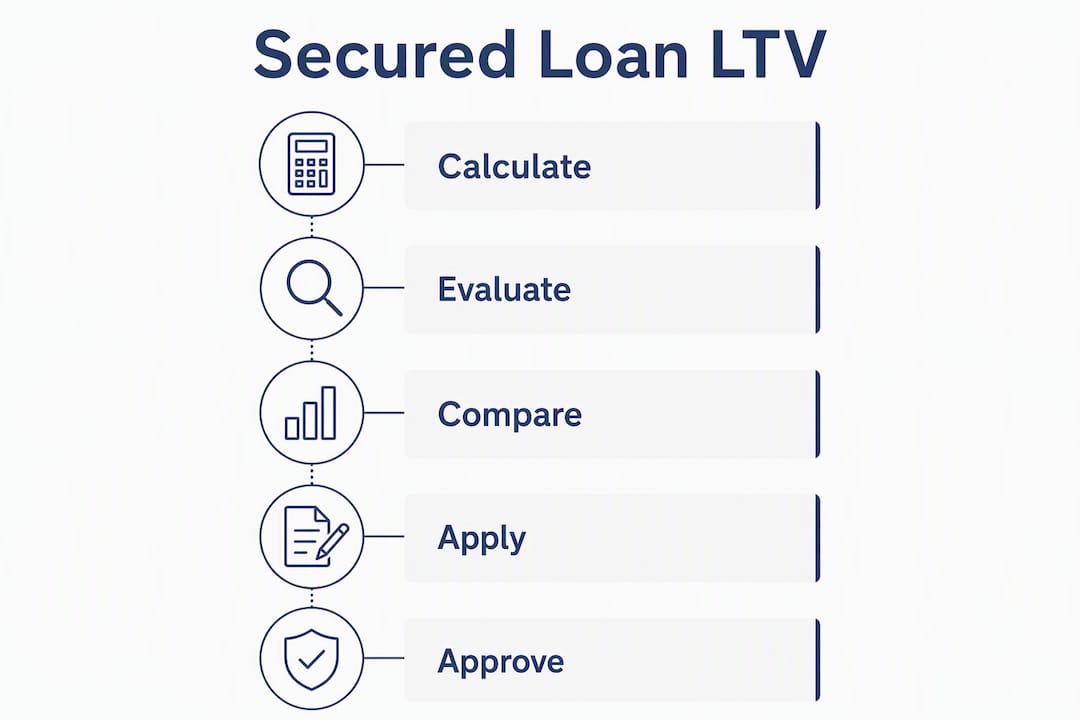
Follow three steps for any secured-loan LTV calculation.
- Establish the current market value of the collateral. For residential property, this is the figure a RICS-registered valuer assigns, not the price you paid or a portal estimate.
- Add all existing secured borrowing on the same asset if you are calculating CLTV. Include your outstanding mortgage balance and any other secured loans.
- Divide the total secured debt (existing plus new loan) by the market value, then multiply by 100.
The table below shows two worked examples side by side.
| Scenario | Property value | Existing mortgage | New loan | Total debt | LTV / CLTV |
|---|---|---|---|---|---|
| Homeowner (residential) | — | — | — | — | 70% CLTV |
| Small business (commercial) | — | £200,000 | — | — | 60% CLTV |
In the homeowner example, the borrower holds £90,000 of equity after the new loan. In the business example, the owner retains £200,000 of equity. Both sit below the 80% threshold that most mainstream lenders treat as the boundary for standard pricing.
For business borrowers, the asset class matters as much as the percentage. Business secured-loan LTV ranges vary by collateral type: residential real estate typically attracts 70–80% LTV, machinery 50–70%, and inventory lower still because it is harder to sell quickly.
Pro Tip: Use an online LTV calculator or the eligibility tool below to cross-check your manual calculation before you speak to a lender. A small arithmetic error on CLTV can shift you from one pricing band to another.
Borrowing Calculator
See how much you could potentially borrow against your home, subject to status.
Please enter a property value that's higher than your outstanding mortgage balance.
Based on your figures, the amount available is below our typical minimum loan of £25,000. Get in touch and we'll talk through your options.
Get my free, no-obligation quoteIllustrative only, based on a maximum combined loan-to-value of 75%. This is not a loan offer or a quote, and your actual rate, borrowing amount and monthly payment will depend on your circumstances, credit profile and the lender's criteria. Think carefully before securing other debts against your home. Your home may be repossessed if you do not keep up repayments on your mortgage or any other debt secured on it.
What LTV limits do UK lenders typically set?
Most lenders require a substantial equity stake for secured loan products, which generally translates to a maximum LTV commonly treated as a boundary for better rates. The more equity you hold, the more you can borrow and the better the rate you are likely to receive.

The table below shows typical LTV ranges by lender type.
| Lender type | Typical max LTV | Minimum equity |
|---|---|---|
| High-street mortgage lender | around 80% | at least 20% |
| Specialist secured-loan lender | up to 80% or slightly higher (with stricter conditions) | 20–25% |
| Commercial / business lender | typically 70–80% for real estate, lower for other asset types | 20–30%, varies by asset and lender |
Specialist lenders can sometimes accept higher LTVs, but those offers usually come with higher rates and stricter conditions. Different asset types attract different LTV ceilings: marketable securities can attract LTVs up to 90%, while inventory may sit around 50% because of its lower liquidity.
80% is the common threshold. Lenders frequently use 80% LTV as the boundary for favourable terms. Above it, rates rise and additional conditions often apply.
In the UK, residential mortgage LTV ratios often vary moderately, with fewer products available at the higher LTV levels. For secured second-charge loans, the ceiling is usually lower than for a first-charge mortgage on the same property.
How does LTV affect your interest rate and approval chances?
A lower LTV results in more favourable interest rates and easier approval. Lenders treat LTV as their primary risk measure for secured lending. The less of the property’s value they are lending against, the smaller their potential loss if the borrower defaults and the property has to be sold.
Beyond LTV, lenders check several other factors during underwriting:
- Affordability: monthly repayments must be sustainable against your verified income
- Credit history: missed payments, CCJs, or defaults affect the rate offered, though specialist lenders can still help
- Debt-to-income ratio: total monthly debt obligations as a share of gross income
- Property valuation: an independent valuer confirms the market value used in the LTV calculation
- Employment status: employed, self-employed, and retired borrowers are assessed differently
CLTV can change an outcome even when the new loan alone looks low-risk. A borrower adding a £20,000 loan to a property with a large existing mortgage may find their CLTV pushes them above a lender’s threshold, triggering a higher rate or a declined application. Lenders prioritise CLTV over single-loan LTV when there is existing secured debt on the same asset.
Higher LTVs may also lead to additional costs such as mortgage insurance or lender-imposed conditions, which increase the total cost of borrowing beyond the headline rate.

Costs, risks, and consumer protections for secured borrowing
Secured loans carry specific costs beyond the interest rate.
- Valuation fee: typically charged upfront to cover the independent property assessment
- Arrangement fee: some lenders charge this for setting up the loan; it can be added to the loan or paid separately
- Early-repayment charges (ERCs): fixed-rate secured loans often carry penalties for repaying early, sometimes calculated as a percentage of the outstanding balance
- Legal fees: a solicitor may be required to register the charge against your property
The principal risk is repossession. If you cannot maintain repayments, the lender can apply to repossess and sell your property to recover the debt. This applies even if the property is your home.
Before signing, check your affordability carefully. The FCA requires regulated lenders to carry out affordability assessments, but the responsibility for sustainable borrowing ultimately rests with you. MoneyHelper (moneyhelper.org.uk) and Citizens Advice offer free, impartial guidance on whether a secured loan is the right choice for your situation.
Loanable operates as a regulated broker. Any advice given by a CeMAP-qualified adviser is subject to FCA oversight, which means you have access to the Financial Ombudsman Service if something goes wrong.
This article is general information, not financial advice. Confirm current lending criteria and your own eligibility with a qualified adviser or the relevant regulatory body before proceeding.
What are your options if you lack sufficient equity?
If your LTV is too high for a standard secured loan, several alternatives are worth considering.
- Second-charge mortgage: a loan secured on your property behind the first mortgage. It uses the same collateral but is assessed on CLTV. Loanable offers second-charge mortgage options for homeowners who need to raise funds without remortgaging.
- Remortgage: switching your existing mortgage to a new deal and releasing equity at the same time. This can lower your overall rate but resets your mortgage term and may trigger ERCs on your current deal.
- Unsecured personal loan: no collateral required, so LTV is irrelevant. Borrowing limits are lower and rates are typically higher, but there is no repossession risk.
- Guarantor loan: a third party (usually a family member) guarantees repayment. This can help where equity is thin, but the guarantor’s assets or credit are at risk if you default.
- Debt consolidation: rolling multiple debts into a single secured loan can reduce monthly outgoings, though extending the term increases total interest paid. Loanable’s debt consolidation loans are structured for homeowners looking to simplify repayments.
For business borrowers, a commercial loan against property may offer higher LTV than a personal secured loan. A partner guide on commercial loans against property sets out the key considerations for business owners.
Unsecured and guarantor options are short-term fixes for most borrowers. If the underlying equity gap is structural, improving LTV before applying is a more durable solution.
How to apply for a secured loan: steps and typical timeline
The process from eligibility check to completion usually takes two to six weeks, depending on valuation speed and document readiness.
- Eligibility check (day 1): a soft credit search confirms whether you are likely to qualify. This does not affect your credit score.
- Document submission (days 1–3): provide proof of income (payslips or SA302s), bank statements, proof of identity, and property deeds or mortgage statements.
- Valuation (days 3–10): a RICS-registered valuer assesses the property’s current market value. This figure determines the LTV used in underwriting. The valuer is independent of the lender.
- Underwriting (days 7–14): the lender reviews affordability, credit history, and the valuation report. Self-employed borrowers should provide two to three years of SA302s and HMRC tax year overviews to speed this stage.
- Formal offer (days 14–21): if approved, the lender issues a binding offer. You have a statutory 7-day reflection period before you are required to sign.
- Completion (days 21–42): funds are released once legal checks are complete and the charge is registered against the property.
Pro Tip: Self-employed borrowers who provide three years of SA302s alongside their HMRC overviews and business accounts at the point of application consistently move through underwriting faster than those who submit documents in stages.
The valuer’s role is central. Lenders will not accept a borrower’s own estimate of property value. If the valuation comes in lower than expected, the LTV rises and the offer may change. Commissioning a pre-application desktop valuation can flag this risk early.
Red flags to check before you sign a secured-loan agreement
Not every secured-loan offer is straightforward. Watch for these warning signs.
Contractual red flags:
- Hidden fees not disclosed in the initial illustration (check the APRC, not just the headline rate)
- Unclear or absent early-repayment charge schedule
- A second charge registered without your explicit written consent
Behavioural red flags:
- Pressure to sign before the statutory reflection period ends
- An adviser who is not FCA-registered (check the FCA register at register.fca.org.uk)
- A valuation figure that seems unusually high and has not been conducted by an independent RICS valuer
Three things to verify on the paperwork before you sign:
- Confirm the total amount repayable, not just the monthly payment
- Check that the charge type (first or second) matches what you agreed
- Verify that the lender is authorised and regulated by the FCA
How Loanable works and what sets it apart
Loanable has funded over £53 million in secured loans for UK borrowers, including homeowners with adverse credit histories who were declined elsewhere. All advisers hold CeMAP qualifications, the industry-standard credential for mortgage and secured-lending advice in the UK.
Key proof points:
- CeMAP-qualified advisers assess your LTV position and match you to lenders from a wide panel
- Adverse credit accepted: Loanable works with specialist lenders who consider applications that high-street banks decline
- Eligibility checks do not affect your credit score
- 5-star client ratings reflect consistent outcomes for borrowers across a range of LTV positions
- £53 million funded across homeowner loans, second-charge mortgages, and debt consolidation
Loanable’s lender panel includes both mainstream and specialist providers, which means borrowers at higher LTV levels are not automatically excluded. The match between your LTV, credit profile, and lender criteria is assessed individually.
For homeowners and business borrowers who want to understand their options before committing, check your eligibility with Loanable. The check is soft, takes minutes, and carries no obligation.
Key takeaways
Secured-loan LTV is the single most important number in your application: it sets your borrowing limit, your interest rate, and whether a mainstream or specialist lender is the right fit.
| Point | Details |
|---|---|
| LTV formula | Divide total secured debt by property market value and multiply by 100. |
| Typical UK threshold | Many lenders treat around 80% LTV as a common threshold for best interest rates; below that level usually means better terms. |
| Minimum equity | Most lenders expect at least 20% equity before approving a secured loan. |
| CLTV matters | Always calculate combined LTV when an existing mortgage is already secured on the property. |
| Loanable | CeMAP-qualified advisers match borrowers to lenders across a wide panel, including options for higher LTV and adverse credit. |
A practical perspective on LTV from a secured-lending adviser
Most borrowers focus on the loan amount they need. The number that actually determines whether they get it, and at what cost, is the LTV. Two borrowers asking for the same £40,000 can receive very different offers if one has a 65% CLTV and the other has an 82% CLTV. The difference in rate between those two positions can be material over a five-year term.
The single most useful thing a borrower can do before applying is to get an accurate, current valuation of their property. Portal estimates and historic purchase prices are not reliable. A valuation that comes in lower than expected at the underwriting stage can change the offer or the rate. Knowing the real number in advance lets you plan around it rather than react to it.
For borrowers who are close to a lender’s LTV threshold, partial overpayment on the existing mortgage before applying can shift the CLTV enough to move into a better pricing band. Home improvements that genuinely increase market value can have the same effect, though the uplift needs to be confirmed by a valuer, not assumed.
Loanable’s secured-loan service: how it works for you
Loanable gives UK homeowners and business borrowers a direct route to secured-loan options matched to their LTV position, credit profile, and borrowing purpose.
The process starts with a soft eligibility check that does not affect your credit score. A CeMAP-qualified adviser then reviews your LTV, existing secured debt, and income to identify lenders from the panel most likely to approve your application at a competitive rate. This applies whether your LTV is comfortably below 80% or you need a specialist lender for a higher LTV position. Loanable has funded over £53 million in loans for UK borrowers, including those with adverse credit histories.
To get started, visit the secured loans page or go directly to check your eligibility now.
Useful sources and further reading
The following sources were used in preparing this article and are suitable for further research.
- What is a loan-to-value ratio and how does it relate to my costs? — Consumer Financial Protection Bureau (CFPB)
- Loan-to-value (LTV) ratio: what it is, how to calculate it — Investopedia
- Secured loan eligibility: lender criteria and how to get accepted — Money Saving Advisors
- What is the loan-to-value ratio? — BDC (Business Development Bank of Canada, useful for asset-class LTV definitions)
- Loan-to-value ratios and how they impact your loan — National Funding
- MoneyHelper — free, impartial money guidance backed by the UK government
- FCA register — verify that any lender or adviser is authorised and regulated
Valuations and lender policies change. These sources are starting points. Always confirm current criteria directly with a regulated lender or adviser before making a borrowing decision.