



If you want the cheapest borrowing over the long term and can switch your whole mortgage without large exit charges, remortgaging usually wins. If you are tied to a competitive fixed rate, need funds quickly, or have recent credit issues, a secured second-charge loan is often the more practical route.
Quick verdicts by situation:
- No early repayment charge (ERC) and a lower rate available — remortgage is likely cheaper overall.
- Mid-fix with a large ERC — a secured loan avoids breaking the deal and paying thousands in penalties.
- Poor credit or self-employed income — second-charge lenders tend to be more flexible than remortgage underwriters.
- Small borrowing need (under £25,000) — a secured loan usually has fewer set-up costs and completes faster.
- Large sum, strong equity, no ERC — remortgaging may save more over a 10–25 year term.
Loanable’s CeMAP-qualified advisers have helped homeowners across both routes, having funded over £53 million in secured loans. The sections below give you the detail to make the call yourself.
Table of Contents
- How do a remortgage and a secured loan compare?
- How each product actually works
- What does each option actually cost?
- Who qualifies, and how long does each option take?
- How to decide: a step-by-step checklist
- How to apply: process steps and realistic timelines
- Key takeaways
- The case for getting the numbers right before you decide
- How Loanable can help you find the right secured borrowing
- Useful sources and further reading
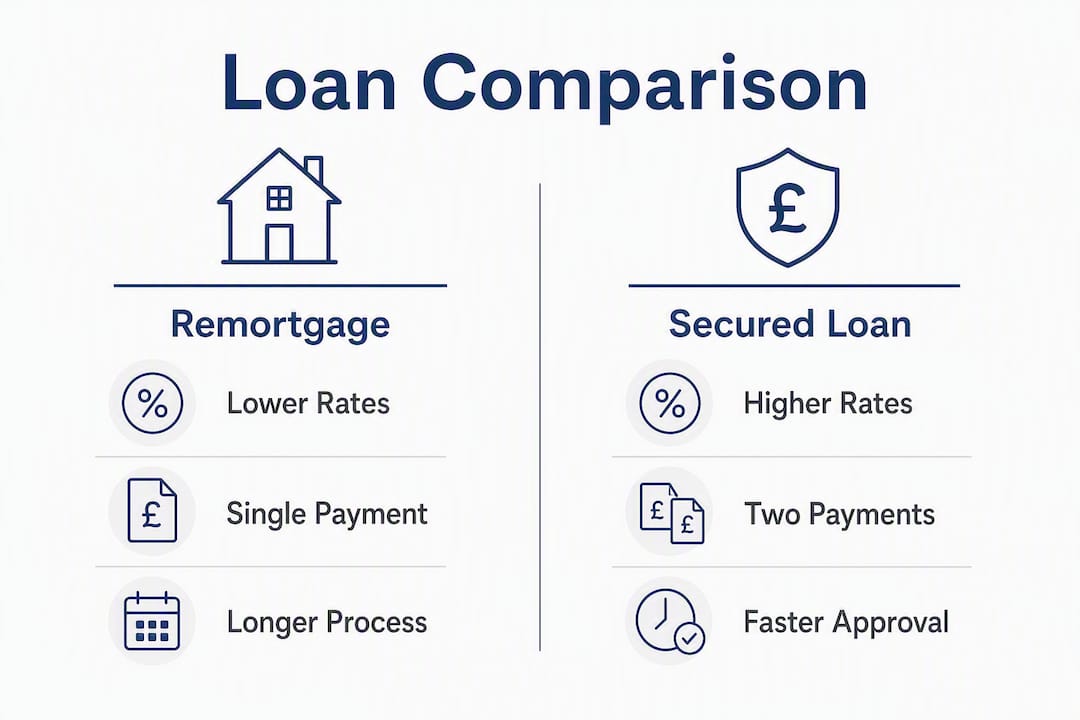
How do a remortgage and a secured loan compare?
| Remortgage | Secured (second-charge) loan | |
|---|---|---|
| Typical interest rate | Usually lower headline rate | Slightly higher, reflecting second-charge risk |
| Upfront costs | Arrangement fee, valuation, conveyancing | Fewer fees; often no conveyancing required |
| Early repayment charges | Can run to several thousand pounds mid-fix | Not applicable — existing mortgage stays intact |
| Total cost over time | Lower if no large ERC and borrowing is large | Can be lower when ERCs would wipe out rate savings |
| Eligibility | Full re-underwriting of whole mortgage | Second-charge only; more flexible on credit/income |
| Speed to funds | Typically 4–8 weeks | Often 2–4 weeks for smaller amounts |
| Impact on future plans | Resets mortgage term and lender relationship | Sits alongside mortgage; must be cleared on sale |
| Common use cases | Large sums, rate reduction, equity release | Debt consolidation, home improvements, one-off costs |

Financial advisers consistently note that headline rates do not tell the whole story. Fees and ERCs can shift the outcome entirely. The worked example in the costs section shows this clearly.
How each product actually works
A remortgage replaces your existing mortgage with a new one, either with your current lender (a product transfer) or a new lender entirely. You borrow the additional funds as part of the new, larger mortgage. Everything is consolidated into one monthly payment, one lender, and one set of terms.
A secured second-charge loan sits alongside your existing mortgage as a separate agreement. The lender takes a second charge over your property, meaning they rank behind your main mortgage lender if the property is ever sold or repossessed. Because second-charge lenders carry more risk, they price that in with a slightly higher rate.
In practice, this structure means two separate monthly payments. On a sale or repossession, the first-charge lender is paid in full before the second-charge lender receives anything. That hierarchy is why second-charge lenders run their own underwriting independently of your mortgage lender, and why their criteria can differ significantly.
Your home is at risk if you do not keep up repayments on either product.
What does each option actually cost?
The cost comparison is rarely as simple as comparing two interest rates. Both products carry their own cost stack.
Remortgage cost components:
- Advertised interest rate (applied to the full new mortgage balance)
- Arrangement or booking fee (often £999–£2,000)
- Valuation fee
- Conveyancing and legal fees (if switching lender)
- Early repayment charge on the existing mortgage — this is the critical one
Secured loan cost components:
- Advertised interest rate (applied to the loan amount only)
- Lender arrangement fee (typically lower than a remortgage)
- No conveyancing in most cases
- No ERC on the existing mortgage
Many lenders levy ERCs on fixed or discounted deals that can run to several thousand pounds, often wiping out the savings from a lower rate entirely.
Worked example — borrowing £20,000 with 3 years left on a fixed rate:
Suppose your existing mortgage carries an ERC at a certain percentage on the balance, resulting in a substantial exit charge before you have paid any remortgage fees. Even if the new remortgage rate saves you £80 per month versus a secured loan, it would take over four years just to recover that exit cost. A secured loan at a slightly higher rate, with no ERC and lower set-up fees, is cheaper for the period you remain on the fix.
Secured homeowner loans typically carry fewer set-up fees and avoid conveyancing costs, which makes them the lower-cost option for shorter borrowing horizons or smaller sums.
Use the calculator below to run your own numbers:
Borrowing Calculator
See how much you could potentially borrow against your home, subject to status.
Please enter a property value that's higher than your outstanding mortgage balance.
Based on your figures, the amount available is below our typical minimum loan of £25,000. Get in touch and we'll talk through your options.
Get my free, no-obligation quoteIllustrative only, based on a maximum combined loan-to-value of 75%. This is not a loan offer or a quote, and your actual rate, borrowing amount and monthly payment will depend on your circumstances, credit profile and the lender's criteria. Think carefully before securing other debts against your home. Your home may be repossessed if you do not keep up repayments on your mortgage or any other debt secured on it.
One further point on monthly payments: a secured loan spread over a shorter term will cost more per month than a remortgage extended over 20 years, but the total interest paid will be far lower. Always compare total repayment cost over the same period, not just the monthly figure.
Who qualifies, and how long does each option take?
Remortgaging requires full re-underwriting of your entire mortgage. The lender assesses your current income, outgoings, credit history, and the property value from scratch. If your circumstances have changed since you took out the original mortgage — a period of self-employment, a missed payment, or reduced income — you may find the remortgage criteria harder to meet than when you first borrowed.
Secured loans assess only the second charge. Because the sum is smaller and the lender’s exposure is limited to that slice of borrowing, underwriting criteria are often more flexible for self-employed borrowers or those with past credit issues. Loanable works with a network of lenders specifically experienced in this area, including options for borrowers with challenged credit histories.
On timing, a remortgage typically takes 4–8 weeks from application to completion, covering valuation, legal work, and lender underwriting. A secured loan for a smaller amount can often complete in 2–4 weeks, with fewer third-party steps involved.
Pro Tip: If your credit file has recent blips, use a broker to present your case to multiple second-charge lenders simultaneously rather than applying directly. A single declined application can affect your score; a broker’s soft-search approach avoids that. Loanable’s eligibility check does not affect your credit score.
How to decide: a step-by-step checklist
Work through these questions in order. The first answer that applies usually points to the right product.
- Do you have an ERC on your current mortgage? If yes, calculate the total exit cost before comparing rates. A large ERC almost always favours a secured loan.
- How much do you need to borrow? Smaller sums tend to be cheaper and faster via a secured loan. Larger sums over a long term may favour remortgaging.
- Is your current rate competitive? If you are on a low fixed rate, breaking it to remortgage at a higher rate makes no sense.
- What is your credit position? Recent arrears, defaults, or self-employed income with limited accounts — a second-charge lender is more likely to say yes.
- How much equity do you have? Both products require equity, but remortgage lenders typically want a lower loan-to-value ratio for the best rates.
- Are you planning to sell or remortgage within 2–3 years? A secured loan must be cleared on sale; factor that into your plan.
- What is the total repayment cost over the same period? Ask any lender or broker for the total amount repayable, not just the monthly payment or the headline rate.
Questions to ask your broker or lender before signing:
- What is the total amount repayable over the full term?
- What are the ERCs on the new product?
- Are there any solicitor or valuation costs I will pay directly?
- Can this secured loan be consolidated into a future remortgage?
- What happens to the second charge if I sell before the loan is repaid?
A CeMAP-qualified adviser is worth consulting when the numbers are close, your credit history is complicated, or you are borrowing a large sum. For straightforward cases with no ERC and good credit, an online calculator and a broker quote may be sufficient to make the call.
How to apply: process steps and realistic timelines
For a remortgage:
- Check your current mortgage for ERCs and the end date of any fixed period.
- Gather proof of income (payslips or accounts), bank statements, and ID.
- Get a Decision in Principle from the new lender.
- Instruct a solicitor for conveyancing (required when switching lender).
- Lender completes valuation and full underwriting.
- Exchange and completion.
For a secured loan:
- Check your available equity and current mortgage balance.
- Gather proof of income, recent bank statements, and ID.
- Use a broker to soft-search multiple lenders without affecting your credit score.
- Receive and compare offers; accept the most suitable.
- Lender completes valuation (often a desktop valuation for smaller amounts).
- Funds released.
| Stage | Remortgage (typical days) | Secured loan (typical days) |
|---|---|---|
| Application to Decision in Principle | 1–3 | 1–2 |
| Valuation | 5–10 | 3–7 |
| Underwriting | 10–20 | 7–8 |
| Legal / conveyancing | 10–20 | Not usually required |
| Total to funds | 4–8 weeks | 2–4 weeks |
Common hold-ups include title register issues, slow solicitor exchanges, and valuation delays on unusual properties. A broker like Loanable can chase lenders directly and flag problems early, which reduces the risk of a last-minute delay.
Key takeaways
A secured loan is usually the better short-term choice when ERCs apply; remortgaging wins on total cost when you can switch without large exit penalties and are borrowing a substantial sum.
| Point | Details |
|---|---|
| ERCs change the maths | Calculate the total exit cost before comparing interest rates — a large ERC can make a secured loan cheaper even at a higher rate. |
| Second-charge loans are faster | Secured loans typically complete in 2–4 weeks versus 4–8 weeks for a remortgage. |
| Credit flexibility matters | Second-charge lenders apply more flexible criteria for self-employed borrowers and those with past credit issues. |
| Compare total repayment cost | Monthly payments are misleading — always ask for the total amount repayable over the same period. |
| Loanable can help | Loanable’s CeMAP-qualified advisers have funded over £53 million in secured loans and offer a no-impact eligibility check. |
The case for getting the numbers right before you decide
Most borrowers focus on the interest rate. That is understandable — it is the number lenders put in the headline. But in practice, the decision between a remortgage and a secured loan turns on three things the rate does not show: the ERC on your existing deal, the total set-up costs, and how long you actually plan to hold the borrowing.
The scenario where a remortgage looks cheaper on paper but costs more in reality is common. A borrower with two years left on a fixed rate, a 2% ERC, and a £150,000 mortgage balance faces a £3,000 exit charge before a single fee is paid. A secured loan at a rate one or two percentage points higher, on a £20,000 borrowing, will often cost less over those two years in total.
The reverse is also true. Borrowers who are out of their fix, have significant equity, and need a large sum over a long term should not default to a secured loan just because it is faster. The rate differential compounds over 10 or 15 years into a meaningful sum.
The practical move is to run both calculations to the same end date, include all fees, and only then compare. That is exactly what a CeMAP-qualified broker does as standard. Your home is at risk if you do not keep up repayments on any secured borrowing, so getting the structure right from the start matters.
How Loanable can help you find the right secured borrowing

Loanable works as a broker for UK homeowners who need secured finance, including those with poor credit, self-employed income, or complex circumstances. Rather than applying to a single lender and hoping for the best, Loanable’s CeMAP-qualified advisers present your case across a network of lenders to find competitive terms suited to your situation.
The proof points are straightforward: Loanable has funded over £53 million in secured loans, holds a 5-star customer rating, and specialises in cases that mainstream lenders often decline. Whether you are consolidating credit card debt into a single secured loan, funding home improvements, or covering a large one-off cost, the process starts with an eligibility check that does not affect your credit score.
To find out which option suits your circumstances, check your eligibility with Loanable today.
This article is general information, not financial advice. Confirm current rates, fees, and eligibility rules with a qualified adviser or the relevant lender before making a decision.
Useful sources and further reading
- Secured loan vs remortgage — MoneyfactsCompare — independent guide covering rate comparisons and ERC considerations.
- Loanable secured loans overview — product detail and eligibility information for Loanable’s secured loan range.
- Improve your secured loan eligibility — Loanable — practical steps to strengthen an application.
- Debt consolidation loans — Loanable — guide to consolidating higher-cost debt using a secured homeowner loan.