



A long term secured loan is a loan secured against your property, repaid over a longer period than a standard personal loan, often several years. It suits UK homeowners who need to borrow a larger sum, want lower monthly payments, or are consolidating higher-cost unsecured debt into a single facility. If that describes your situation, check your eligibility with Loanable before approaching a lender directly.
Quick summary:
- Pro: Lower monthly payments than short-term borrowing; access to larger loan amounts than most unsecured products
- Con: Your home is at risk if you miss payments; total interest over a long term can be substantial
- Who should be cautious: Anyone already in financial difficulty, or whose equity is limited relative to existing mortgage debt
Pro Tip: Before you apply anywhere, get a clear figure for your available equity. Lenders base their maximum offer on loan-to-value, so knowing your equity saves time and sets realistic expectations.
Table of Contents
- What does a long term secured loan actually mean?
- How secured loans work in practice
- When does a secured loan make sense for you?
- What a long term secured loan typically costs
- Risks and protections you need to know about
- Who is eligible and what lenders assess
- How to apply: a step-by-step guide
- How to improve your chances and reduce the cost
- Alternatives worth considering before you commit
- Key takeaways
- A practical perspective on long term secured borrowing
- How Loanable can help you find the right secured loan
- Useful sources and further reading
What does a long term secured loan actually mean?
A secured loan places a legal charge on your property. If you stop making payments, the lender can apply to repossess and sell the property to recover what you owe. In exchange for that security, lenders typically offer lower interest rates and higher borrowing limits than unsecured personal loans.

“Long term” in the UK market generally means a repayment period of 5–25 years, though some products extend to 30 years. Short-term secured products, by contrast, tend to run for 1–5 years and are more common in bridging or development finance. The longer the term, the lower the monthly payment, but the more interest you pay overall.
Most homeowner secured loans in the UK are structured as second-charge mortgages. This means the loan sits behind your existing mortgage (the first charge) in priority order. A remortgage replaces your existing mortgage entirely; a second-charge loan sits alongside it.
Key distinctions at a glance:
- Unsecured personal loan: — No charge on property; typically capped at lower amounts and shorter terms; higher interest rates
Both second-charge mortgages and remortgages are regulated by the Financial Conduct Authority (FCA), and complaints can be escalated to the Financial Ombudsman Service. That regulatory framework gives UK borrowers meaningful protections that do not exist in every market.
How secured loans work in practice
The typical lifecycle runs as follows: you submit an application, the lender orders a property valuation, an offer is issued, a legal charge is registered at HM Land Registry, and funds are released. From initial enquiry to drawdown, a straightforward case usually takes a few weeks; complex title issues or slow solicitors can cause further delays.
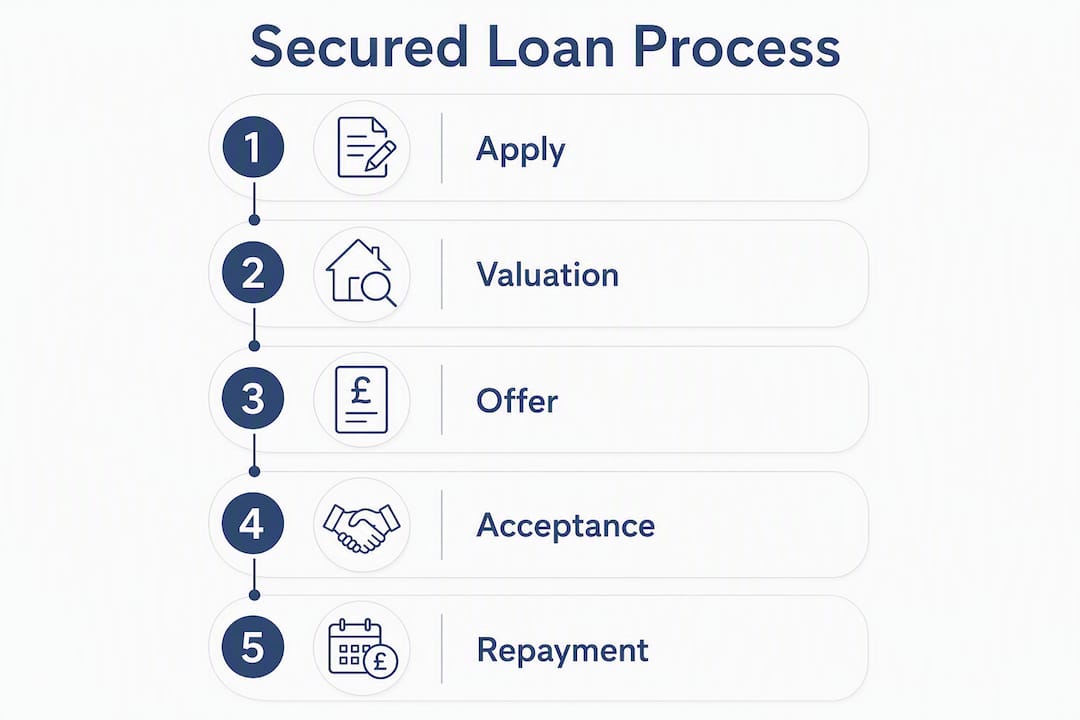
Loan-to-value (LTV) is the central constraint on how much you can borrow. If your home is worth £300,000 and your mortgage balance is £180,000, you have £120,000 in equity. Most lenders will lend up to a combined loan-to-value within a typical range across both the first and second charge.
Interest can be fixed or variable. A fixed rate gives certainty over monthly payments for the agreed term. A variable rate, often linked to the Bank of England base rate, can fall but can also rise. For longer terms, many borrowers prefer fixed rates to protect against payment increases over time.
Repayment types are either capital and interest (you repay both throughout the term, so the balance reduces each month) or interest-only (you pay only the interest monthly and repay the full capital at the end). Interest-only secured loans require a credible repayment vehicle and are less commonly offered to residential borrowers.
Common fees to expect:
- Arrangement or product fee (added to the loan or paid upfront)
- Valuation fee
- Solicitor or legal fees (often required for second-charge registration)
- Broker fee (where applicable)
- Early repayment charges (ERCs) if you repay before the agreed term ends
When does a secured loan make sense for you?
The most common reasons UK homeowners take a long-term secured loan are debt consolidation, home improvements, and large one-off expenses such as a wedding, vehicle purchase, or medical costs.

Debt consolidation is the most frequent use case. Replacing several high-rate credit cards or personal loans with a single secured facility can reduce monthly outgoings significantly. The trade-off is that previously unsecured debt becomes secured against your home, and spreading repayment over a longer term usually means paying more interest in total, even at a lower rate. Anyone considering this route should read the debt consolidation secured loan guide before proceeding.
Home improvements are a natural fit because the works may increase the property’s value, partially offsetting the borrowing. Lenders are generally comfortable with this purpose.
Large one-off expenses make sense where the sum required exceeds what an unsecured lender will offer, or where the rate on a secured product is materially lower.
| Use case | Why a secured loan is chosen | Key trade-off |
|---|---|---|
| Debt consolidation | Lower rate; single monthly payment | Unsecured debt becomes secured; longer-term interest cost |
| Home improvements | Larger amounts; potential uplift in property value | Repossession risk if payments missed |
| Large one-off expense | Access to sums unsecured lenders will not provide | Total interest over long term can exceed original benefit |
| Education or medical costs | Flexible purpose; competitive rate vs personal loan | Home at risk; consider whether a shorter term is viable |
When to seek regulated debt advice first: If you are consolidating debt because you are struggling to meet current payments, speak to a free debt adviser at StepChange or National Debtline before securing any debt against your home. A secured loan is not always the right solution for financial difficulty.
What a long term secured loan typically costs
APR (Annual Percentage Rate) is the figure to compare across lenders. It includes the interest rate plus most mandatory fees, expressed as an annual percentage of the amount borrowed. The nominal rate alone understates the true cost when arrangement fees are added.
Term length has a direct effect on total interest. A lower monthly payment over 20 years costs more in total than a higher payment over 10 years, even at the same rate. The table below uses illustrative figures to show how this plays out. These are examples only; your actual rate will depend on your credit profile, LTV, and lender criteria.
| Loan amount | Term | Illustrative rate (APR) | Est. monthly payment | Est. total repayable |
|---|---|---|---|---|
| £25,000 | 10 years | 7.5% | — | — |
| £25,000 | 15 years | 7.5% | — | — |
| £25,000 | 20 years | 7.5% | — | — |
| — | 20 years | 7.5% | — | — |
| — | 25 years | 7.5% | — | — |
These figures are illustrative only and do not constitute a quote. Your actual rate and repayment will differ. Always obtain a personalised illustration from a regulated lender or broker.
[loanable_borrowing_calculator]
Points to check before committing:
- Whether the APR quoted includes all mandatory fees or only the interest rate
- The size of any early repayment charge and how long it applies
- Whether extending the term reduces your monthly payment but materially increases total cost
- Whether the rate is fixed for the full term or only an initial period
Risks and protections you need to know about
The primary risk is repossession. If you miss payments and cannot reach an agreement with the lender, they can apply to a court to repossess your home. This applies even if your first-charge mortgage is up to date, because the second-charge lender has its own independent right to enforce.
Beyond repossession, there are four further risks worth understanding:
- Total interest cost: Longer terms substantially increase the amount of interest paid over the life of the loan, even at a competitive rate
- Impact on future borrowing: A second charge reduces your available equity and may affect remortgage options or further borrowing
- Negative equity: If property values fall, you could owe more than the property is worth across both charges
- Credit impact: Missed payments on a secured loan damage your credit record and make future borrowing harder
Consumer protections in the UK:
- The FCA requires lenders to carry out affordability assessments and to disclose APR clearly before you sign
- The Financial Ombudsman Service handles complaints if a lender or broker has treated you unfairly
- Citizens Advice provides free, impartial guidance on debt and financial products
- StepChange and National Debtline offer regulated debt advice at no cost
Request all offers and key facts in writing. Keep copies of every document, including the European Standardised Information Sheet (ESIS), which lenders are required to provide for second-charge mortgages. If something in the offer changes between illustration and completion, ask for a written explanation before proceeding.
Who is eligible and what lenders assess
Most lenders require applicants to be UK homeowners aged 18 or over (some set a minimum of 21 or 25), with sufficient equity in their property and a demonstrable ability to afford the repayments. Credit history matters, but a less-than-perfect record does not automatically disqualify you. Lenders set their own criteria, and some specialise in borrowers with adverse credit.
Main underwriting criteria:
- Income and affordability: Lenders stress-test repayments against your income; they will check that the new payment, alongside your mortgage and other commitments, is affordable
- Equity and LTV: The combined LTV across first and second charge must fall within the lender’s maximum (commonly 75–85%)
- Credit history: County Court Judgements (CCJs), defaults, and missed payments are assessed; recent adverse events carry more weight than older ones
- Property type and condition: Standard construction properties in good condition are straightforward; non-standard construction or properties in poor repair may be declined or require a specialist lender
- Existing charges: The lender will check HM Land Registry for any existing charges and may require consent from your first-charge mortgage lender
Documents lenders typically request:
- Photo ID (passport or driving licence)
- Proof of address (utility bill or bank statement, dated within 3 months)
- Last 3 months’ payslips (or 2–3 years’ accounts if self-employed)
- Last 3 months’ bank statements
- Most recent mortgage statement
- Proof of property ownership (title deeds or Land Registry document)
- Details of any existing secured or unsecured debts
Special cases: Self-employed applicants need to provide SA302 tax calculations and tax year overviews from HMRC, typically for the last 2–3 years. Loanable has a dedicated guide for self-employed secured loan applicants. Buy-to-let owners face additional checks on rental income and portfolio exposure. Borrowers with poor credit should expect a higher rate and may need a larger equity cushion to qualify.
How to apply: a step-by-step guide
The process is sequential. Skipping steps or submitting incomplete documents is the most common cause of delays.
- Eligibility check: Use a soft-search tool (such as Loanable’s eligibility checker) to get an indication of what you can borrow without affecting your credit score. Establish your available equity and approximate LTV before this step.
- Quote and comparison: A broker or lender provides an indicative quote based on your circumstances. Compare APR, total repayable, fees, and ERC terms across at least two or three options.
- Formal application: Submit the full application with supporting documents. The lender carries out a hard credit search at this stage, which is recorded on your credit file.
- Valuation: The lender instructs a surveyor to value your property. This is usually a desktop or drive-by valuation for standard cases; a full survey may be required for higher LTVs or unusual properties.
- Formal offer: If the application is approved, the lender issues a formal mortgage offer. Review it carefully against the original illustration. Check that the rate, term, fees, and ERC terms match what you agreed.
- Legal completion and charge registration: A solicitor (sometimes the lender’s own) registers the second charge at HM Land Registry. Funds are released to you after completion, typically within a few days of registration.
Typical timeline: 3–6 weeks for a clean case; 8–12 weeks if title issues, slow solicitors, or complex income evidence is involved.
Questions to ask at each stage:
- Is the rate fixed for the full term or only an initial period?
- What is the total amount repayable, including all fees?
- What are the ERC terms and when do they expire?
- Does my first-charge mortgage lender need to consent, and will you handle that?
Red flags to watch for: Any lender or broker who pressures you to sign quickly, asks for upfront fees before a formal offer is issued, or cannot provide a clear ESIS document.
How to improve your chances and reduce the cost
The single most effective step is to reduce your combined LTV before applying. Paying down your mortgage or waiting for property values to rise increases your equity, which typically unlocks lower rates and higher maximum loan amounts. Even a modest reduction in LTV can move you into a better rate band.
Concrete steps to take before applying:
- Check your credit reports with Experian, Equifax, and TransUnion; correct any errors before submitting an application
- Pay down high-utilisation credit card balances to improve your credit score
- Avoid applying for other credit in the 3–6 months before your secured loan application
- Gather all income documentation in advance, including P60s and bank statements, to avoid delays
- If self-employed, make sure your accounts are filed and your SA302s are available from HMRC
Cost-reduction tactics:
- A shorter term reduces total interest paid, even if monthly payments are higher
- A joint application with a partner who has a stronger credit profile can improve the rate offered
- Ask whether the lender offers a rate reduction for existing customers or for setting up a direct debit
- Compare second-charge options against a remortgage with capital raise; if your existing mortgage has no ERC, remortgaging may be cheaper overall
- Use a whole-of-market broker to access lenders not available on the high street
For a detailed checklist, Loanable’s guide on improving secured loan eligibility covers each of these steps with practical examples.
Pro Tip: If your credit history includes older defaults or CCJs that are now satisfied, a CeMAP-qualified adviser can identify lenders who treat satisfied adverse credit more favourably. Applying to the wrong lender wastes a hard credit search and can make your file look worse.
Alternatives worth considering before you commit
A long-term secured loan is not always the right answer. The alternatives below are worth assessing against your specific situation before you proceed.
- Remortgage with capital raise: If your existing mortgage deal is near its end (or has no ERC), remortgaging to a larger amount may give you a lower blended rate than a second charge. The drawback is that you restart the mortgage term on the full balance, which can increase total interest significantly.
- Unsecured personal loan: For smaller amounts (typically up to £25,000–£35,000) and shorter terms (up to 7 years), an unsecured loan does not put your home at risk. Rates are higher, but the total interest on a smaller sum over a shorter term can be less than a secured loan over 15–20 years.
- Balance transfer credit card: For consolidating credit card debt specifically, a 0% balance transfer card can eliminate interest entirely for an introductory period (typically 12–24 months). This only works if you can clear the balance before the 0% period ends and if your credit score qualifies you for a competitive offer. A practical comparison is available in Loanable’s guide to consolidating credit cards.
- Further advance from your existing mortgage lender: Some mortgage lenders offer a further advance on your existing mortgage at a rate close to your current deal. This avoids the need for a second-charge lender entirely, though it is subject to affordability reassessment.
- Formal debt solutions (IVA or debt management plan): If you are consolidating debt because you cannot meet current payments, a formal debt solution may be more appropriate than securing additional borrowing against your home. StepChange and National Debtline both provide free, regulated advice on these options.
The right choice depends on loan size, term, your credit profile, whether your existing mortgage has ERCs, and whether you are willing to secure your home. A whole-of-market broker can model the total cost of each route for your specific figures.
Key takeaways
Long-term secured loans give UK homeowners access to larger sums at lower rates than unsecured borrowing, but the risk to your property and the total interest cost over a longer term are key factors to consider.
| Point | Details |
|---|---|
| Security and risk | Your home is at risk if you miss payments; repossession can occur even if your mortgage is up to date. |
| Total cost vs monthly payment | Longer terms reduce monthly payments but increase total interest paid over the life of the loan. |
| Eligibility factors | LTV, income, credit history, and property type are the main criteria; equity is the binding constraint for most borrowers. |
| Alternatives exist | Remortgage, unsecured loans, balance transfers, and formal debt solutions may be more appropriate depending on your situation. |
| Loanable’s role | Loanable brokers secured loans and second-charge mortgages for UK homeowners, with CeMAP-qualified advisers and an eligibility check that does not affect your credit score. |
A practical perspective on long term secured borrowing
The most common mistake I see borrowers make is focusing entirely on the monthly payment and ignoring the total amount repayable. A £40,000 loan at 7.5% over 10 years costs materially less in total than the same loan over 20 years, even though the monthly payment is higher. The monthly payment is a cash-flow question; the total repayable is the real cost question. They are not the same thing, and conflating them leads to poor decisions.
The second pattern worth flagging is the consolidation trap. Consolidating £30,000 of unsecured debt into a secured loan can reduce monthly outgoings and simplify payments. But if the borrower continues to use the credit cards they have just cleared, they end up with the secured loan and a rebuilt unsecured debt pile. The loan did not solve the problem; it deferred it and added property risk. Regulated debt advice from StepChange or National Debtline is the right first step for anyone consolidating because they are struggling, not because they want a lower rate.
For borrowers who are in a stable financial position and simply want to fund a large home improvement or access a lower rate than unsecured products offer, a long-term secured loan is a straightforward and well-regulated product. The FCA framework, the ESIS disclosure requirement, and the Financial Ombudsman Service all provide meaningful protection. The key is to compare total cost, not just monthly payment, and to use a whole-of-market broker who can access lenders across the full credit spectrum.
How Loanable can help you find the right secured loan
Loanable brokers secured loans and second-charge mortgages for UK homeowners, working with a panel of lenders to find competitive rates for debt consolidation, home improvements, and large personal expenses. Every adviser holds a CeMAP qualification, and the initial eligibility check does not affect your credit score.
Loanable has facilitated a substantial volume of funded loans, with positive ratings from borrowers who include those with complex income, adverse credit, and high loan-to-value requirements. The process starts with a straightforward eligibility check, after which a qualified adviser reviews your circumstances and presents options from across the lender panel. There are no hidden fees in the initial assessment.
For debt consolidation specifically, the debt consolidation loans page sets out how Loanable structures consolidation applications and what lenders typically require. Loanable is authorised and regulated by the FCA; if you have a complaint that cannot be resolved directly, the Financial Ombudsman Service is available as an independent escalation route.
Check your eligibility now to get a no-obligation indication of what you could borrow.
This article provides general information only and does not constitute financial advice. Confirm current rates, eligibility criteria, and regulatory requirements with a qualified adviser or the relevant primary source before making any borrowing decision.
Useful sources and further reading
- Financial Conduct Authority (FCA): The UK regulator for secured lending and second-charge mortgages; use the FCA Register to verify that any lender or broker you deal with is authorised.
- Financial Ombudsman Service: Free, independent service for resolving complaints about regulated financial products, including secured loans.
- Citizens Advice: Free guidance on debt, borrowing, and consumer rights; useful if you are unsure whether a secured loan is appropriate for your situation.
- StepChange Debt Charity: Free, regulated debt advice; recommended before consolidating debt by securing it against your home.
- National Debtline: Free debt advice by phone and online; covers all formal debt solutions including IVAs and debt management plans.
- Loanable secured loans: Loanable’s homeowner loan page covering second-charge mortgages, eligibility, and the application process.
- Loanable eligibility check: Soft-search eligibility tool; no impact on your credit score.
Save or print any formal offer and ESIS document you receive from a lender, and keep copies of all correspondence throughout the application process.