



Yes, you can consolidate debt while receiving benefits in the UK, and no, a debt solution will not normally stop your benefit payments. That is the short answer. The caveat that matters most: benefits such as Universal Credit, PIP, and Child Benefit are usually counted as income when a lender or insolvency practitioner checks whether a solution is affordable for you, even though the arrangement itself does not touch your entitlement.
Three sources are worth knowing before you go further. MoneyHelper sets out every debt option available to UK residents, free of charge. The Department for Work and Pensions publishes the rules on how benefit income interacts with debt repayment plans. And the IVA protocol confirms that benefits are included in income calculations for an Individual Voluntary Arrangement but do not stop as a result of one.
- Benefits count towards affordability assessments for formal solutions like DMPs and IVAs.
- Ongoing benefit payments generally continue once an arrangement is agreed.
- Secured loans carry a real risk to your home if repayments are missed.
- Free advice from MoneyHelper, Citizens Advice, or StepChange should always come before signing anything.
Quick fact: under the IVA protocol, disability benefits such as PIP and DLA are declared as income but can be offset by listing disability-related costs in your budget, protecting that money from being swallowed up by repayments.
Table of Contents
- At a glance: main UK options for people on benefits
- How receiving benefits changes eligibility and payment calculations
- Secured consolidation loans for homeowners: how they work and risks for people on benefits
- Unsecured consolidation loans and credit checks for people on benefits
- Formal UK debt solutions and what they mean for benefit recipients
- When consolidation is not the right choice for someone on benefits
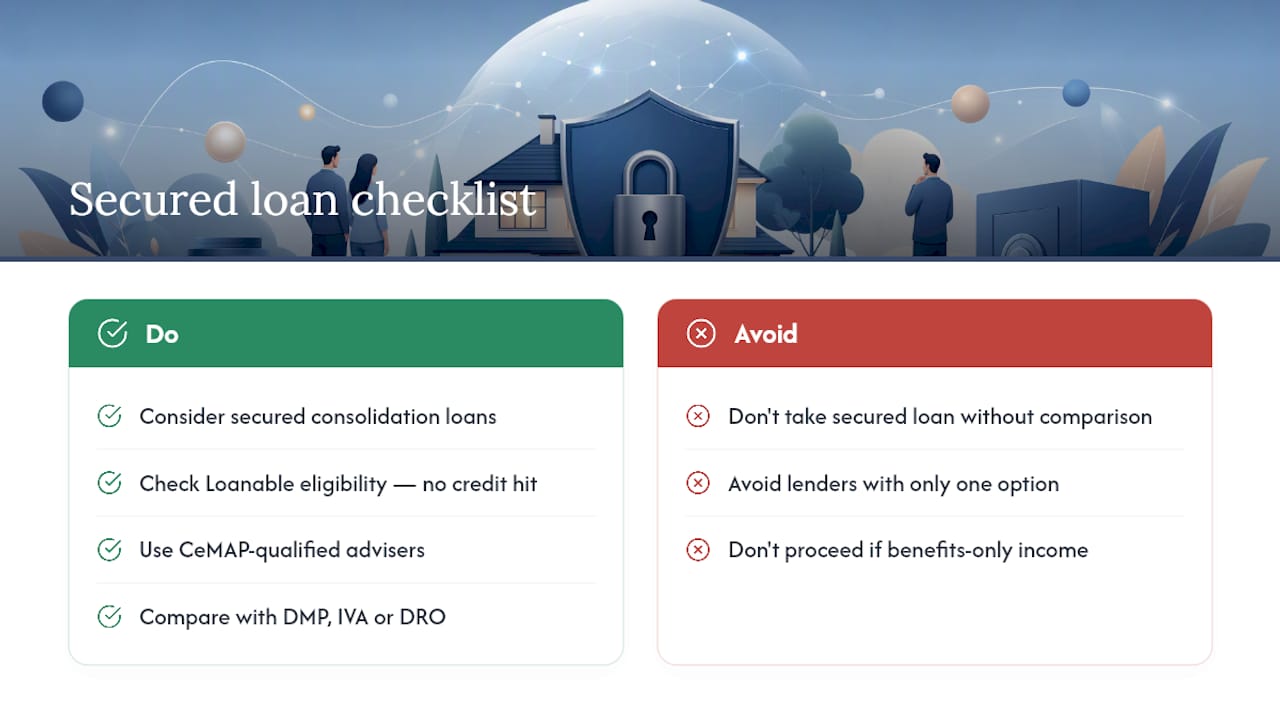
- How to decide: a checklist and questions to ask advisers or lenders
- Next steps: where to get free, impartial UK debt advice
- A practical view from someone who has been through it
- If you’re a homeowner, explore secured consolidation loans with Loanable
- Key takeaways: what to remember about consolidation while on benefits
- Sources
At a glance: main UK options for people on benefits
Not every debt solution fits every situation. A homeowner with a stable Universal Credit top-up has different choices to a private renter with no other income at all. Here is the shortlist worth understanding before you dig into detail.
- Secured consolidation loan (homeowner): borrows against your property; suits homeowners with equity and a steady income, including benefit income, but puts your home at risk if payments are missed.
- Unsecured consolidation loan: a personal loan with no asset attached; harder to get approved on benefits alone, and rates tend to be higher.
- Debt Management Plan (DMP): an informal, flexible arrangement negotiated by a free adviser; no credit check required, but creditors can opt out.
- Individual Voluntary Arrangement (IVA): a formal, legally binding agreement covering most debts; needs a minimum monthly contribution and affects your credit file for six years.
- Debt Relief Order (DRO): designed for people with low income, low assets, and debts under a set threshold; a common route for those relying solely on benefits.
- Administration order: for people with a county court judgment and multiple debts, managed through the court.
- Bankruptcy: the most drastic option, usually a last resort when assets and income cannot support any repayment plan.
If none of that is immediately clear, start with a free conversation. MoneyHelper, Citizens Advice, and StepChange all offer impartial guidance and will not push you towards a product that pays them a fee.
How receiving benefits changes eligibility and payment calculations
Benefit income does not disqualify you from consolidating debt, but it shapes how much a lender or adviser thinks you can realistically afford to repay. Universal Credit, Child Benefit, PIP, and DLA are typically added into the income side of an affordability assessment for formal solutions such as a DMP or IVA. The IVA protocol confirms this directly: benefits are included in the calculation, but the arrangement itself does not stop your payments continuing as normal.
There is a useful nuance for disability benefits specifically. PIP and DLA must be declared, but you can offset them by listing disability-related expenses, such as mobility costs, care, or specialist equipment, in your monthly outgoings. An insolvency practitioner will usually accept one combined figure rather than an itemised breakdown of every cost.
Pro Tip: Keep a simple running total of disability-related costs each month rather than trying to reconstruct receipts later. One clear “disability-related expenditure” line is what most advisers ask for, not a shoebox of invoices.
- Benefit receipt: continues normally once a DMP, IVA, or DRO is in place.
- DWP deductions: existing deductions for debts like advance repayments or rent arrears are separate from any new consolidation arrangement and are not automatically stopped by it.
- Creditor enforcement: formal solutions generally pause further collection action and interest once accepted, though rules differ by product.
Secured consolidation loans for homeowners: how they work and risks for people on benefits
A secured consolidation loan uses your home as collateral to borrow a lump sum, which then clears your existing debts and replaces them with a single monthly repayment. Lenders assess two things above all else: the equity in your property and whether your total income, including any benefits, comfortably covers the new repayment. This makes it a realistic route for homeowners on benefits who have a stable combined income, but a poor fit for renters or anyone whose only income is a benefit payment with no property to secure against.
Borrowing Calculator
See how much you could potentially borrow against your home, subject to status.
Please enter a property value that's higher than your outstanding mortgage balance.
Based on your figures, the amount available is below our typical minimum loan of £25,000. Get in touch and we'll talk through your options.
Get my free, no-obligation quoteIllustrative only, based on a maximum combined loan-to-value of 75%. This is not a loan offer or a quote, and your actual rate, borrowing amount and monthly payment will depend on your circumstances, credit profile and the lender's criteria. Think carefully before securing other debts against your home. Your home may be repossessed if you do not keep up repayments on your mortgage or any other debt secured on it.
Before applying, run through a basic affordability checklist: your total monthly income against all outgoings, how much equity sits in the property, whether the new term genuinely reduces monthly pressure without ballooning total interest, and what happens if your circumstances change. The risk is not abstract. Missing repayments on a secured loan can ultimately lead to repossession, which is why this route deserves more caution than an unsecured product.
Loanable works with CeMAP-qualified advisers who specialise in secured lending for homeowners, including those with a challenged credit history or income built partly from benefits. The business has funded over £53 million in loans to UK homeowners, drawing on a network of lenders to find terms suited to circumstances that a single high-street bank might turn away.
Losing your home is the single biggest risk with any secured loan. No consolidation product is worth signing if you cannot say with confidence that the new repayment is affordable every month, not just this year.
| Suitable if | Effect on benefits | Credit check needed | Risk to assets | Speed to arrange |
|---|---|---|---|---|
| Homeowner with equity and stable combined income | Benefits usually continue unaffected | Yes, but softer criteria for poor credit | High, repossession risk if missed | Weeks, depending on valuation |
| Renter or no property | Not applicable, unlikely to qualify | Yes | None from this route | Not applicable |
Pro Tip: Ask any adviser to show you the total cost of the loan over its full term, not just the monthly figure. A lower monthly payment stretched over ten years can cost far more than a shorter, higher one.
Unsecured consolidation loans and credit checks for people on benefits
Getting an unsecured consolidation loan while relying on benefits is harder, though not impossible. Lenders look at your credit score, debt-to-income ratio, general affordability, and often your employment status. Benefit income can be included in that calculation, but not every lender treats it the same way, and some will want to see it alongside other regular income.
Realistically, expect higher interest rates, smaller loan amounts, and sometimes a request for a guarantor or joint applicant if you rely solely on benefit income. That is simply how unsecured risk pricing works when there is no asset backing the loan.
- Gather your benefit award letters and recent bank statements before applying.
- List any disability-related expenses separately so affordability looks accurate.
- Apply to a small number of lenders rather than multiple applications in quick succession, since repeated hard searches can knock your credit score.
- Consider whether a practical step-by-step approach to consolidating credit cards suits your debt mix better than a single new loan.
Pro Tip: Timing your application after a benefit review or reassessment, rather than during one, tends to give lenders a clearer, more stable income picture to work from.
Formal UK debt solutions and what they mean for benefit recipients
Government guidance lists Debt Management Plans, administration orders, IVAs, DROs, and bankruptcy as the main formal routes, and which one fits you depends heavily on your assets, income, and total debt. Citizens Advice offers a useful plain-English breakdown of each if you want to compare them side by side.
| Solution | Suitable if | Effect on benefits | Credit check | Risk to assets |
|---|---|---|---|---|
| DMP | Steady income, want flexibility | Continues unaffected | Usually none | Low |
| IVA | Regular income, multiple debts, want legal protection | Continues, benefits count as income | Yes | Moderate, depends on assets |
| DRO | Low income, low assets, debt under threshold | Continues unaffected | Light check | Very low |
| Administration order | County court judgment, several debts | Continues unaffected | Court-managed | Low |
| Bankruptcy | No realistic repayment option | Continues, but assets may be sold | Yes | High |
A DMP is often the easiest formal route for someone on benefits because it usually skips a credit check entirely, though creditor participation is voluntary rather than guaranteed. An IVA offers more legal weight and stops most enforcement action once accepted, but it requires a minimum monthly contribution and stays on your credit file for six years. A DRO exists specifically for people with low income and few assets, which describes many benefit recipients precisely.
Pro Tip: If you’re unsure which formal route applies to you, a free adviser can usually tell within one conversation based on your total debt, assets, and income. Do not guess this yourself before speaking to someone.
When consolidation is not the right choice for someone on benefits
Consolidation is a tool, not a fix. Investopedia’s analysis of debt consolidation makes the point clearly: it can simplify payments and sometimes lower your rate, but stretching the term often means paying more interest overall, and it does nothing to address why the debt built up in the first place.
- Your income, including benefits, is already stretched with nothing left over each month.
- A secured loan would put your home at risk when an unsecured or informal route would not.
- The new term is significantly longer purely to make the monthly figure look smaller.
- Bailiffs or DWP deductions are already active against you.
If enforcement action is already underway, get free advice immediately rather than researching further. A debt adviser can apply for Breathing Space on your behalf, which pauses interest, fees, and most enforcement for a set period while your options are properly assessed.
How to decide: a checklist and questions to ask advisers or lenders
- Check whether the solution protects your benefit income or simply adds it to an affordability sum.
- Compare total cost over the full term, not just the monthly repayment figure.
- Establish whether any asset, particularly your home, is at risk.
- For a DMP, confirm which creditors have actually agreed to participate.
- Ask for a realistic timeline from application to the first reduced payment.
- Check whether the plan relies heavily on benefit income continuing unchanged.
Take these questions to any lender or adviser:
- What happens to my repayments if my benefit award changes?
- Is there a fee, and when is it charged?
- What is the minimum monthly contribution for an IVA in my case?
- Could I apply for Breathing Space before committing to anything?
Walk away from any offer promising guaranteed approval before checking your circumstances, pressure to sign within 24 hours, or unclear fee structures buried in small print.
Next steps: where to get free, impartial UK debt advice
Three organisations should be your first call, not a lender. MoneyHelper offers a debt advice locator and calculators covering your whole financial picture. Citizens Advice can talk through formal and informal routes in person or by phone. StepChange runs free debt management plans and can assess DRO or IVA eligibility on the same call.
Before your appointment, gather:
- Recent benefit award letters (Universal Credit, PIP, DLA, Child Benefit).
- The last three months of bank statements.
- Letters from every creditor, including balances and account numbers.
- Your rent or mortgage statement.
- A list of essential monthly costs, including any disability-related expenses.
An adviser can apply for Breathing Space on the spot if you are already facing enforcement action, giving you room to think without added pressure.
A practical view from someone who has been through it
Kevin here. I’ve spoken with enough homeowners on benefits considering consolidation to notice a pattern: the ones who do best treat the paperwork stage seriously before they treat the application stage seriously. One case that stuck with me involved a homeowner receiving PIP alongside part-time earnings, weighing a secured consolidation loan against an IVA. What made the difference wasn’t the product itself but the budget behind it. Once disability-related expenses were properly listed as a single combined figure, rather than left vague, the numbers worked in a way they hadn’t on paper before.
The challenge nobody warns you about is patience. Formal solutions take weeks to set up properly, and rushing that process to escape immediate pressure from creditors is exactly how people end up in arrangements that don’t fit. My honest lesson from watching this play out: get free advice before you commit to anything, because benefits genuinely can continue through most of these routes, but only if the arrangement is built around your real numbers, not a rough guess.
If you’re a homeowner, explore secured consolidation loans with Loanable
If you own your home and your income, including any benefits, is stable enough to support a new monthly repayment, a secured consolidation loan through Loanable can bring several debts under one manageable payment, often at a lower rate than several separate unsecured balances.
Loanable works with CeMAP-qualified advisers who specialise in homeowners with complex circumstances, including challenged credit histories and income partly made up of benefits. The company has funded over £53 million in loans by drawing on a wide panel of lenders rather than a single high-street option, which matters when your situation doesn’t fit a standard template. This is worth stressing plainly: a secured loan puts your home at risk if repayments are missed, so it deserves comparison against a DMP, IVA, or DRO before you decide, particularly if your income is entirely benefit-based.
If a secured loan looks like the right fit after weighing the alternatives, check your eligibility with Loanable to see what terms might be available, with no impact on your credit score at the initial check stage.
Key takeaways: what to remember about consolidation while on benefits
Debt consolidation on benefits is possible in the UK, but every formal route counts your benefit income in its affordability check while leaving your actual payments untouched.
| Point | Details |
|---|---|
| Consolidation is possible on benefits | Benefits count towards affordability checks but payments themselves continue as normal. |
| Free advice comes first | MoneyHelper, Citizens Advice, and StepChange should be your first call, not a lender. |
| Formal routes suit different situations | DMP, IVA, DRO, administration order, or bankruptcy fit different income and asset profiles. |
| Secured loans carry real risk | A homeowner’s property is at stake if repayments on a secured loan are missed. |
| Loanable fits homeowners specifically | CeMAP-qualified advisers assess secured consolidation options for homeowners with benefit income or challenged credit. |
Sources
These are the organisations worth bookmarking before you make any decision:
- Debt solutions – Citizens Advice
None of these organisations will charge you for a first conversation, and none will benefit financially from steering you towards a particular product. That impartiality is precisely why they should be your starting point, not an afterthought.
This article provides general information and is not a substitute for personalised financial or debt advice. Always confirm current rules and your own eligibility with a qualified adviser or the primary sources listed above before making a decision.