



Debt consolidation is the process of combining multiple credit card balances into a single loan or payment, typically at a lower interest rate. If you are managing three or four credit cards with different due dates and varying rates, the monthly admin alone creates room for missed payments and compounding costs. Average credit card APR sits at 21.52%, while a two-year personal loan averages 11.40% APR. That gap of over ten percentage points is the core financial case for consolidation. Loanable has funded over £53 million in loans for UK borrowers, many of whom used consolidation to cut monthly outgoings and regain control of their finances.
What does it mean to consolidate credit cards?
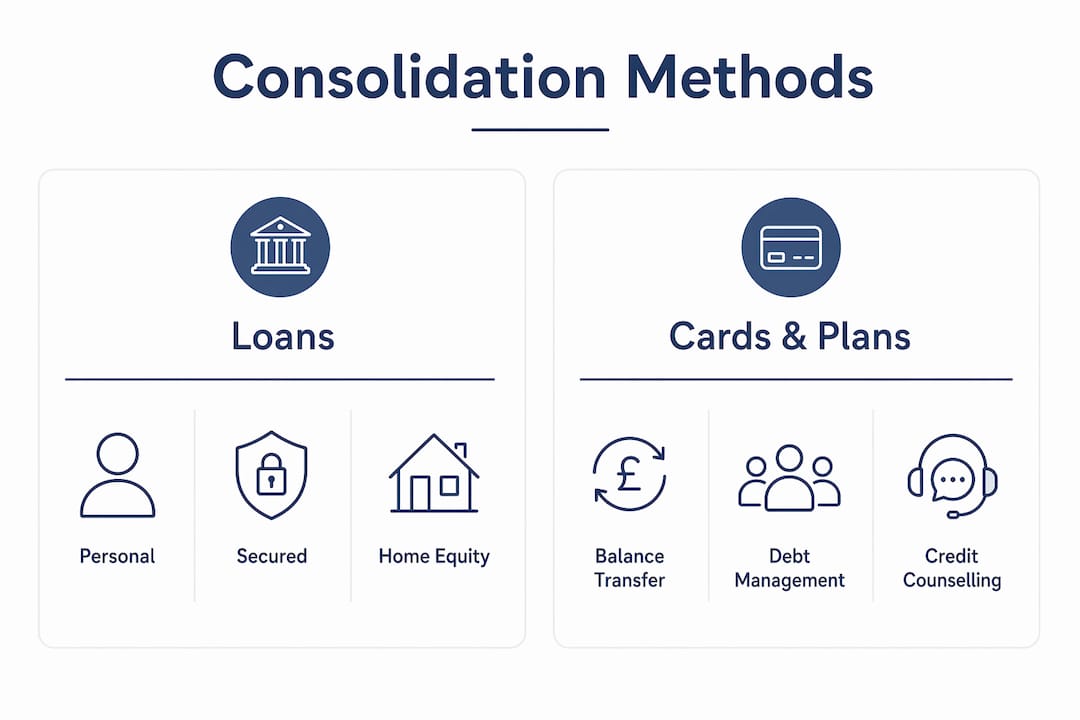
To consolidate credit cards means to pay off several card balances using a single new credit facility, leaving you with one monthly repayment instead of many. The industry term for this is debt consolidation, and it covers several distinct products. Each method works differently, and the right choice depends on your credit profile, the total debt amount, and whether you own property.
The four main methods are personal loans, balance transfer cards, secured loans (including home equity products), and debt management plans. Personal loans carry fixed monthly payments and terms that typically run two to five years. That predictability makes budgeting straightforward. Balance transfer cards offer 0% or very low APR for up to 21 months but charge a 3–5% transfer fee on the amount moved. Borrowers with strong credit can access personal loan rates as low as 7%, making this route highly cost-effective.

Secured loans and home equity products use your property as collateral, which lowers the lender’s risk and often produces lower rates. The trade-off is that your home is at risk if repayments fail. Loanable specialises in secured consolidation loans for UK homeowners, with CeMAP-qualified advisors who match borrowers to competitive rates across a wide lender network.
Debt management plans via credit counselling agencies negotiate lower interest rates and fees directly with creditors, paying off debt in 3–5 years without requiring a new loan. They do not harm your credit score and suit borrowers who cannot qualify for a loan product. Government-approved agencies provide this service and can negotiate better terms than most individuals could achieve independently.
| Method | Best for | Key cost | Main risk |
|---|---|---|---|
| Personal loan | Good to fair credit | Origination fee 1–8% | Rate depends on credit score |
| Balance transfer card | Strong credit | Transfer fee 3–5% | Debt remains if 0% period ends |
| Secured loan | Homeowners | Arrangement fees | Property at risk |
| Debt management plan | Poor credit or high debt | Monthly admin fee | Longer repayment timeline |
Pro Tip: If your credit score is strong, a balance transfer card with a 0% introductory period can be the cheapest short-term option. If your score is lower, a structured debt management plan often costs less overall than a high-rate personal loan.
What do you need to check before consolidating?
Preparation prevents costly mistakes. Before applying for any consolidation product, you need four figures: total debt, current interest costs, the monthly payment you can afford, and your credit score.
- Add up all balances. List every card, its balance, its APR, and its minimum monthly payment. This gives you the loan amount you need and a baseline interest cost to beat.
- Calculate affordable monthly payments. Use a free loan calculator to model repayments at different rates and terms. A lower monthly payment over a longer term can cost more in total interest.
- Account for fees. Origination fees range from 1% to 8%, and lenders deduct them from the disbursed amount. If your total debt is £10,000 and the fee is 3%, the lender pays out £9,700. You must borrow £10,310 to receive the full £10,000 needed. Factor this into your loan request from the start.
- Check your credit score. Your score determines which products you qualify for and at what rate. A score above 700 typically unlocks the most competitive personal loan rates. Scores below that may point you toward a secured loan or a debt management plan.
- Compare scenarios side by side. Model the total cost of each option, including fees and interest over the full term. A lower rate does not always mean a lower total cost if the term is much longer.
Pro Tip: Rate shopping within a 14 to 45-day window is treated as a single hard inquiry by most credit scoring models. Apply to multiple lenders in quick succession to compare real offers without damaging your score.
Your credit profile heavily influences which method suits you best. Strong credit opens the door to 0% balance transfer cards and low-rate personal loans. Lower credit scores often make secured homeowner loans or debt management plans the more practical route.
How to consolidate credit card debt step by step
The process is straightforward when broken into clear stages.
- Gather your debt details. Collect statements for every card. Note the balance, APR, minimum payment, and any early repayment charges.
- Choose your consolidation method. Use the comparison above to match your credit profile and debt level to the right product. Homeowners with equity have more options than renters.
- Shop for rates. Apply to several lenders within a short window to collect real rate offers. Pre-qualification tools that use soft credit checks let you compare without any score impact.
- Read the full loan terms. Check the APR, origination fee, repayment term, and whether the lender pays creditors directly or transfers funds to you.
- Apply and receive funds. Once approved, the lender either pays your card issuers directly or deposits funds into your account. Some lenders release funds directly to borrowers, which requires strict personal discipline to apply the money correctly. Misuse at this stage can worsen your debt position.
- Confirm each card balance is cleared. Do not assume the lender has paid every card. Check each account statement after the transfer and request written confirmation of zero balances.
- Decide whether to close old accounts. Keeping accounts open preserves your credit utilisation ratio, which benefits your credit score. Closing them all at once can lower your score temporarily. Close high-fee accounts first and keep the oldest account open if possible.
- Set up a single direct debit. Automate your new consolidated payment so you never miss a due date.
Common mistakes to avoid:
- Borrowing more than you need because the lender offers a higher limit
- Continuing to use cleared credit cards and rebuilding balances
- Choosing the longest repayment term without checking total interest cost
- Ignoring origination fees when comparing loan offers
Consolidating £10,000 of credit card debt at 29% APR into a personal loan at 12% APR over three years reduces total interest by £3,129. That saving is real, but only if the cleared cards stay at zero.
What challenges should you expect after consolidating?
The biggest risk after consolidation is behavioural, not financial. Continuing to use credit cards after consolidation without budgeting can return borrowers to the same position within months. Consolidation clears the balances. It does not change the spending patterns that created them.
“Consolidation is not a permanent fix. Without improving spending habits and budgeting, borrowers risk falling back into debt. The loan solves the symptom; a budget addresses the cause.”
Origination fees and longer loan terms can also erode savings. A five-year personal loan at a lower rate may cost more in total interest than a three-year loan at a slightly higher rate. Always compare total repayment cost, not just monthly payment size.
Signs that consolidation is the right move:
- You have two or more cards with balances above 50% of their credit limit
- You are paying only minimum payments and balances are not falling
- You have a stable income that supports a fixed monthly repayment
- Your credit score qualifies you for a rate meaningfully lower than your current card APRs
Signs that consolidation may not help:
- Your total debt is small enough to clear within 12 months through extra payments
- You cannot qualify for a rate lower than your current cards
- You have no plan to change the spending behaviour that built the debt
Pro Tip: After consolidation, put a temporary freeze on your cleared credit cards rather than closing them. This preserves your credit history and available credit limit while removing the temptation to spend.
If a loan product is unsuitable, government-approved credit counselling agencies offer debt management plans that negotiate directly with creditors. These plans carry no loan application and do not require a minimum credit score.
Key takeaways
Debt consolidation works when the new rate is genuinely lower than your current card APRs, fees are factored into the total cost, and spending habits change alongside the loan.
| Point | Details |
|---|---|
| Rate comparison is critical | Average credit card APR is 21.52%; personal loans average 11.40%, a saving of over ten percentage points. |
| Fees affect total cost | Origination fees of 1–8% are deducted from the loan, so borrow slightly more than your total debt to cover the shortfall. |
| Credit score shapes your options | Strong credit unlocks 0% balance transfer cards; lower scores suit secured loans or debt management plans. |
| Behaviour determines success | Cleared cards must stay at zero. Rebuilding balances on old cards cancels out consolidation savings. |
| Rate shop within 45 days | Applying to multiple lenders within 14–45 days counts as one credit inquiry, protecting your score. |
My view on credit card consolidation
I have seen borrowers make the same mistake repeatedly. They consolidate, feel the relief of one lower payment, and then gradually reload the cleared cards over the following year. Twelve months later they have the consolidation loan and rebuilt card balances. The loan did not fail. The plan did.
The borrowers who benefit most from consolidation treat it as a structural change, not a rescue. They close or freeze the cleared cards immediately, set a monthly budget before the first repayment lands, and treat the consolidation loan as a countdown to zero rather than a reset.
My practical advice: match the method to your credit profile honestly. If your score is below 650, do not chase a personal loan rate you will not qualify for. A secured loan through Loanable or a debt management plan will cost you less in real terms. If your score is strong, a 0% balance transfer card for smaller debts under £5,000 is hard to beat, provided you clear the balance before the introductory period ends.
Consolidation is a tool. Like any tool, it works well when used correctly and causes damage when misapplied. The financial maths are straightforward. The harder work is the budget discipline that follows.
— kevin
Loanable’s debt consolidation loans for UK homeowners
Loanable works with UK homeowners who want to replace multiple credit card payments with a single, fixed monthly repayment.
Loanable’s CeMAP-qualified advisors assess your full financial picture and match you to competitive rates across a wide panel of lenders, including options for borrowers with less-than-perfect credit histories. The company has funded over £53 million in loans and holds 5-star customer ratings. If you are a homeowner carrying credit card debt across multiple accounts, you can check your eligibility in minutes. For a full overview of available products, visit Loanable’s debt consolidation loan page to compare options and start your application.
FAQ
What does it mean to consolidate credit cards?
Consolidating credit cards means combining multiple card balances into one loan or payment facility, typically at a lower interest rate, to simplify repayments and reduce total interest costs.
Will consolidating credit card debt hurt my credit score?
Applying for a consolidation loan triggers a hard credit inquiry, which may lower your score slightly in the short term. Paying off card balances reduces your credit utilisation ratio, which typically improves your score over time.
What is the best way to consolidate credit card debt?
The best method depends on your credit profile. Strong credit scores suit 0% balance transfer cards or low-rate personal loans. Homeowners with equity benefit from secured loans. Borrowers with lower scores often find debt management plans the most cost-effective route.
How much can I save by consolidating credit card debt?
Savings depend on the rate difference and loan term. Consolidating £10,000 at 29% APR into a 12% APR personal loan over three years reduces interest by £3,129, based on Experian’s published example.
Do I need to close my credit cards after consolidating?
Closing all cards at once can lower your credit score by reducing available credit. Keep older accounts open where possible, especially those with no annual fee, and avoid accumulating new balances on cleared cards.