



A self employed secured loan is a borrowing arrangement where your property or another asset acts as collateral, giving lenders the confidence to advance larger sums than unsecured products allow. For the UK’s growing self-employed population, this distinction matters. High-street banks often reject applications based on irregular income alone, yet secured loans for self-employed borrowers shift the lender’s focus from payslips to property equity. SA302 tax calculations, finalised business accounts, and a clear picture of net profit replace the standard employment contract. Specialist lenders, including Loanable, are built to assess income in this way.
What documentation do self-employed borrowers need?
Lenders assess a self employed secured loan application differently from a standard employed one. The core documents they require are SA302 tax calculations covering the last two to three years, finalised business accounts, and bank statements showing consistent deposits. Proper application packaging with complete documentation improves lender confidence and reduces the chance of delays or outright rejection.
Income verification: net profit, not gross turnover
Lenders focus on net profit or salary and dividends, not gross turnover. They target debt-to-income ratios below 36% based on net profit figures drawn from SA302s. Over-relying on gross income is the single most common cause of rejection for self-employed applicants. If your business turns over £120,000, but your net profit is £40,000, lenders will base affordability on the £40,000 figure.

Most lenders prefer a minimum of two years of self-employment history. Some specialist lenders will consider one year of accounts, but they typically apply stricter loan-to-value limits in those cases. Credit score requirements are also more flexible with secured products because the property reduces the lender’s risk exposure.
Eligibility checklist:
- SA302 tax calculations for the last two to three years
- Finalised business accounts prepared by a qualified accountant
- Three to six months of personal and business bank statements
- Proof of property ownership and a recent mortgage statement
- Valid photo ID and proof of address
- Details of any existing credit commitments
Pro Tip: Ask your accountant to prepare a brief income summary letter alongside your accounts. Some specialist lenders accept this as supporting evidence when income patterns are complex or seasonal.
Which secured loan options suit the self-employed in the UK?
Several distinct secured loan products are available to self-employed borrowers, and the right choice depends on your purpose, timeline, and existing mortgage position. Unsecured loans for sole traders typically advance only £8,000 to £16,000 based on an £8,000 monthly turnover, whereas secured options leverage property equity to raise substantially higher amounts. That gap makes the product choice consequential.
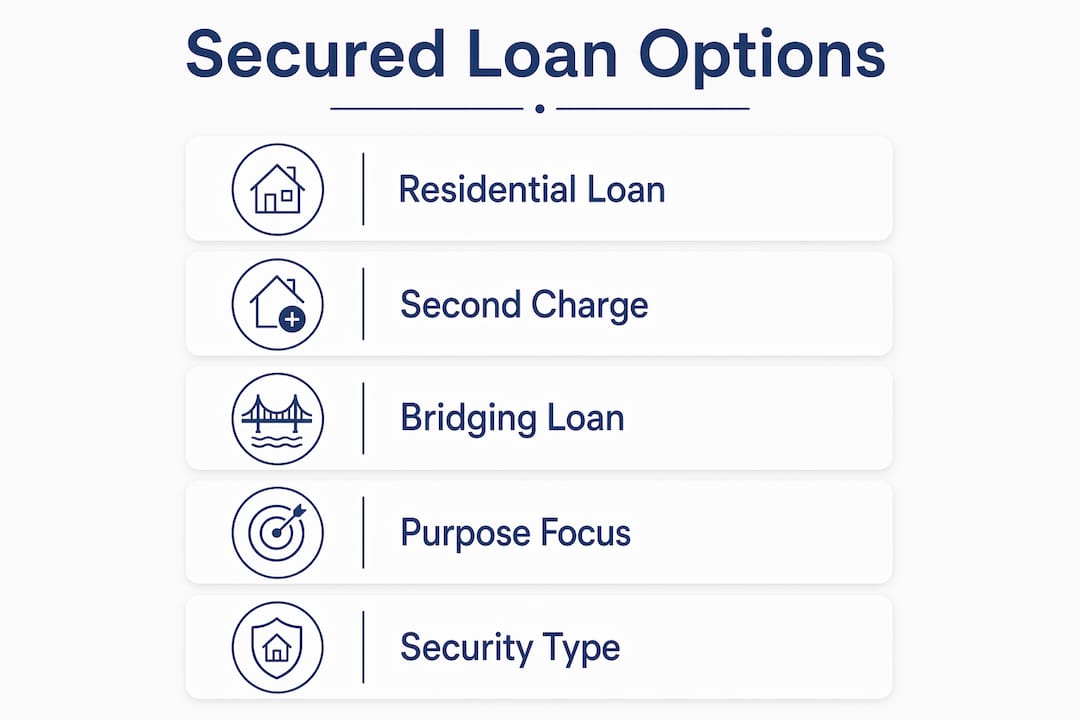
| Loan type | Typical use | Security required | Best suited for |
|---|---|---|---|
| Residential secured loan | Home improvements, debt consolidation | Residential property | Homeowners with equity |
| Second charge mortgage | Raising capital without remortgaging | Property behind first charge | Complex credit histories |
| Bridging loan | Short-term purchases or refurbishments | Property | Clear exit strategy needed |
| Asset-based finance | Tools, vehicles, equipment | Business asset | Traders with high-value assets |
Second charge mortgages
Second charge loans allow you to raise capital without replacing your existing mortgage. This is particularly useful if your current mortgage carries a low fixed rate that you do not want to disturb. Specialist lenders offer these products and are more willing to consider borrowers with complex credit histories. The loan sits behind your first mortgage in priority order, which is why lenders assess both charges together when calculating affordability.
Bridging loans
Bridging loans provide short-term finance for purchases, refurbishments, or chain breaks, and are secured on property with a clear exit strategy required. They are not designed for long-term borrowing. A self-employed builder buying a property at auction, for example, might use a bridging loan to complete the purchase quickly and then refinance onto a standard secured loan once the work is done.
Pro Tip: If you are considering a second charge mortgage, check your existing mortgage terms for early repayment charges before applying. A second charge avoids triggering those charges entirely.
How to apply for a self employed secured loan
Preparation is the single biggest factor in a successful application. Lenders make faster decisions when the file is complete, consistent, and clearly presented. The steps below reflect what specialist advisors recommend for self-employed applicants in 2026.
Gather your financial records. Collect SA302s, business accounts, and bank statements before approaching any lender. Gaps in documentation are the most common reason applications stall.
Calculate your usable income. Work out your net profit figure across the last two to three years. If income varies significantly year to year, lenders will often average the figures or use the lower year as a conservative baseline.
Check your credit file. Obtain your credit report from a UK credit reference agency. Identify any errors and address them before applying. Secured lenders are more flexible than high-street banks, but a clean file still improves your rate.
Assess your property equity. Lenders will commission a formal valuation. Knowing your approximate loan-to-value ratio in advance helps you target lenders whose criteria match your position.
Choose a specialist lender or broker. Working with a broker experienced in self-employed mortgage qualification gives you access to lenders who understand non-standard income. Loanable’s CeMAP-qualified advisors match borrowers to lenders based on their specific income structure and credit profile.
Submit a complete application. Include all supporting documents in one submission. Incomplete applications create delays and can result in a declined decision that leaves a footprint on your credit file.
Prepare for valuation and legal work. Once a lender approves your application in principle, they will instruct a valuer and solicitor. Budget for these costs as part of your overall borrowing plan.
Pro Tip: Avoid making multiple full applications to different lenders simultaneously. Each hard credit search leaves a mark on your file. Use a broker to identify the right lender before a formal application is submitted.
What challenges do self-employed borrowers face with secured loans?
Irregular income is the most cited obstacle for self-employed borrowers seeking secured finance. Lenders trained on salaried income models struggle to interpret seasonal earnings, retained profits, or director’s salary and dividend structures. Specialist lenders evaluate income in a more contextual manner, considering property strategy and exit routes rather than applying rigid income multiples.
Credit history presents a separate challenge. A period of late payments during a slow trading year, or a county court judgement from an earlier business venture, can disqualify an application at a high-street bank. Specialist lenders take a different view. Self-employed borrowers rejected by high-street lenders often benefit from products that focus on property equity rather than rigid credit scoring models.
Valuation fees and legal costs are a practical consideration that catches many first-time secured borrowers off guard. These costs vary by loan type and lender but are standard in secured borrowing because property is involved as collateral. Budget for them from the outset.
Mitigation strategies:
- Work with a broker who specialises in alternative loans for self-employed borrowers to access lenders outside the high-street model
- Present two to three years of accounts even if only one year is technically required, to demonstrate income stability
- Address any errors on your credit file at least three months before applying
- Use a mortgage broker to package your application before it reaches the lender, reducing the risk of a declined decision
- Factor valuation and legal fees into your loan amount calculation so they do not create a shortfall at completion
Key takeaways
A self employed secured loan gives UK borrowers access to significantly higher capital than unsecured products by using property equity as collateral, provided the application is properly documented and submitted to the right lender.
| Point | Details |
|---|---|
| Secured loans unlock higher amounts | Property equity allows borrowing well beyond the £8,000–£16,000 cap typical of unsecured sole trader loans. |
| Net profit drives affordability | Lenders use SA302 net profit figures, not gross turnover, to calculate what you can borrow. |
| Specialist lenders assess differently | They consider property security and income context, not just credit scores or payslips. |
| Documentation quality matters | Complete SA302s, finalised accounts, and bank statements reduce delays and improve approval rates. |
| Broker support improves outcomes | A specialist broker packages your application correctly and targets lenders suited to your profile. |
The reality of self-employed secured lending in the UK
The biggest misconception I encounter is that self-employed borrowers are automatically high-risk. That framing comes from high-street lending models built for salaried employees, not for the reality of how self-employed income actually works. A contractor earning £90,000 a year through a limited company is not a riskier borrower than a salaried employee on £55,000. The income is real. The challenge is presenting it in a way lenders can assess confidently.
What I have found consistently is that preparation separates successful applications from failed ones. Borrowers who arrive with two years of clean, accountant-prepared accounts, a clear picture of their net profit, and a realistic loan-to-value position get decisions quickly. Those who submit incomplete files or rely on gross turnover figures face delays, rejections, and unnecessary hard searches on their credit file.
The other thing worth stating plainly is that the secured loan market for self-employed borrowers in the UK is genuinely well-served by specialist lenders. The products exist. The criteria are achievable. The gap is usually knowledge, not eligibility. Working with an advisor who understands self-employed income structures is not a luxury. It is the most practical step you can take before submitting any application.
If you are self-employed and own property with equity, a secured loan is a realistic option. Do not let a high-street rejection define what is possible.
— kevin
How Loanable helps self-employed borrowers
Self-employed borrowers often spend months approaching the wrong lenders before finding one that understands their income structure. Loanable cuts through that process by matching you directly with specialist lenders suited to your profile.
Loanable’s CeMAP-qualified advisors have facilitated over £53 million in loans for UK borrowers, including those with complex income histories and challenging credit profiles. The team assesses your situation and identifies lenders whose criteria align with self-employed income from the outset. Whether you need a secured homeowner loan for home improvements, a second charge mortgage to raise capital, or a secured loan for debt consolidation, Loanable’s advisors guide you through each step. Check your eligibility today and get a clear picture of your options without a hard credit search.
FAQ
What is a self employed secured loan?
A self employed secured loan is a loan backed by property or another asset, allowing self-employed borrowers to access larger amounts than unsecured products permit. Lenders assess net profit from SA302 tax calculations rather than payslips.
How many years of accounts do I need to apply?
Most lenders require two to three years of finalised business accounts. Some specialist lenders will consider one year, though they typically apply tighter loan-to-value limits in those cases.
Can I get a secured loan with bad credit if I am self-employed?
Specialist lenders focus on property equity and overall financial context rather than credit score alone. Self-employed borrowers rejected by high-street banks often qualify through specialist lenders who use contextual underwriting.
What is a second charge mortgage and is it right for me?
A second charge mortgage lets you borrow against your property without replacing your existing mortgage. It suits self-employed borrowers who want to raise capital while keeping a favourable existing mortgage rate in place.
What fees should I expect with a secured loan?
Secured loans typically involve valuation fees and legal costs because property is used as collateral. These costs vary by lender and loan type, so factor them into your total borrowing calculation from the start.