



For most UK borrowers who need payment certainty, a fixed-rate loan is the safer choice. For those with a short holding period or genuine tolerance for rate rises, a variable-rate product can offer a lower starting rate. The core trade-off is straightforward: fixed rates lock your repayment for a set term, protecting you if the Bank of England Bank Rate rises, while variable rates move with the market and can fall as well as climb. The FCA’s MCOB 10A rules require lenders to disclose the Annual Percentage Rate of Charge (APRC) on all mortgage and secured loan offers, which is the figure that makes a genuine comparison possible. Loanable’s CeMAP-qualified advisers work through both options with borrowers before recommending one.
Table of Contents
- What do fixed and variable rate loans actually mean?
- Fixed vs variable at a glance: pros, cons and what to watch
- How do you choose between fixed and variable?
- What happens when your fixed period ends?
- Which fixed-term length suits you?
- Borrower scenarios: which option typically fits?
- How lenders price fixed and variable loans in the UK
- Key takeaways
- Why there is no universal answer here
- How Loanable can help you choose the right loan structure
- Useful sources and further reading
What do fixed and variable rate loans actually mean?
A fixed-rate loan locks your interest rate for a defined period, typically 2, 3, 5 or 10 years. Your monthly repayment stays the same throughout that term regardless of what happens to wider interest rates. At the end of the fixed period, the loan usually reverts to the lender’s Standard Variable Rate (SVR) unless you remortgage or renegotiate.
A variable-rate loan has a rate that can change. Two main types exist in the UK:
Fixed or variable structures appear across several product categories:
- Residential mortgages and second charge mortgages
- Secured homeowner loans
- Debt consolidation secured loans
Some products carry an initial teaser fixed period before reverting to a variable rate. That structure is common on introductory mortgage deals and is worth identifying clearly on any product illustration before you sign.
MoneyHelper’s guidance on mortgage interest rate options covers the tracker vs SVR distinction in plain language if you want a regulator-endorsed summary.
Fixed vs variable at a glance: pros, cons and what to watch
| Feature | Fixed rate | Variable rate |
|---|---|---|
| Monthly payment | Stays the same for the fixed term | Can rise or fall |
| Typical headline rate | Usually slightly higher at outset | Often lower at outset |
| Payment certainty | High | Low to moderate |
| Best suited to | Budget-conscious borrowers, long holders | Short-term holders, rate-tolerant borrowers |
| Main drawback | ERCs if you exit early; misses rate falls | Payment shock if Bank Rate rises sharply |
Variable-rate secured products typically carry lower headline rates than fixed equivalents at the point of application, because the lender does not absorb the risk of future rate rises. That lower starting rate is real, but it is not guaranteed to stay low.
Pros of fixing:
- Predictable monthly outgoings, useful for household budgeting
- Protection against Bank Rate increases during the fixed term
- Easier to plan around if you have a fixed income or tight margins
Cons of fixing:
- You will not benefit if rates fall during the fixed period
- Early repayment charges (ERCs) apply if you exit before the term ends
- The post-fix reversion rate (SVR) can be materially higher
Pros of a variable rate:
- Lower starting rate in most market conditions
- No ERCs on many tracker products, giving flexibility to exit
- You benefit directly if Bank Rate falls
Cons of a variable rate:
- Monthly payments can rise without warning
- Harder to budget long-term
- SVR products give the lender discretion to raise rates independently of Bank Rate
Pro Tip: The headline rate is what lenders advertise; the APRC is what you actually pay across the full term. Under FCA MCOB 10A, lenders must include arrangement fees, mandatory charges and the post-fix reversion assumption in the APRC calculation. Two products with the same headline rate can have very different APRCs once fees are factored in.
How do you choose between fixed and variable?
Work through these questions before you commit to either structure.
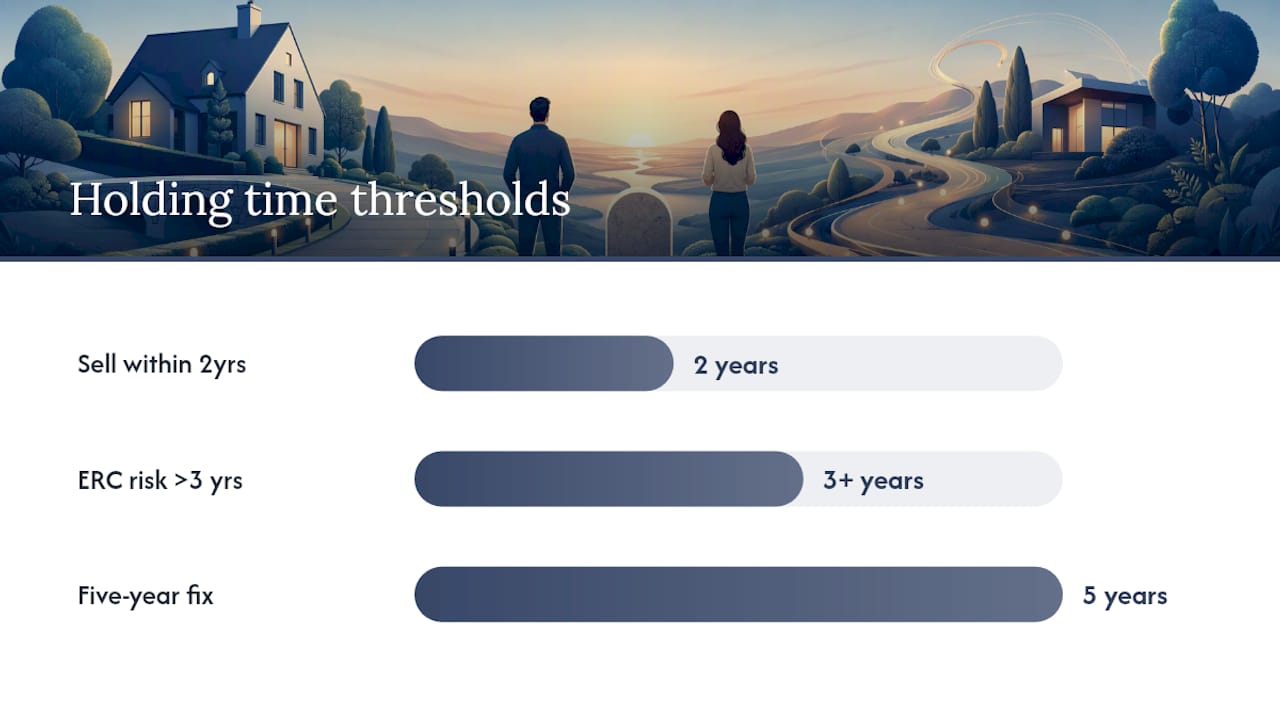
How long do you plan to hold the loan? If you expect to sell, remortgage or repay within two years, a variable tracker with no ERC may cost less overall than a five-year fix with exit penalties.
Can your budget absorb a payment rise? Model what your monthly repayment would look like if Bank Rate rose by 1.5 percentage points. If that increase would cause genuine hardship, a fixed rate removes that risk.
What is the APRC, not just the headline rate? Compare APRC figures across products of the same term and loan size. A lower headline rate with a large arrangement fee can produce a higher APRC than a slightly higher rate with no fee. Secured loan fees such as arrangement charges, valuations and legal costs all feed into APRC.
Are you planning home improvements or a sale? If you intend to sell within the fixed period, ERCs could wipe out any rate saving. Check the ERC scale on the product illustration before applying.
What is your LTV and credit profile? Both affect the rates available to you. Improving either before you apply can move you into a better pricing band.
Red flags on loan illustrations worth checking:
- Arrangement fees above £1,500 on a standard secured loan
- A post-fix reversion rate that is materially higher than the current SVR market average
- An ERC scale that stays above 3% for more than three years
- A headline rate significantly below the APRC, suggesting heavy front-loaded fees
Always verify the lender on the FCA Register before sharing personal details or submitting an application. A CeMAP-qualified adviser can review product illustrations side by side and flag anything unusual before you commit. Using a whole-of-market broker rather than going direct to a single lender gives you access to a wider product range and independent guidance on which structure fits your situation.
What happens when your fixed period ends?
When a fixed term expires, the loan automatically reverts to the lender’s SVR unless you act. SVRs are almost always higher than the rate you were paying during the fix, sometimes by two percentage points or more. That gap can add a meaningful amount to your monthly repayment overnight.
Key points on reversion and remortgaging:
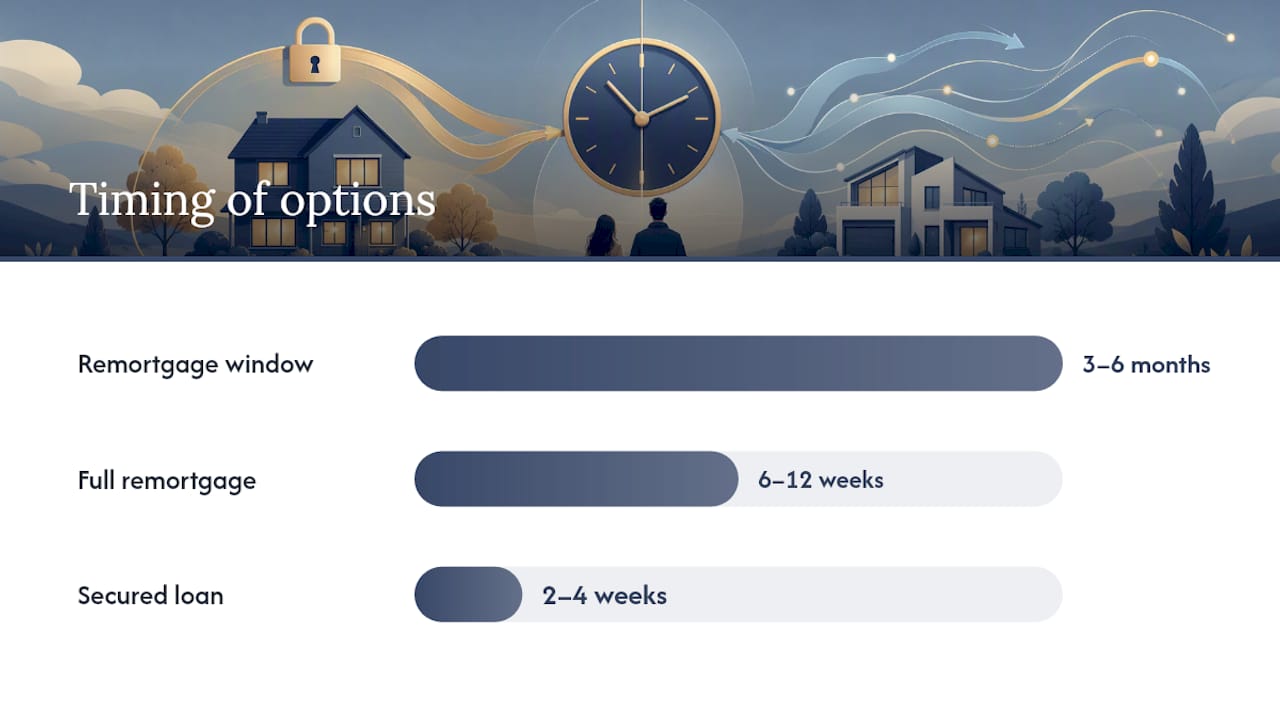
- Start the remortgage process early. Most lenders allow you to lock a new rate three to six months before your current deal ends. A binding offer secured in advance protects you against rate rises in that window.
- A secured loan can be faster than remortgaging. A second charge secured loan typically completes in 2–4 weeks; a full remortgage often takes 6–12 weeks. If you need funds quickly or want to avoid disturbing a low first-charge rate, a secured loan can be the more practical route.
- Early repayment charges (ERCs) on fixed deals can be significant; for example, a 3% ERC on a £100,000 loan is £3,000. That cost must be weighed against any saving from switching to a better rate.
- Illustration validity matters. A mortgage or secured loan illustration is not a binding offer. Confirm with the lender how long the quoted rate is held once a formal application is submitted.
A secured loan leaves your existing first-charge mortgage intact. If you are mid-way through a low fixed-rate mortgage, a second charge product avoids triggering ERCs on that deal entirely.
The typical sequence runs: fixed term expiry → automatic reversion to SVR → remortgage window opens (3–6 months before expiry) → new product locked via binding offer → ERC period on new deal begins.
Which fixed-term length suits you?
Common fix lengths carry different trade-offs. The right choice depends on how long you plan to stay in the property and how much certainty you need.
- 2-year fix: lowest rate premium over variable; suits borrowers who expect to remortgage soon, plan to sell, or want to reassess rates frequently. Comes with more remortgage admin and more exposure to rate cycles.
- 3-year fix: a middle ground that reduces remortgage frequency without committing to a long ERC period. Less common than 2- or 5-year products but available from most lenders.
- 5-year fix: the most popular term in the UK market. Provides five years of payment certainty and reduces remortgage costs over time. Suits borrowers with stable long-term plans who want to minimise rate-review frequency.
- 10-year fix: maximum certainty, but the rate premium is higher and ERCs can extend for the full decade. Suits borrowers who are confident they will not move or remortgage and who prioritise absolute payment stability above all else.
Split-rate or hybrid arrangements divide the loan between a fixed and a variable portion. A borrower might fix 70% of the balance for five years and leave 30% on a tracker. This reduces the impact of rate rises on the fixed portion while retaining some benefit if rates fall on the variable portion. It also limits the ERC exposure: only the fixed portion carries exit penalties. Split arrangements are less common on standard secured loans than on larger mortgage products, but some lenders offer them.
Borrower profiles by term:
- Short-term owner or likely mover within three years: 2-year fix or variable tracker with no ERC
- Long-term holder with stable income: 5-year fix
- Borrower wanting maximum certainty and no plans to move: 10-year fix
- Borrower uncertain about future plans: split arrangement or 2-year fix with a low ERC scale
Borrower scenarios: which option typically fits?
These scenarios illustrate how the fixed vs variable decision plays out in practice. They are not personalised advice.
First-time buyer on a tight budget. Monthly cash flow is the priority. A 5-year fixed-rate mortgage or secured homeowner loan removes the risk of a payment shock during the period when finances are most stretched. The slightly higher headline rate is the cost of that certainty.
Borrower consolidating debt. Consolidating multiple credit balances into a single debt consolidation secured loan works best on a fixed rate. Predictable monthly repayments make it easier to track progress and avoid re-accumulating debt. Variable rates introduce uncertainty that can undermine the budgeting discipline consolidation requires.
A simple illustration of rate movement impact: on a £50,000 secured loan over 10 years at 6%, the monthly repayment is approximately £555. If a variable rate rises by 1.5 percentage points to 7.5%, the same loan costs approximately £594 per month. That is roughly £39 more each month, or around £468 per year. On larger loan balances, the gap widens proportionally.
How lenders price fixed and variable loans in the UK
Four main factors drive the rate you are offered on any fixed or variable secured loan.
Borrowing Calculator
See how much you could potentially borrow against your home, subject to status.
Please enter a property value that's higher than your outstanding mortgage balance.
Based on your figures, the amount available is below our typical minimum loan of £25,000. Get in touch and we'll talk through your options.
Get my free, no-obligation quoteIllustrative only, based on a maximum combined loan-to-value of 75%. This is not a loan offer or a quote, and your actual rate, borrowing amount and monthly payment will depend on your circumstances, credit profile and the lender's criteria. Think carefully before securing other debts against your home. Your home may be repossessed if you do not keep up repayments on your mortgage or any other debt secured on it.
| Pricing driver | Effect on fixed rate | Effect on variable rate |
|---|---|---|
| Bank of England Bank Rate | Indirect (via swap rates) | Direct (tracker) or discretionary (SVR) |
| Swap rates / wholesale funding | Primary driver of fixed pricing | Minimal direct effect |
| Credit profile (LTV and credit score) | Higher risk = wider margin | Higher risk = wider margin |
| Product type and term length | Longer fix = higher premium | N/A |
Swap rates are the wholesale cost at which lenders fund fixed-rate products. When markets expect Bank Rate to rise, swap rates increase and fixed rates follow. Variable rates respond more directly to actual Bank Rate decisions from the Bank of England.
Lenders publish product cards with rates banded by LTV thresholds and typically refresh those cards every 2–8 weeks. A small reduction in your loan amount, or a modest increase in your property value, can move your case into a lower LTV band and unlock a better rate. When Bank Rate is actively moving, product cards can change more frequently than that.
The APRC figure on any product illustration, mandated under FCA MCOB 10A, captures the full cost including fees and the post-fix reversion assumption. Two products with identical headline rates can have meaningfully different APRCs once arrangement fees and reversion rates are included. Always compare APRCs across the same term and loan size.
Pro Tip: When Bank Rate is in an active cycle, monitor lender product cards weekly rather than monthly. Lock the rate via a formal binding offer as soon as you find terms that work. A whole-of-market broker can model small adjustments to loan size to optimise your LTV band and potentially access a lower pricing tier.
Key takeaways
For most UK homeowners, a fixed-rate secured loan or mortgage is the lower-risk choice, provided you match the fix length to your expected holding period and compare APRC rather than headline rate.
| Point | Details |
|---|---|
| Compare APRC, not headline rate | APRC includes fees and reversion assumptions; two identical headline rates can produce very different total costs. |
| Match fix length to holding period | A 5-year fix on a property you plan to sell in 2 years creates ERC exposure that can outweigh any rate saving. |
| ERCs can be significant | Check the ERC scale on your illustration before applying; on larger loans this is a material cost. |
| Split loans reduce binary risk | Fixing part of the balance and leaving part on a tracker limits ERC exposure while retaining some rate flexibility. |
| Loanable offers whole-of-market brokerage | Loanable’s CeMAP-qualified advisers compare fixed and variable products across lenders and check eligibility without affecting your credit score. |
Why there is no universal answer here
The conventional wisdom on fixed vs variable tends to collapse into “fix when rates are rising, go variable when they are falling.” That framing is not wrong, but it is incomplete in a way that costs borrowers money.
Rate timing is genuinely difficult. Swap markets, which drive fixed pricing, often price in expected Bank Rate moves before the Bank of England acts. By the time a rate rise is announced, fixed rates may already reflect it. Borrowers who wait for a “clear signal” to fix frequently find they have already missed the window.
The more reliable framework is personal, not macroeconomic. Your holding period, income stability and ERC tolerance matter more than your view on where Bank Rate is heading. A borrower who fixes for five years and sells in three has paid for certainty they did not need and paid ERCs on top. A borrower on a variable rate who cannot absorb a £100 monthly rise faces real hardship regardless of what the market does next.
The split-rate approach is underused in the UK secured loan market. It is not a compromise; it is a deliberate structure that limits downside on both sides. More borrowers should ask their adviser whether it is available on the product they are considering.
Loanable’s approach, working through a whole-of-market panel with CeMAP-qualified advisers, is built around this kind of case-by-case assessment rather than a default recommendation. Having funded over £53 million in loans, the pattern is consistent: the right structure depends on the individual, not the rate cycle.
How Loanable can help you choose the right loan structure
Choosing between a fixed and variable rate on a secured loan or second charge mortgage is a decision with real financial consequences. Loanable gives you direct access to CeMAP-qualified advisers who compare fixed and variable products across a whole-of-market lender panel, not just a single lender’s range.

Whether you are consolidating debt, funding home improvements, or remortgaging a second charge, Loanable’s advisers assess your holding period, credit profile and LTV position before recommending a structure. Eligibility checks do not affect your credit score. Loanable has facilitated over £53 million in secured loans for UK homeowners, including borrowers with complex credit histories.
Check your eligibility now or visit the secured loans page to see current options. If consolidation is the goal, the debt consolidation loans page covers the fixed-rate approach in detail.
This article provides general information only and is not personalised financial advice. Confirm current rates, terms and eligibility with a qualified adviser or the relevant lender before making any borrowing decision.
Useful sources and further reading
- Bank of England Bank Rate: bankofengland.co.uk
- FCA MCOB 10A (APRC and disclosure rules): handbook.fca.org.uk/handbook/MCOB/10A/
- FCA Register: register.fca.org.uk
- Understanding mortgages and interest rates
- Secured Loan Interest Rates UK 2026
- Secured Loan vs Remortgage: Which Is Better? (UK Guide 2026)
- The best secured loans & the rates in the UK – May 2026
- Check My Eligibility – Loanable