



UK homeowners taking out a fixed-rate home improvement loan can typically expect a representative APR somewhere between 5.9% and 14.9% for unsecured personal loans, or roughly 6% to 10% APR for secured homeowner loans (second charge mortgages). Where you land in that range depends on three things above all else.
- Credit profile: a clean file with low utilisation gets you closer to the advertised headline rate; adverse history pushes you toward the upper end or beyond it
- Security: pledging your property as security (a secured homeowner loan) typically unlocks lower APRs and longer terms than an unsecured product
- Loan amount and term: larger amounts over shorter terms usually attract better rates; stretching the term reduces monthly payments but increases total interest paid
Pro Tip: Before you apply anywhere, run a soft eligibility check. It shows your likely rate without leaving a mark on your credit file. Loanable’s eligibility check does exactly this and takes a few minutes.
Key takeaways
Fixed-rate secured homeowner loans typically offer lower APRs than unsecured products for larger projects, and comparing total amount repayable rather than monthly payment is the most reliable way to judge the true cost.
| Point | Details |
|---|---|
| Typical UK rate range | Fixed-rate home improvement loans run from roughly 5.9%–14.9% APR unsecured, or 6%–10% APR for secured homeowner loans. |
| Secured vs unsecured | Secured loans offer lower APRs but place a second charge on your property; unsecured loans are faster with no property risk. |
| Compare total repayable | A 2.4 percentage point APR difference on £25,000 over 10 years adds over £3,480 to the total cost. |
| Improve your rate first | Reducing credit utilisation and fixing file errors can move you into a lower rate band before you apply. |
| Use Loanable | Loanable’s CeMAP-qualified advisers search a panel of secured lenders and have funded over £53 million in loans for UK homeowners. |
Table of Contents
- What representative APRs and repayment examples look like for UK homeowners
- How lenders set the rate you are offered
- Fixed-rate loans vs variable-rate options: which suits home improvements?
- Secured vs unsecured loans: what are the real trade-offs for home improvements?
- How to compare offers and choose the right home improvement loan
- Quick repayment examples for common loan sizes and terms
- How long does an application take, and what documents do you need?
- What alternatives to a dedicated home improvement loan are worth considering?
- Why Loanable can help UK homeowners get competitive secured home-improvement rates
- What loan amounts and repayment terms are available?
- Budgeting for a home improvement loan: questions to ask yourself first
- How credit improvements can lower your home improvement loan rate
- How purpose-specific offers and promotions affect your rate
- What overborrowing or refinancing costs you in the long run
- An honest view on fixed-rate home improvement loans
- Loanable: competitive secured home-improvement rates, without the guesswork
- Sources
What representative APRs and repayment examples look like for UK homeowners
Standard personal loans marketed as home improvement products commonly sit in a 5.9%–14.9% APR band. Secured homeowner loans in 2026 typically run from around 6% to 10% APR depending on term and borrower profile. Green personal loans and dedicated solar or energy-efficiency loans tend to sit lower still, at roughly 3%–7% APR, often 1–2 percentage points below the standard personal loan rate.
To put those numbers in context, here are illustrative repayment examples based on common market APR assumptions. These are examples, not offers, and your actual rate will depend on your circumstances.
- £5,000 over 3 years at 6.9% representative APR: approximately £154 per month, total repayable around £5,540
- £10,000 over 5 years at 8.9% representative APR: approximately £207 per month, total repayable around £12,420
- £20,000 over 7 years at 9.9% representative APR: approximately £328 per month, total repayable around £27,552
- £30,000 over 10 years at 7.5% representative APR (secured): approximately £356 per month, total repayable around £42,720
What “representative APR” actually means: lenders are required to offer the advertised representative APR to at least 51% of successful applicants. The other 49% may receive a higher rate. Your personal APR is set after the lender assesses your credit file, income, and the loan amount. Comparison sites commonly quote headline fixed-rate examples in the 5.9%–6.4% range for certain loan bands, but these are floor rates, not guarantees.
How lenders set the rate you are offered
Lenders price home improvement loans using a combination of factors specific to you and factors driven by the wider market.
Borrower-specific factors:
- Credit score and credit history: the single biggest variable. Late payments, defaults, or high credit utilisation all push your rate up. Improving key credit factors before application, such as reducing utilisation and fixing inaccuracies on your file, can materially lower the rate lenders quote.
- Affordability: lenders assess your income against existing commitments. A high debt-to-income ratio signals risk and raises your rate.
- Loan amount: many lenders offer tiered pricing. Borrowing £15,000 often attracts a lower rate than borrowing £5,000 from the same lender.
- Loan term: longer terms mean more risk for the lender and more total interest for you.
- Security: a secured homeowner loan (second charge) reduces the lender’s risk substantially, which is why secured rates are typically lower than unsecured equivalents.
- Loan purpose: some lenders offer preferential rates for energy-efficiency works. Green personal loans commonly sit at roughly 3%–7% APR and are typically 1–2% below standard personal loan rates, making them worth checking for solar, insulation, or heat-pump projects.
- Existing relationship: some banks offer marginally better rates to existing current-account or mortgage customers.
Market-level factors:
The Bank of England base rate sets the floor for lender funding costs. When the base rate rises, lenders’ own borrowing costs increase, and this feeds through to the rates they charge. Fixed-rate products insulate you from future base-rate movements once the loan is agreed, which is one reason fixed-rate home improvement loans are popular for larger projects. Some banks and building societies also offer green mortgages or promotional home-improvement incentives, though folding works into a long mortgage term can increase total interest substantially.
Pro Tip: Check your credit report on Experian, Equifax, or TransUnion before applying. Correcting a single error, such as a wrong address or a settled debt still showing as open, can shift your credit score enough to move you into a lower rate band.
Fixed-rate loans vs variable-rate options: which suits home improvements?
For most home improvement projects, a fixed-rate loan is the more practical choice. The monthly payment stays the same from day one to the final payment, which makes budgeting straightforward whether you are paying a contractor in stages or managing a loft conversion over twelve months.
| Feature | Fixed-rate loan | Variable-rate loan |
|---|---|---|
| Monthly payment | Stays the same throughout | Can rise or fall with base rate |
| Budgeting | Predictable | Less certain |
| Rate at outset | Slightly higher than variable | Often lower initially |
| Benefit if rates fall | None — you stay at your agreed rate | Payments reduce |
| Risk if rates rise | None — you are protected | Payments increase |
| Best suited to | Larger projects, longer terms | Short-term borrowing, promotional deals |
Variable-rate products can make sense when you plan to repay quickly (within 12–24 months) or when a lender is running a promotional rate that undercuts fixed equivalents. For a kitchen extension or a full bathroom renovation where you need 5–10 years to repay comfortably, the certainty of a fixed rate is usually worth the marginally higher starting point.
Homeowners who are particularly sensitive to cash flow, such as those on a fixed income or with tight monthly margins, almost always benefit from the predictability of a fixed rate. Knowing your exact repayment on day one removes one variable from an already complex project.
Secured vs unsecured loans: what are the real trade-offs for home improvements?
The choice between a secured homeowner loan and an unsecured personal loan is one of the most consequential decisions you will make when financing a renovation.
Secured homeowner loans (second charge mortgages):
- Lower representative APRs, typically 6%–10%, because the lender holds a charge over your property
- Larger amounts available, often up to £100,000 or more depending on available equity
- Longer repayment terms, sometimes up to 25 years
- Suitable for major works: extensions, full refurbishments, structural changes
- Your property is at risk if you do not keep up repayments. A second charge also appears on the title and must be discharged before you can sell or remortgage cleanly. Read more about borrowing against your home before committing.
Unsecured personal loans:
- No charge on your property; your home is not directly at risk
- Faster to arrange, often with funds in 24–48 hours for straightforward applications
- Typically limited to £25,000–£35,000 depending on the lender
- Higher representative APRs, commonly 5.9%–14.9% for home improvement products
- Shorter maximum terms, usually up to 7–10 years
A secured loan is not automatically the right choice just because the APR is lower. The total cost depends on the term as much as the rate. A secured loan at 7% over 15 years can cost more in total interest than an unsecured loan at 9% over 5 years. Always compare total amount repayable, not just the monthly payment or headline APR. Borrowing on a personal loan increases total cost versus cash; compare total amount repayable, not just monthly payment or headline APR.
[loanable_borrowing_calculator]
Use the calculator above to model different loan amounts, terms, and APR assumptions side by side. Changing the term from 10 years to 7 years on the same loan amount and rate can reduce total interest by thousands of pounds, even though the monthly payment rises.
Pro Tip: If you have equity in your home and need more than £15,000, a secured homeowner loan through a specialist broker like Loanable will almost always produce a lower APR than an unsecured product from a high-street bank. The rate difference compounds significantly over a 7–10 year term.

How to compare offers and choose the right home improvement loan
Headline APR is the starting point, not the finish line. Use this checklist when comparing any two offers.
- Representative APR vs your personal APR — confirm the rate you have been quoted, not the advertised representative rate
- Nominal fixed interest rate — the annual rate before fees; useful for comparing like-for-like across lenders
- Arrangement fees — some lenders charge 1%–3% of the loan amount upfront; add this to the total cost calculation
- Early repayment charges (ERCs) — check whether you can overpay or repay early without penalty, and what the charge is if you do
- Monthly repayment — confirm the exact figure, not an estimate
- Total amount repayable — the single most honest comparison figure; it captures rate, fees, and term together
- Loan term — shorter terms cost less overall but require higher monthly payments
- Security type — secured or unsecured, and what happens to the charge on completion
- Eligibility criteria — minimum credit score, income requirements, LTV limits for secured products
Questions to ask any lender before signing:
- What is my personal APR, and how was it calculated?
- Are there any arrangement, broker, or completion fees not included in the APR?
- What is the total amount repayable over the full term?
- Can I make overpayments, and is there a charge?
- How long from application to funds in my account?
Red flags to watch for: no clear representative example on the product page; fees disclosed only in the small print after application; pressure to decide quickly; no FCA registration number visible.
Trust signals worth seeking: a CeMAP-qualified adviser who can explain the product clearly; verifiable customer reviews; a broker with a documented track record of funded loans. Loanable carries all three, with CeMAP-qualified advisers, five-star customer ratings, and over £53 million in funded loans.
Pro Tip: Use the Loanable eligibility checker before submitting a full application anywhere. A soft search shows your likely rate without affecting your credit score, so you can compare real offers rather than advertised ones.
Quick repayment examples for common loan sizes and terms
The figures below are illustrative examples based on fixed representative APR assumptions. They are not offers. Your actual rate and repayment will depend on your credit profile, the lender, and whether the loan is secured or unsecured.
The difference between the last two rows illustrates a point worth holding onto: a 2.4 percentage point difference in APR on £25,000 over 10 years adds over £3,480 to the total cost. That is why comparing total amount repayable rather than just the monthly payment is the most reliable way to judge affordability.
Extending the term reduces the monthly payment but increases total interest. On a £15,000 loan at 7.9% APR, moving from a 7-year term to a 10-year term cuts the monthly payment by roughly £55 but adds approximately £1,800 in total interest. The right term depends on what your budget can sustain each month, not just what looks affordable on paper.
How long does an application take, and what documents do you need?
Timeline and document requirements vary between unsecured personal loans and secured homeowner loans. Unsecured products are faster; secured products involve more checks.
Typical timeline for a secured homeowner loan:
- Initial quote and soft eligibility check — same day, often within minutes
- Decision in principle — 24–48 hours after submitting basic details
- Full application submitted — documents reviewed, usually 2–5 working days
- Property valuation — required for second-charge products; typically 5–10 working days to arrange
- Legal checks and second-charge registration — 2–4 weeks depending on solicitor speed
- Completion and funds released — total timeline commonly 4–8 weeks for a secured loan
Unsecured personal loans can move from application to funds in 24–72 hours for straightforward cases.
Documents checklist:
- Photo ID (passport or driving licence)
- Proof of address dated within the last 3 months (utility bill or bank statement)
- Last 3 months’ payslips or, for self-employed applicants, 2 years’ SA302 tax calculations
- Last 3 months’ bank statements
- Most recent mortgage statement (for secured applications)
- Contractor quotes or planning permission documents where the lender requests them
Use Loanable’s secured loan eligibility checklist to confirm you have everything before you apply.
Common causes of delay: address discrepancies between documents; outstanding mortgage arrears not declared upfront; slow solicitor responses during second-charge registration; incomplete contractor quotes. Preparing documents in advance and being upfront about your mortgage position removes most of these.
What alternatives to a dedicated home improvement loan are worth considering?
A dedicated home improvement loan is not always the optimal route. These alternatives are worth a brief assessment before you commit.
- Cash or savings: no interest cost, no risk to your property. The right choice when you have the funds and the project is not urgent.
- Green personal loans: dedicated green or solar loans typically range from roughly 3%–7% APR over 3–7 years and are often 1–2% below standard personal loan rates. Worth checking specifically for solar panels, heat pumps, or insulation works.
- Further advance on your mortgage: your existing mortgage lender may offer additional borrowing at or near your current mortgage rate. The risk is that you are spreading a relatively small cost over a very long term, which can increase total interest substantially even at a low rate.
- Credit card (0% promotional): for smaller projects under £5,000 with a clear repayment plan within the promotional window, a 0% purchase card can be the cheapest option. The risk is the revert rate if you do not clear the balance in time.
- Installer or point-of-sale finance: convenient but often carries higher rates than a standalone loan. Always compare the total repayable against an independent loan before accepting.
- Government and council schemes: the UK Warm Homes Plan and local authority schemes offer grants or subsidised loans for energy-efficiency improvements. Eligibility is income and property-type dependent; check your local council and the government’s own scheme pages.
The alternative that beats a dedicated home improvement loan most reliably is a green personal loan for eligible energy-efficiency works, or cash for small projects. For larger renovations where you need more than £15,000 and have equity available, a secured homeowner loan through a specialist broker typically produces the most competitive total cost.
Why Loanable can help UK homeowners get competitive secured home-improvement rates
Loanable is a specialist secured loan broker, not a single lender. That distinction matters when you are trying to find a competitive rate, because Loanable searches across a panel of lenders rather than offering you one product and stopping there.
- CeMAP-qualified advisers: every adviser holds the Certificate in Mortgage Advice and Practice, the industry standard qualification. They can explain second-charge mechanics, compare products, and identify which lenders are most likely to approve your profile.
- Five-star customer ratings: independently verified reviews from homeowners who have completed secured loans through Loanable.
- Over £53 million in funded loans: a documented track record of completed transactions, not just enquiries.
- Specialist experience with challenged credit: Loanable works with borrowers who have adverse credit history and can often source terms that a direct high-street application would not produce.
- Eligibility check with no credit impact: the initial check is a soft search. It does not affect your credit score, so you can see your likely rate before committing.
Loanable’s approach is particularly useful for homeowners who want to improve their secured loan eligibility before applying, or who are unsure whether a secured or unsecured product is the better fit for their project size and credit profile.
Pro Tip: If you have been declined by a high-street bank or quoted a rate that feels high, a specialist broker like Loanable can often find a lender whose criteria better match your profile. Going direct to multiple lenders and triggering multiple hard searches can itself damage your credit score; a broker runs one search and presents multiple options.
What loan amounts and repayment terms are available?
Unsecured personal loans for home improvements are generally available from around £1,000 to £35,000, with terms of 1–7 years being most common, though some lenders extend to 10 years for larger amounts.
Secured homeowner loans start from around £5,000 and can reach £500,000 or more depending on available equity and the lender’s criteria. Terms typically run from 3 to 25 years. The wider range of amounts and terms is one of the main practical advantages of a secured product for substantial renovation projects.
Loan-to-value (LTV) is the key constraint on a secured loan. Most lenders will lend up to 85%–90% of your property’s value minus any outstanding mortgage balance. If your home is worth £300,000 and your mortgage balance is £200,000, your available equity is £100,000, and a lender at 85% LTV might offer up to £55,000 as a second charge. The exact figure depends on the lender’s own LTV cap and affordability assessment.
Budgeting for a home improvement loan: questions to ask yourself first
Before approaching a lender, a clear budget prevents overborrowing and reduces the risk of repayment difficulties later.
Start with the total project cost, not just the headline contractor quote. Add 10%–15% for contingency on structural works; smaller cosmetic projects carry less risk of overrun. Then work backwards from what you can comfortably repay each month, using the calculator above to test different term lengths.
Key questions to work through before you apply:
- What is the total project cost including contingency?
- What monthly repayment can you sustain without stretching your budget?
- How long do you want to be repaying, and what does total interest look like at that term?
- Do you have any existing debts that could be consolidated to free up monthly capacity?
- Is the project likely to add value to the property, and does that affect how much equity you are comfortable using?
Lenders will also ask about existing financial commitments. Being clear about these upfront, rather than having them surface during underwriting, speeds the application and avoids a declined decision that leaves a hard search on your file.
How credit improvements can lower your home improvement loan rate
Your credit score is not fixed. Specific, targeted actions before you apply can move you into a lower rate band, sometimes within 30–90 days.
Improving core credit-file factors such as utilisation and fixing errors can materially improve the rate lenders offer. The most effective actions, in order of typical impact:
- Reduce credit card utilisation below 30% — high utilisation is one of the most visible negative signals on a credit file
- Fix errors — check all three main credit reference agencies (Experian, Equifax, TransUnion) and raise disputes on any inaccurate entries
- Register on the electoral roll — lenders use this to verify identity and address; not being registered is a straightforward negative
- Avoid new credit applications in the 3 months before applying — each hard search leaves a footprint
- Close unused credit accounts — open accounts with zero balances can still count against your available credit, which some lenders view negatively
Even a modest improvement in credit score can shift you from a 12.9% APR offer to a 9.9% offer on the same loan amount. On £15,000 over 7 years, that difference reduces total interest by over £2,000.
How purpose-specific offers and promotions affect your rate
Lenders increasingly segment their home improvement loan products by purpose, and this creates genuine rate differences worth exploiting.
Green or energy-efficiency loans are the clearest example. Several high-street banks and specialist lenders now offer dedicated green personal loans at rates 1–2 percentage points below their standard equivalent. If your project involves solar panels, a heat pump, double glazing, or loft insulation, always ask specifically for the green or energy-efficiency product variant before accepting a standard personal loan rate.

Promotional rates tied to installer partnerships are another route. Some solar and heat-pump installers have arrangements with finance providers that offer 0% or near-0% APR for a fixed period, typically 12–24 months. These can be the cheapest option for smaller projects, provided you can repay within the promotional window. After the promotional period, the revert rate is often high, so read the full terms before signing.
Seasonal promotions from banks and building societies, particularly around spring and autumn when home improvement activity peaks, can also produce temporarily lower representative APRs. Timing your application to coincide with a promotional period is not always practical, but it is worth checking current offers before committing.
What overborrowing or refinancing costs you in the long run
Borrowing more than you need is one of the most common and costly mistakes homeowners make when financing renovations.
The logic is understandable: if you are already going through the application process, adding an extra £5,000 to the loan feels low-effort. But that additional £5,000 at 9% APR over 7 years adds roughly £1,700 in interest, and it increases your monthly commitment for the full term. If the project does not require the extra funds, the money typically sits in a current account earning far less than 9%.
Refinancing an existing home improvement loan before the term ends carries its own cost. Early repayment charges on fixed-rate products can be substantial, sometimes equivalent to 1–2 months’ interest per remaining year. Before refinancing to access a lower rate, calculate whether the interest saving over the remaining term exceeds the ERC. If the gap is less than 12 months of payments, refinancing rarely makes financial sense.
Adding home improvement borrowing to your mortgage (a further advance) is the version of this problem most likely to be underestimated. A £10,000 addition to a mortgage at 4% over 20 years costs roughly £4,800 in interest. The same £10,000 as a standalone 5-year personal loan at 8.9% costs around £2,420 in interest. The mortgage rate is lower, but the term is four times longer.
An honest view on fixed-rate home improvement loans
The fixed-rate secured homeowner loan is the right product for most substantial renovation projects. The predictability of a fixed monthly payment matters more than most homeowners expect when a project runs over budget or takes longer than planned. Knowing your repayment will not change removes one variable from an already pressured situation.
For smaller jobs under £10,000 with a clear, short repayment horizon, an unsecured personal loan is simpler and faster. The rate will be higher, but the absence of a second charge on your property and the speed of funds make it the practical choice for a new bathroom or a garden landscaping project.
The mistake I see most often is homeowners accepting the first rate they are quoted, usually from their existing bank, without checking whether a specialist broker can produce a better offer. A broker with access to a panel of secured lenders, particularly one with CeMAP-qualified advisers who understand second-charge mechanics, will almost always find a more competitive rate for a homeowner with equity available. The effort involved in a soft eligibility check is minimal. The potential saving over a 7–10 year term is not.
Loanable: competitive secured home-improvement rates, without the guesswork
Loanable gives UK homeowners direct access to a panel of secured lenders, matched by CeMAP-qualified advisers who understand second-charge products. The eligibility check is a soft search, so checking your rate costs nothing and leaves no mark on your credit file.
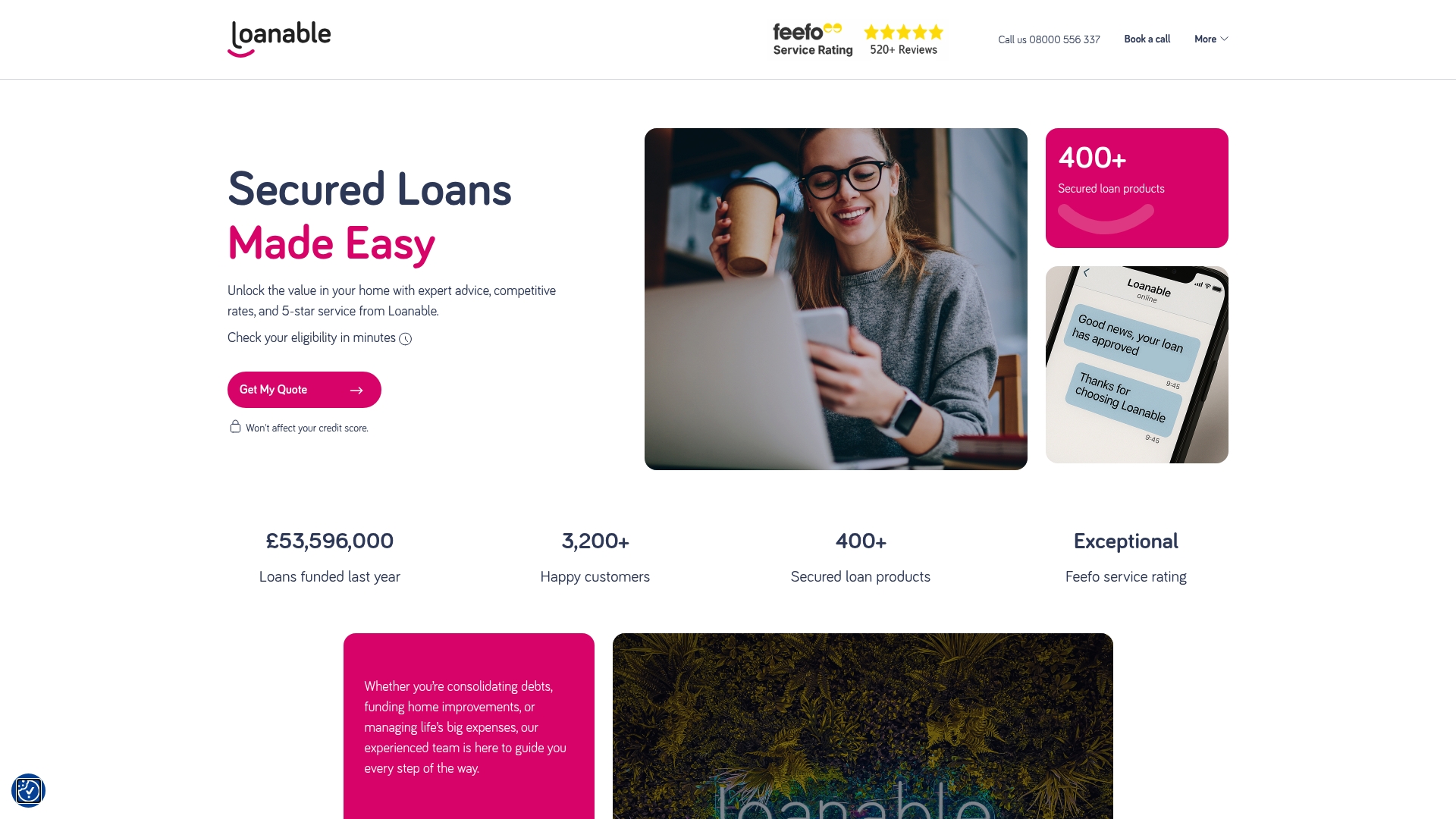
Loanable has funded over £53 million in loans for UK homeowners, including those with challenging credit histories who were quoted unfavourable terms elsewhere. The service is built around finding the most competitive secured rate for your specific profile, not the most convenient product for a single lender’s book.
Check your eligibility now or visit the secured loans page to see how Loanable’s advisers can help you finance your home improvement at a rate that reflects your actual circumstances.
Sources
- Solar Panel Funding & Financing in the UK (2026 Guide)
- Credit Score Impact on Credit Applications: 2026 Guide – Rate Grove
When verifying any adviser or lender, check their FCA registration number on the FCA Register before proceeding.
This article is general information, not a substitute for advice from a qualified financial advisor. Consult a qualified financial professional about your own circumstances before acting on anything here.