



Homeowners with a regular income and equity to protect usually suit an IVA. People with no significant assets and very little disposable income usually suit bankruptcy. That is the core distinction, and everything else in this guide expands on it.
Signals that point toward an IVA:
- You own property with equity, or have assets worth protecting
- You can afford a realistic monthly payment over five to six years
- Your employment or professional licence could be affected by bankruptcy
Signals that point toward bankruptcy:
- You have no significant assets and very low disposable income
- You need debt cleared quickly, with discharge typically at around 12 months
- You cannot sustain a multi-year payment plan
On timelines: an IVA typically runs for five to six years; bankruptcy usually brings discharge at around 12 months, though the Official Receiver can require income payments for up to 36 months. StepChange confirms both routes are recorded on insolvency registers and affect your credit file for six years.
The comparison table below gives a side-by-side view. The decision checklist in section 6 helps you work through your own circumstances step by step.
Key takeaways
Both IVA and bankruptcy write off unsecured debt, but the right choice depends on whether you own property, how much disposable income you have, and what employment restrictions you can afford.
| Point | Details |
|---|---|
| IVA suits homeowners | An IVA usually protects your property; bankruptcy puts equity at direct risk via the trustee’s duty to realise assets. |
| Bankruptcy is faster | Discharge typically happens at around 12 months, versus five to six years of payments under an IVA. |
| Both affect credit for six years | IVA and bankruptcy both appear on the Individual Insolvency Register and impact your credit file for six years. |
| Some debts survive both routes | Student loans, certain court fines, and child support arrears may remain enforceable after either process. |
| Loanable offers an alternative | Homeowners with equity and stable income can explore a secured consolidation loan via Loanable before committing to insolvency. |
Where to get free, regulated advice and official guidance
Before committing to any debt solution, contact a free, regulated adviser. None of the services below charge for initial advice.
- Gov: Official rules, statutory pages, and the online bankruptcy application. The authoritative source for procedural detail on both routes.
- The Insolvency Service: Maintains the Individual Insolvency Register and publishes guidance on trustee duties, discharge rules, and income payments.
- StepChange: A debt charity offering free IVA and bankruptcy advice, including a full debt assessment and referral to a licensed insolvency practitioner where appropriate.
- Citizens Advice: Free, impartial debt advice available online, by phone, and in person. Covers all debt solutions including DROs, DMPs, IVAs, and bankruptcy.
- MoneyHelper: Government-backed consumer guidance on all debt options, with a debt advice locator tool to find regulated advisers near you.
To locate an authorised insolvency practitioner, use the Insolvency Service’s register of licensed practitioners. Always verify that any IP you use is licensed before signing any proposal.
This article is general information, not financial or legal advice. Debt solutions affect your credit file and legal status. Confirm the current rules and your personal eligibility with a regulated debt adviser or insolvency practitioner before making any decision.
This article is general information, not a substitute for advice from a qualified financial advisor. Consult a qualified financial professional about your own circumstances before acting on anything here.
Table of Contents
- How do IVA and bankruptcy compare side by side?
- What is an IVA and how does it work in the UK?
- What is bankruptcy and how does it work in the UK?
- What are the real-life differences between an IVA and bankruptcy?
- How do you choose between an IVA and bankruptcy?
- What happens step by step after you apply?
- Alternatives worth checking first: DRO, debt management plans, and consolidation loans
- Secured consolidation loans: an alternative for homeowners
- Sources
How do IVA and bankruptcy compare side by side?
The table below covers the dimensions that matter most when weighing IVA vs bankruptcy for UK households.
| Dimension | IVA | Bankruptcy |
|---|---|---|
| Typical duration | 5–6 years (monthly payments) | Discharge at ~12 months; income payments possible for up to 36 months |
| What happens to your home | Usually retained; equity clause may require remortgage attempt in later years | Trustee assesses equity; property may be sold if equity exceeds de minimis threshold |
| What happens to other assets | Cars and savings above agreed thresholds may need to be disclosed; IP sets allowances | Official Receiver takes control; assets above small thresholds realised for creditors |
| Costs and fees | No upfront government fee; insolvency practitioner fees deducted from monthly payments | Upfront application fee required (set by the Insolvency Service) |
| Credit file and public record | Recorded on Individual Insolvency Register for six years; less public than bankruptcy | Recorded on Individual Insolvency Register and advertised in the London Gazette |
| Who it suits | Homeowners; those with steady income; those in regulated professions | Renters; very low income; no significant assets; need fast resolution |
| Employment restrictions | Fewer automatic restrictions; disclosure rules apply | Directors banned from company management; some regulated roles restricted |
| Typical monthly payments | Based on disposable income after essential allowances; negotiated with IP | Income Payments Agreement if disposable income exceeds threshold |
| Debts included or excluded | Most unsecured debts; some exclusions (e.g. student loans, court fines) | Most unsecured debts; some debts remain enforceable after discharge |

What is an IVA and how does it work in the UK?
An Individual Voluntary Arrangement is a formal, legally binding agreement between you and your unsecured creditors, set up and supervised by a licensed insolvency practitioner (IP).
How it is set up. Your IP drafts a proposal based on your income, essential outgoings, and assets. That proposal goes to your creditors, who vote on it. Gov that approval requires a 75% majority by value of creditors who vote. Creditors can propose modifications before accepting, so the process is negotiable rather than automatic. Once approved, the arrangement is legally binding on all unsecured creditors, including those who voted against it.
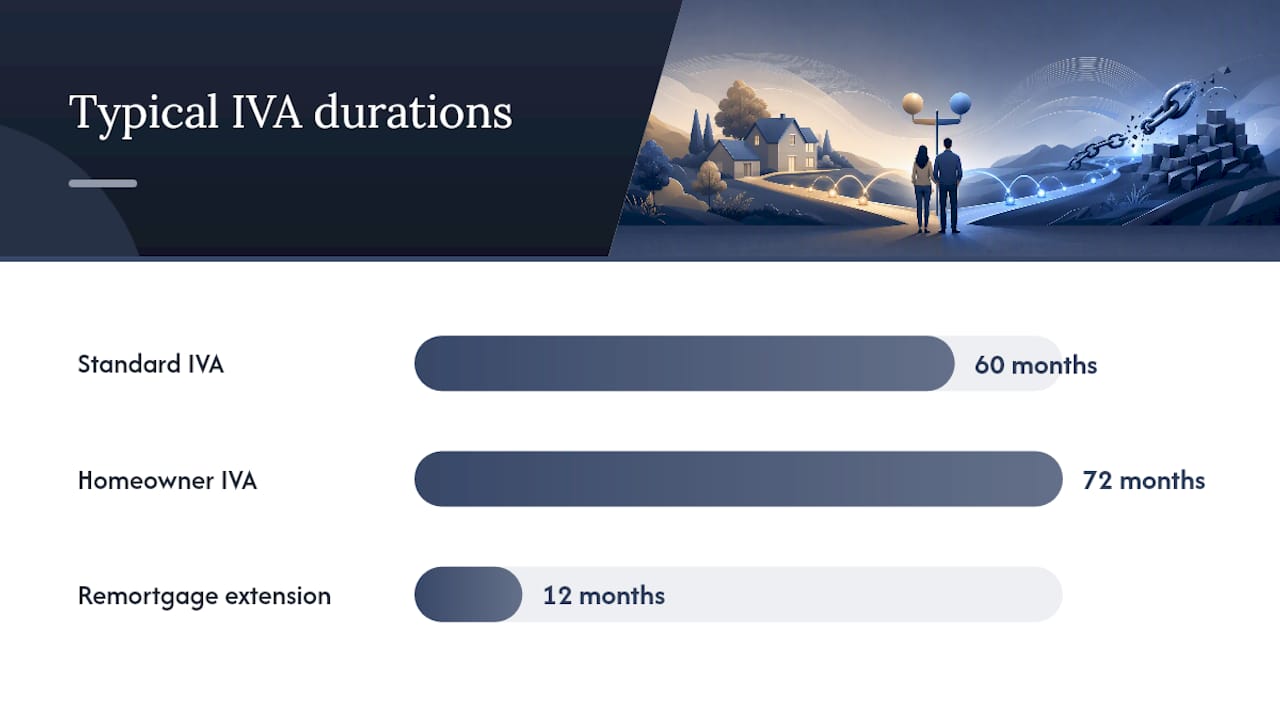
How payments are calculated. Your IP runs a disposable income test: your total income minus essential living allowances (rent or mortgage, food, utilities, travel) leaves a surplus that becomes your monthly IVA payment. IP fees come out of those payments rather than being charged upfront. Most IVAs run for 60 months (five years). If you own a home with equity, a sixth year is often added, during which you are usually required to attempt a remortgage to release equity for creditors.
Once the IVA starts, interest and charges on included debts are frozen. At completion, any remaining balance on those debts is written off. That write-off is often the single biggest financial benefit for people who owe more than they could realistically repay in full.
The homeowner equity clause in practice. Most IVA proposals include a clause requiring you to try to remortgage in year five or six to release equity up to a set limit. If a remortgage is not available (which is common when you are IVA-listed), the IVA usually extends by 12 months instead. In the current mortgage market, getting a remortgage while on an IVA register is genuinely difficult, so many homeowners end up on a 72-month arrangement.
Key points for homeowners considering an IVA:
- Your home is usually protected, but the equity clause is real and should be discussed in detail with your IP
- Monthly payments can be reviewed if your income or essential costs change significantly
- Creditors can reject or modify a proposal, so approval is not guaranteed
Pro Tip: When comparing IVA proposals from different insolvency practitioners, ask specifically: “How will my essential allowances be reviewed if my living costs rise significantly?” Some IPs apply rigid standard budgets; others build in annual reviews. The answer tells you how protected your monthly budget actually is.
What is bankruptcy and how does it work in the UK?
Bankruptcy is a formal insolvency process that writes off most of your unsecured debts in exchange for surrendering control of your assets to an Official Receiver or trustee.
How it begins. You apply online through GOV.UK and pay an upfront application fee set by the Insolvency Service. Once approved, an Official Receiver is appointed. They take control of your assets, investigate your financial affairs, and decide what can be realised to repay creditors. A trustee may be appointed separately if there are significant assets to administer.
Discharge timeline. Discharge from bankruptcy typically happens at around 12 months. After discharge, most unsecured debts are written off. However, if the Official Receiver finds you have disposable income above a set threshold, they can require you to sign an Income Payments Agreement (IPA), which runs for up to 36 months from the bankruptcy order, not from discharge. So the practical financial commitment can extend well beyond the 12-month headline.
What happens to your home. The Gazette’s guidance on trustee duties confirms that trustees have a statutory duty to realise property where equity exists. If your home has equity above a small de minimis threshold (generally around £1,000), the trustee is expected to act on it. A co-owner or partner is usually offered the chance to buy out the bankrupt’s share, but they must find the funds quickly. If no buyout happens, the property can be sold. This is the starkest practical difference between bankruptcy and an IVA for homeowners.
Other assets. The Official Receiver will assess your car, savings, and investments. A car needed for work may be retained up to a reasonable value; savings and non-essential assets above small thresholds are generally taken.
Public record. The Insolvency Service’s Individual Insolvency Register records your bankruptcy. Unlike an IVA, bankruptcy is also advertised in the London Gazette, making it more publicly visible. This matters for anyone whose employer, landlord, or professional body monitors such records.
Key restrictions during bankruptcy:
- You cannot act as a company director without court permission
- Solicitors, financial advisers, and some other regulated professionals face automatic restrictions
- You must inform creditors and certain counterparties of your status
- Obtaining credit above a small threshold without disclosing your bankruptcy is a criminal offence
What are the real-life differences between an IVA and bankruptcy?
The biggest practical difference is this: an IVA usually protects your home but commits you to years of managed payments; bankruptcy clears debts faster but puts assets, including property, at real risk.
Homeowners. In an IVA, your property stays in your name throughout, but the equity clause means creditors have a claim on any equity that builds up. In bankruptcy, the trustee’s duty to realise equity is not optional. If you have meaningful equity, bankruptcy is a serious risk to your home.
Renters and those with no significant assets. For a renter with low disposable income and no savings worth protecting, bankruptcy often makes more sense. The 12-month discharge is faster than five or six years of IVA payments, and there are fewer assets for the Official Receiver to pursue.
Practical impact bullets:
- Career: Bankruptcy automatically restricts directorships and some regulated roles. An IVA has fewer automatic restrictions, though your employment contract may still require disclosure.
- Privacy: An IVA appears on the Individual Insolvency Register. Bankruptcy appears there and in the London Gazette, making it more visible to employers, landlords, and professional bodies.
- Creditor return: An IVA usually returns more to creditors over time (five or six years of payments). Bankruptcy may return very little if there are no assets.
- Debt write-off: Both routes can write off remaining balances, but Citizens Advice notes that some debts, such as certain court fines, student loans, and child support arrears, survive both processes.
Two illustrative scenarios:
Renter, low income. Someone renting privately, with £15,000 of credit card debt and £80 per month of disposable income after essentials, is unlikely to sustain a five-year IVA. Bankruptcy clears the debt at 12 months. If disposable income stays low, no IPA is required. The main cost is the upfront fee and the six-year credit file impact.
Homeowner with equity. A homeowner with £40,000 of unsecured debt and £300 per month of disposable income has equity worth protecting. Bankruptcy puts that equity at risk immediately. An IVA keeps the property in their name, freezes interest, and writes off the remaining balance at completion, though the equity clause will require a remortgage attempt or an extended sixth year.
How do you choose between an IVA and bankruptcy?
Work through this checklist in order. Your answers will point clearly toward one route or the other.
- Assess your home equity. Do you own property with equity above a small threshold? If yes, bankruptcy puts that equity at direct risk. An IVA is usually the safer route for homeowners.
- Calculate your realistic disposable income. After genuine essential outgoings, how much is left each month? If it is very low (broadly under £100), sustaining a five-year IVA payment is unlikely. Bankruptcy may be more realistic.
- Check your employment and licence risk. Are you a company director, solicitor, financial adviser, or in another regulated role? Bankruptcy carries automatic restrictions. An IVA usually does not, though you should check your employment contract.
- Estimate your ability to maintain payments for five years. Your income and outgoings will be reviewed annually in an IVA. If your income is variable or insecure, discuss how the IP handles shortfalls before committing.
- Check whether you can afford the bankruptcy application fee. Bankruptcy requires an upfront fee. If you cannot pay it, an IVA (with no upfront charge) or a Debt Relief Order may be the only practical options.
Questions to ask a free debt adviser or insolvency practitioner:
- How will my mortgage or rent be treated in the disposable income calculation?
- Will I be required to attempt a remortgage, and what happens if I cannot get one?
- What fees are deducted from my monthly IVA payments, and how are they prioritised?
- Which of my debts would not be covered by either route?
- Does my employment contract require me to disclose insolvency proceedings?
Pro Tip: One of the most common errors is assuming a remortgage will be available in year five of an IVA. Being listed on the Individual Insolvency Register makes standard mortgage products largely inaccessible. Ask your IP what the IVA terms say if a remortgage cannot be obtained, before you sign the proposal.
What happens step by step after you apply?
Bankruptcy is quicker to resolve but may involve income payments for up to three years; an IVA takes longer overall but usually keeps your assets intact throughout.
Bankruptcy timeline:
- Week 1–4: Application submitted online; upfront fee paid; adjudicator reviews and approves the order.
- Month 1–3: Official Receiver appointed; assets investigated; property equity assessed; creditors notified.
- Month 3–12: Trustee realises assets where applicable; income reviewed for IPA eligibility.
- Month 12: Automatic discharge from bankruptcy (unless suspended for non-cooperation).
- Up to month 36: IPA payments continue if agreed; bankruptcy record remains on the Individual Insolvency Register.
IVA timeline:
- Weeks 1–6: IP drafts proposal; income and asset assessment completed; proposal sent to creditors.
- Week 6–8: Creditors’ meeting or virtual vote; 75% by value must approve; modifications may be requested.
- Month 2 onward: Monthly payments begin; interest on included debts frozen.
- Month 54–60 (year 5): Equity review; remortgage attempt required for homeowners.
- Month 60 or 72: IVA completes; remaining balances written off; IP issues completion certificate.
Key time-bound milestones:
| Milestone | IVA | Bankruptcy |
|---|---|---|
| Creditor vote / approval | ~6–8 weeks from proposal | Not applicable |
| First payment / asset action | Month 2 | Month 1–3 |
| Discharge or completion | Month 60–72 | Month 12 |
| Income payments end | Month 60–72 | Up to month 36 |
| Credit file cleared | 6 years from start | 6 years from order |
Practical preparation notes:
- Both routes require proof of income, bank statements, a list of creditors and balances, and details of any assets
- For an IVA, your IP will need evidence of essential outgoings to set the disposable income figure
- For bankruptcy, the Official Receiver may contact your employer to verify income
Alternatives worth checking first: DRO, debt management plans, and consolidation loans
Several other routes exist, and for some readers they are a better fit than either an IVA or bankruptcy.
Debt Relief Order (DRO). A DRO suits people with very low income, minimal assets, and debts under the current statutory threshold. It provides a 12-month moratorium, after which qualifying debts are written off. There is a small application fee, and you apply through an authorised intermediary rather than directly. The DRO vs IVA comparison from IVA Info outlines the eligibility criteria in detail. If your debts and assets fall within the DRO limits, it is worth checking before considering an IVA.
Debt Management Plan (DMP). A DMP is an informal arrangement, not a statutory insolvency process. You make reduced monthly payments to creditors through a debt management company or charity. It does not write off debt and creditors are not legally bound to freeze interest, but it carries no automatic employment restrictions and does not appear on the Individual Insolvency Register. A guide to debt management plans explains how they work and when they suit people with manageable debt levels who want to avoid formal insolvency.
Secured consolidation loan. For homeowners with sufficient equity and a stable income, a secured consolidation loan can replace multiple unsecured debts with a single monthly payment at a lower rate. This is not an insolvency route: it does not write off debt, and your home is used as security. The key question is whether the monthly repayment is genuinely affordable long-term. If it is, consolidation avoids the insolvency register entirely and preserves your credit profile better than either an IVA or bankruptcy. If it is not affordable, it adds risk rather than reducing it.
[loanable_borrowing_calculator]
Quick borrowing check for homeowners:
- Do you have usable equity in your property?
- Is your income stable enough to service a secured loan for the full term?
- Would consolidating your debts reduce your total monthly outgoing to a manageable level?
- Have you taken free debt advice to confirm insolvency is not the better route?
If you answered yes to the first three and no to the last, a debt consolidation loan for homeowners may be worth exploring before committing to an IVA or bankruptcy.
A secured consolidation loan does not write off debt. It replaces multiple unsecured debts with a single secured loan, using your home as collateral. If you cannot keep up repayments, your property is at risk. Always take free, regulated debt advice before deciding whether to borrow or enter insolvency.
A note on what we see at Loanable
Homeowners who approach Loanable for a secured consolidation loan often do so after being told by a debt adviser that an IVA is their only option. In many cases, they have equity and a stable income, which means consolidation is genuinely viable. Loanable’s CeMAP-qualified advisors have helped arrange over £53 million in secured lending, including for borrowers with challenging credit histories. The outcome is not always a loan: sometimes the advice is to pursue free debt charity support first. The point is that homeowners have more options than the IVA-or-bankruptcy binary suggests, and it is worth checking eligibility before closing off any route. You can check your eligibility without affecting your credit score.
Secured consolidation loans: an alternative for homeowners
For homeowners who can afford repayments and want to avoid the insolvency register, a secured consolidation loan is a practical alternative to an IVA or bankruptcy.
Loanable specialises in secured loans for UK homeowners, including debt consolidation. The core benefit is straightforward: one monthly payment, potentially at a lower rate than the combined cost of multiple unsecured debts, without entering formal insolvency.
When a secured consolidation loan may make sense:
- You have sufficient equity in your home to secure the borrowing
- Your income is stable and the monthly repayment is genuinely affordable
- You want to avoid the employment and credit restrictions that come with an IVA or bankruptcy
- A free debt adviser has confirmed insolvency is not the more appropriate route
The main risk is clear. Your home secures the loan. If you cannot keep up repayments, you could lose it. This is a serious commitment and should only be considered after taking regulated advice.
Loanable’s advisors work with a wide network of lenders and can access options for borrowers with imperfect credit histories. To see whether a secured consolidation loan fits your situation, take a look at Loanable’s debt consolidation loans page, or run an eligibility check that does not affect your credit score.
Sources
- Gov
- Individual voluntary arrangement (IVA) or bankruptcy? | StepChange
- Individual Insolvency Register – Insolvency Service (insolvencydirect)
- What are the differences between an IVA and bankruptcy? — The Gazette