



The right loft conversion finance depends on one thing above all else: how your project cost compares to your available equity and savings.
- Have full savings and a healthy emergency fund: pay cash. No interest, no approval, no risk to your property.
- Need £10,000–£25,000 quickly and own your home: an unsecured personal loan or home improvement loan is the fastest route with no security required.
- Need £40,000–£80,000+ and have meaningful equity: a remortgage, further advance, or secured homeowner loan give you lower rates over a longer term.
- Over 55 with significant equity but limited income: equity release can free a large lump sum, though it reduces what you leave behind.
- Planning insulation or heating as part of the conversion: check ECO4 and local authority grants first. They will not cover the full build, but they can reduce the net cost.
Before you commit to any route, get a fixed-price quote from a contractor. Then add a contingency allowance on top. That total figure is what you need to borrow or save, not the headline estimate.
Table of Contents
- How do you choose the right loft conversion finance?
- Grants, ECO4 and local schemes that can reduce the cost
- What are the hidden costs you need to budget for?
- How do you apply, and how long does it take?
- Quick comparison of the main loft conversion financing options
- Worked repayment examples and borrowing calculator
- Key takeaways
- The real pitfalls brokers see most often
- Loanable can arrange secured finance for your loft conversion
- Useful sources and further reading
How do you choose the right loft conversion finance?
The single most important driver is project scale relative to your equity and savings. A £20,000 Velux conversion and an £80,000 L-shaped dormer are entirely different financial problems.
Five factors determine which route fits:
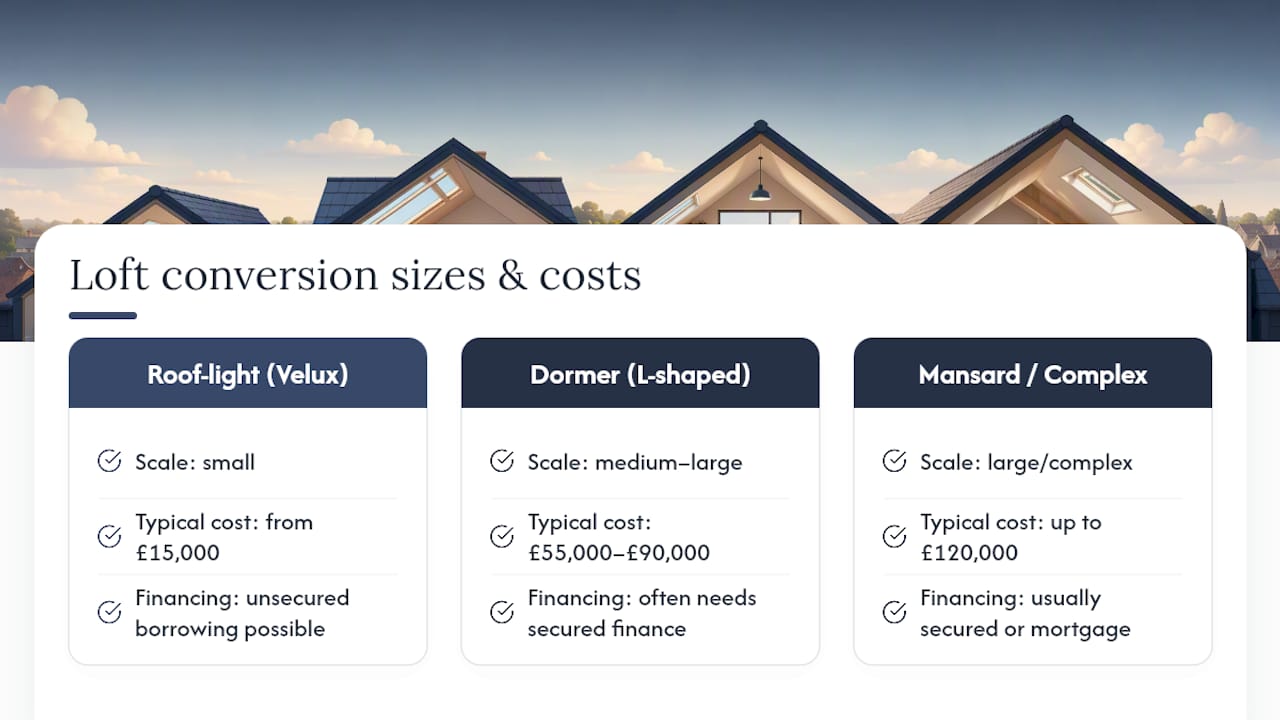
1. Project size and cost. According to Use Your Space, loft conversions typically range from around £55,000 to £120,000 depending on the type and specification. However, some eaves or roof-light projects can cost from £15,000, and large L-shaped dormers with premium finishes can reach around £90,000; high-spec mansard or complex conversions may approach the top of the range. Smaller projects can be handled with unsecured borrowing; larger ones almost always need secured finance or a mortgage product.
2. Available equity. Secured loans and remortgages require usable equity in your property. Check your current loan-to-value ratio before approaching any lender.
3. Your existing mortgage deal. If you are mid-fix, early repayment charges can make remortgaging expensive. A further advance or a second-charge secured loan may be cheaper in that situation.
4. Credit profile and urgency. Unsecured loans are approved faster but carry higher APRs and lower limits. If your credit history is patchy, a specialist secured lender may offer better terms than a high-street bank.
5. Valuation risk. Before borrowing heavily, check the street ceiling for your area. If comparable properties nearby sell for £350,000 and your post-conversion home would be worth £380,000, spending £80,000 on the project is a lifestyle choice, not an investment. That does not make it wrong, but it changes the financial logic.
Pro Tip: Get a fixed-price quote from a Federation of Master Builders registered contractor before approaching any lender. Lenders want certainty; a fixed quote also stops you borrowing more than you need.
Grants, ECO4 and local schemes that can reduce the cost
Grants rarely cover a full loft conversion, but energy-efficiency schemes can fund insulation or heating work that forms part of the project, reducing the net amount you need to borrow.
- ECO4 (Energy Company Obligation 4): funded by energy suppliers, ECO4 covers insulation and heating upgrades for eligible low-income or vulnerable households. If your loft conversion includes insulation work and you meet the criteria, this can offset a meaningful portion of that element. Check current eligibility at GOV.UK or via your energy supplier.
Sunlight Lofts advises planning energy measures into the conversion from the outset. Retrofitting insulation after the build is more expensive and may not qualify for the same grant support.
Grant availability and eligibility windows change. Always verify current criteria directly with GOV.UK or your local council before factoring grant income into your budget.
What are the hidden costs you need to budget for?
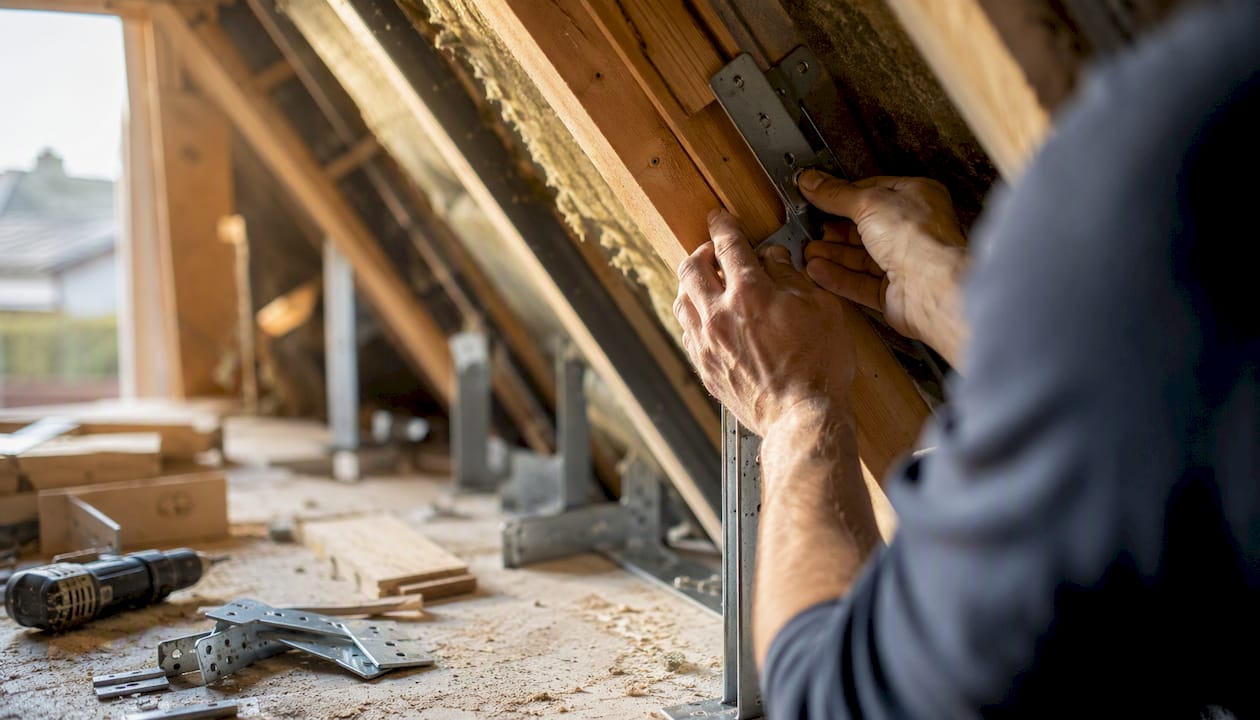
Professional fees and contingency commonly add 10–15% to a contractor quote. Budget for these from the start, not as an afterthought.
| Cost item | Typical range | Notes |
|---|---|---|
| Contractor build cost (Velux/roof-light) | £15,000–£30,000 | Basic conversion, no dormer |
| Contractor build cost (dormer) | £40,000–£80,000+ | Single or double dormer |
| Contractor build cost (mansard/L-shaped) | £60,000–£120,000 | High spec or complex structure |
| Architect / designer fees | — | Drawings, planning support |
| Structural engineer | — | Calculations for building regs |
| Planning application fee | — | If permitted development does not apply |
| Building regulations | — | Inspection and sign-off |
| VAT (on contractor fees) | 20% | Standard rate applies to most residential work |
| Fixtures and finishes | £10,000–£25,000 | Staircase, bathroom, flooring |
| Contingency | 10–15% of total | Non-negotiable |
Before calculating how much to borrow, work through this checklist:
- Fixed-price contractor quote (not an estimate)
- Architect and structural engineer fees
- Planning and building regulations fees
- VAT on all contractor and professional fees
- Fixtures, fittings, and staircase
- Temporary accommodation if required during the build
- 10–15% contingency on the total
If your primary loan is delayed and the build has already started, a short-term personal loan or an agreed overdraft can bridge the timing gap. Plan for this possibility before work begins.
How do you apply, and how long does it take?
The fastest routes take days; the most complex take months. Choose based on urgency as well as cost.
- Run a soft eligibility check. Use a broker or lender’s soft-search tool to gauge likely approval without affecting your credit score. Loanable’s eligibility check does not leave a mark on your file.
| Finance route | Typical timeline |
|---|---|
| Unsecured personal loan | 1–5 working days |
| Secured homeowner loan | 3–6 weeks |
| Further advance | 2–4 weeks |
| Remortgage | 4–8 weeks |
| Equity release | 6 weeks |
Quick comparison of the main loft conversion financing options
The right option depends on your project size, equity position, and how quickly you need funds.
| Loan type | Typical borrowing range | APR / term shape | Security required | Best for | Key fees |
|---|---|---|---|---|---|
| Savings (cash) | Any | None | None | Full-pay homeowners with reserves intact | None |
| Unsecured personal loan | — | Higher APR, 1–7 years | None | Small projects, quick funding | Possible early repayment fee |
| Secured homeowner loan | £10,000–£80,000+ | Lower APR, 5–25 years | Property (second charge) | Large projects, existing mortgage to protect | Arrangement fee, valuation |
| Further advance | £10,000–£80,000+ | Mortgage rate, mortgage term | Property (first charge) | Existing lender, no ERC due | Arrangement fee |
| Remortgage | — | Lowest APR, full mortgage term | Property (first charge) | Large projects, end of fix | Valuation, legal, possible ERC |
| Equity release | — | Rolls up (no monthly payment) | Property (lifetime charge) | Homeowners 55+, no income for repayments | Advice fee, arrangement fee |
Reading APR and total cost: a lower APR over a longer term does not always mean lower total cost. A £50,000 secured loan at 7% over 20 years costs more in total interest than the same sum at 9% over 8 years. Always compare total repayable, not just the monthly figure.
Worked repayment examples and borrowing calculator
Monthly payments and total interest vary significantly depending on loan type and term. Two examples illustrate the difference.
Example 1: £30,000 unsecured personal loan over 5 years
At a representative APR of 8.9%, monthly repayments would be approximately £620. Total repayable over the term would be approximately £37,200. This suits a smaller dormer or Velux conversion where speed matters and the homeowner does not want to secure the debt against their property.
Example 2: £60,000 secured homeowner loan over 20 years
At a rate of 7%, monthly repayments would be approximately £465. Total repayable over the term would be approximately £111,600. The monthly cost is lower, but the total interest paid is substantially higher than a shorter term. A homeowner who can afford £800 per month and takes a 10-year term instead would pay approximately £83,600 in total, saving around £28,000 in interest.
Borrowing Calculator
See how much you could potentially borrow against your home, subject to status.
Please enter a property value that's higher than your outstanding mortgage balance.
Based on your figures, the amount available is below our typical minimum loan of £25,000. Get in touch and we'll talk through your options.
Get my free, no-obligation quoteIllustrative only, based on a maximum combined loan-to-value of 75%. This is not a loan offer or a quote, and your actual rate, borrowing amount and monthly payment will depend on your circumstances, credit profile and the lender's criteria. Think carefully before securing other debts against your home. Your home may be repossessed if you do not keep up repayments on your mortgage or any other debt secured on it.
Use the calculator above to run your own figures. Adjust the loan amount, term, and rate to see how monthly cost and total interest change. You can also use mortgage and affordability calculators to model how additional borrowing affects your overall mortgage position.
Expert note: Loanable’s CeMAP-qualified advisors consistently flag one underappreciated trade-off: a longer term lowers monthly cost but can affect your ability to remortgage later if the additional charge pushes your LTV above a lender’s threshold. Match the term to what you can genuinely afford monthly, not just to what the lender will approve.
Key takeaways
Secured homeowner loans and remortgages suit large loft conversions best; unsecured loans work for smaller projects; always add 10–15% contingency to your fixed quote before calculating how much to borrow.
| Point | Details |
|---|---|
| Match route to project scale | Unsecured loans suit projects under ~£25,000; secured loans and remortgages suit larger sums. |
| Get a fixed quote first | Borrow against a confirmed cost, not an estimate, to avoid under-borrowing. |
| Budget 10–15% contingency | Professional fees and unexpected structural work routinely add to the contractor quote. |
| Check mortgage terms early | Early repayment charges can make remortgaging expensive; a secured second-charge loan may cost less. |
| Loanable for secured borrowing | Loanable brokers secured homeowner loans for large conversions, including options for non-standard credit. |
The real pitfalls brokers see most often
Most homeowners who struggle with loft conversion finance run into the same small set of problems.
The most common is borrowing against an estimate rather than a fixed quote. Costs rise, the loan falls short, and the homeowner has to return to a lender mid-build, often at a worse rate. Get the fixed quote first.
The second is ignoring early repayment charges. A homeowner mid-way through a five-year fix with a 2% ERC on a £180,000 mortgage is looking at £3,600 in charges before the remortgage even starts. A secured second-charge loan avoids that entirely and often costs less overall when the ERC is factored in.
The third is underestimating the contingency. Once a loft is opened up, structural surprises are common: undersized joists, unexpected party wall complications, or a roof that needs more work than the survey suggested. A 10% contingency sounds cautious until you need it.
From a broker’s perspective, the applications that move fastest are the ones where the homeowner arrives with a fixed quote, a clear picture of their equity, and three months of bank statements already organised. Lenders respond to preparation. Gaps in documentation add weeks to a timeline, not days.
Loanable’s secured loan specialists work with homeowners across the credit spectrum, including those who have been declined elsewhere. An eligibility check does not affect your credit score.
Loanable can arrange secured finance for your loft conversion
Remortgaging is not always the right answer. If you are mid-fix, have a competitive existing rate, or have been declined by a high-street lender, a secured homeowner loan brokered through Loanable is often the more practical route.
Loanable has arranged over £53 million in secured loans for UK homeowners, including those with non-standard credit histories. The process starts with a soft eligibility check that does not affect your credit score. A CeMAP-qualified advisor then reviews your situation, accesses a panel of lenders, and presents options matched to your project cost and financial position.
- No impact on your credit score to check eligibility
- Access to lenders who consider non-standard credit
- Specialist advice on second-charge vs remortgage trade-offs
- Fixed-quote requirement built into the process
Check your eligibility now or visit Loanable’s secured loans page to see how the process works.
This article provides general information only and is not financial advice. Confirm current rates, eligibility criteria, and grant availability with the relevant lender, scheme provider, or a qualified financial adviser before making any borrowing decision.
Useful sources and further reading
- How Do You Finance a Loft Conversion or Extension? – Use Your Space
- Financing Your Loft Conversion: Loans, Remortgages and Grants UK | Sunlight Lofts
- Loft Conversion Financing: A Guide to Loft Conversion Loans
- How To Finance a Loft Conversion: A UK Guide (2026)
- The best ways to cover loft conversion costs
- moneysavingexpert.com
- moneyhelper.org.uk
- telegraph.co.uk