



A second charge mortgage is affordable if two things line up: your household budget can absorb the new monthly payment on top of your existing first mortgage, and your combined loan-to-value (CLTV) leaves enough equity for a lender to lend against. Miss either test and the application fails, regardless of how good your credit score looks.
The FCA’s 2026 review of second charge mortgages found some affordability assessments relied on unrealistic expenditure assumptions rather than a borrower’s actual spending. That same review noted intermediary fees typically sit at 10% to 15% of the loan value, a figure worth knowing before you compare quotes.
If you want a quick, personalised estimate rather than working through the theory first, use the calculator further down this page. For everything else, here’s what actually determines whether you’ll qualify.
- Income affordability: can you sustainably cover the new payment alongside existing debt?
- Combined LTV: does enough equity remain once your first mortgage and the new loan are added together?
- Credit history: adverse entries narrow lender choice and push up pricing
- Fees and APR: intermediary and lender charges affect the real cost of borrowing
Broker fees on second charge loans typically run 10% to 15% of the amount borrowed, according to the FCA’s review findings, so factor that into any affordability sum before you commit.
Key Takeaways
Second charge mortgage affordability depends on the lower of your income-based limit and your combined LTV-based limit, both stress-tested against realistic household spending.
| Point | Details |
|---|---|
| Two gating factors | Income affordability and combined LTV both cap borrowing; the lower figure wins. |
| Fees shape true cost | Intermediary fees typically run 10% to 15% of loan value, so compare APR, not headline rate. |
| Expenditure must be real | FCA findings show some checks used generic averages; bring evidence of your actual spending. |
| Credit history compounds | Adverse credit raises rates, which raises the stress-tested payment and lowers what you can borrow. |
| Get a lender-specific answer | Loanable’s CeMAP-qualified advisers assess your case against its own lender panel rather than a generic calculator output. |
Table of Contents
- What lenders look at when assessing second charge mortgage affordability
- How much equity do you actually have to borrow against?
- Why realistic expenditure assumptions matter more than lenders once assumed
- Does bad credit stop you qualifying for a second charge mortgage?
- Fees, APR and the true cost of a second charge mortgage
- Worked example: estimating your second charge borrowing capacity
- Practical steps that improve your affordability outcome
- Remortgaging, unsecured loans or a second charge: which fits your affordability?
- How long does a second charge mortgage affordability assessment take?
- A CeMAP adviser’s view on borrowing sensibly
- Loanable’s approach to second charge mortgage affordability
- Primary sources and further reading
- Frequently asked questions
- Sources
What lenders look at when assessing second charge mortgage affordability
Lenders build their assessment around evidence, not estimates. Whatever your income type, they want documentation that proves it’s real, regular, and likely to continue.
For employed applicants, that usually means three months of payslips and bank statements, plus a P60. Self-employed borrowers face more scrutiny: lenders typically ask for two to three years of SA302s, tax-year overviews or full business accounts, alongside personal and business bank statements. Where income varies year to year, most lenders average the last two years rather than taking the best year in isolation, which catches out some applicants who assumed a strong recent year would carry the whole application.
Then comes the stress test. Lenders don’t assess affordability against today’s rate. This protects both the lender and you from a loan that only works while rates stay low.
- Payslips and P60s for employed income
- SA302s or accounts for self-employed income
- Bank statements showing income consistency
- Proof of any additional income (rental, benefits, pensions)
Files with strong, consistent documentation move through underwriting faster and attract better terms than applications built on assumptions about future income.
Tip: If your income fluctuates, include a short covering letter explaining why, alongside your accounts. Underwriters read context, and an unexplained dip in year two can trigger unnecessary delays.
How much equity do you actually have to borrow against?
Available equity is simple arithmetic: your property’s current value minus everything already secured against it. If your home is worth £320,000 and your first mortgage balance is £180,000, you have £140,000 of equity before any lending limit is applied.
Lenders then cap what they’ll advance using combined loan-to-value bands. The UK second charge market typically works within these bands:
- Conservative lenders cap combined LTV around 75%, favouring lower risk and often better rates.
- Standard lenders stretch to around 80%, the most common ceiling across the market.
- Higher-risk lenders will go up to 85+% for stronger applicants, usually at a higher price.
Subtract the £180,000 first mortgage and the maximum second charge is £76,000, before affordability is even tested.
Valuation method affects both the figure lenders use and how quickly your case moves. An automated valuation model (AVM) is fastest and cheapest but can undervalue unusual properties. A desktop valuation sits in the middle. A full physical valuation costs more and takes longer but gives lenders (and you) the most defensible figure, particularly on properties that have changed significantly since the last sale.

Why realistic expenditure assumptions matter more than lenders once assumed
Equity supports the security. It doesn’t prove you can afford the repayments, and that distinction sits at the heart of the FCA’s 2026 findings. The regulator’s review flagged that some affordability checks leaned on generic statistical averages for household spending rather than a borrower’s actual costs.
That matters because average figures rarely reflect real households. A family with young children, an older property needing repairs, or a long commute has cost profiles that statistical averages simply miss.
Costs lenders should be accounting for, and that you should raise yourself if they don’t ask, include:
- Childcare and school-related costs
- Ongoing home repairs and maintenance
- Buildings and contents insurance
- Council tax and utility increases
- Travel and commuting costs
The FCA’s review also noted that many second charge borrowers show characteristics of financial vulnerability, which raises the stakes on getting expenditure assessments right rather than defaulting to averages.
Where lenders under-check spending, the burden shifts to the borrower. Bring three to six months of bank statements and be ready to itemise anything unusual, a new childcare arrangement, a recent boiler replacement, so the lender is assessing your real budget rather than a statistical proxy for it.
Does bad credit stop you qualifying for a second charge mortgage?
Adverse credit doesn’t automatically rule you out, but it does two things that reduce what you can borrow. First, it narrows the pool of lenders willing to consider your application, and many of those that remain cap combined LTV lower to offset their risk. Second, it usually means a higher interest rate, which feeds directly into the stress test.
That second point is the one borrowers underestimate. A higher rate produces a higher stressed monthly payment, and a higher stressed payment reduces the maximum loan the affordability test will pass, even where equity is plentiful. Adverse credit therefore compounds: worse pricing shrinks your borrowing capacity twice over, once through lender appetite and once through the affordability sum itself.
- Defaults and missed payments typically narrow lender choice, not eliminate it entirely
- CCJs often require specialist lenders and carry a rate premium
- An active IVA or debt management plan restricts options further still
- Full disclosure upfront avoids applications collapsing at underwriting
Disclose everything at the outset. Lenders run credit searches regardless, and an undisclosed default discovered mid-application usually causes delay or outright refusal, where early disclosure lets an adviser match you to lenders who already accept your profile.
Fees, APR and the true cost of a second charge mortgage
Headline interest rates tell you almost nothing about what a second charge mortgage will actually cost you. Fees do most of the damage, and there are several to account for.
Intermediary fees, the broker’s charge for arranging the loan, typically fall between 10% and 15% of the loan value. On top of that, expect valuation fees, legal or solicitor costs, and a lender arrangement fee, which vary by lender and loan size. Our breakdown of second charge mortgage fees covers typical ranges in more detail.
APR is the number that actually lets you compare two offers fairly, because it folds interest and most mandatory fees into a single annual figure. A loan with a lower headline rate but higher fees can easily carry a higher APR than a competitor’s offer, so never compare rate alone.
- Compare APR, not headline rate, across every quote
- Ask whether fees can be paid upfront rather than added to the loan
- Rolling fees into the loan increases both the capital borrowed and the monthly payment
- Request an Initial Disclosure Document early so fee structures are transparent from the start
Fees rolled into the loan aren’t free, they’re financed, and that pushes up the very stress-tested payment your affordability depends on passing.
Worked example: estimating your second charge borrowing capacity
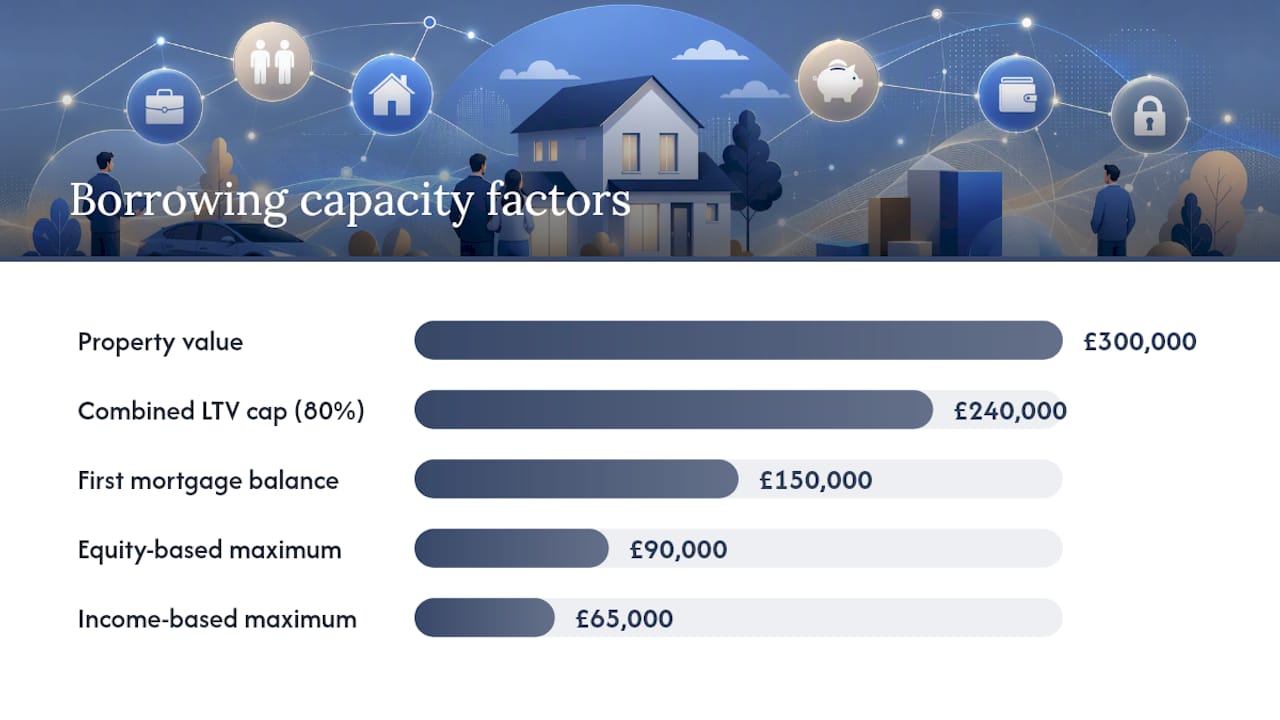
Take a property worth £300,000 with a £150,000 first mortgage balance.
- Calculate available equity-based limit: £300,000 × 80% = £240,000, minus £150,000 first mortgage = £90,000 maximum.
- Calculate the income-based limit: apply the lender’s income multiple, typically 3.5 to 4.5 times annual income, then stress-test the resulting payment against a higher notional rate.
- Take the lower figure. If the income test only supports £65,000 once existing debts and stressed payments are factored in, £65,000 is your realistic maximum, not £90,000.
Borrowing Calculator
See how much you could potentially borrow against your home, subject to status.
Please enter a property value that's higher than your outstanding mortgage balance.
Based on your figures, the amount available is below our typical minimum loan of £25,000. Get in touch and we'll talk through your options.
Get my free, no-obligation quoteIllustrative only, based on a maximum combined loan-to-value of 75%. This is not a loan offer or a quote, and your actual rate, borrowing amount and monthly payment will depend on your circumstances, credit profile and the lender's criteria. Think carefully before securing other debts against your home. Your home may be repossessed if you do not keep up repayments on your mortgage or any other debt secured on it.
| Factor | Example figure |
|---|---|
| Property value | £300,000 |
| First mortgage balance | £150,000 |
| Combined LTV cap applied | 80% |
| Equity-based maximum | £90,000 |
| Income-based maximum (illustrative) | £65,000 |
Calculator outputs are a starting point, not a guarantee. Every lender treats stress rates, income multiples and expenditure differently, and outputs remain indicative until a lender underwrites your specific case against its own policy.
Practical steps that improve your affordability outcome
Advisers see the same handful of moves make a genuine difference to how a case is underwritten. None of them are complicated, but most applicants skip at least one.
Reducing unsecured debt before applying lowers your existing commitments, which directly raises the income-based limit a lender will approve. Evidencing variable income properly, rather than hoping an underwriter infers it, avoids delays. Itemising committed costs (childcare, care contributions, regular transfers to family) gives lenders a realistic picture instead of a statistical guess. Choosing a longer term can lower the monthly payment enough to pass a stress test, though it increases total interest paid over the loan’s life, a trade-off worth discussing with an adviser rather than assuming automatically.
- Pay down or consolidate unsecured debt where possible before applying
- Prepare a full income and expenditure evidence pack, not just the minimum requested
- Get an Initial Disclosure Document early to compare fee structures
- Ask about term length trade-offs before signing anything
Tip: Bring your documents to the first conversation with a broker, not after they’ve shortlisted lenders. It lets a CeMAP-qualified adviser match you to the right lender first time rather than resubmitting.
Loanable’s advisers hold CeMAP qualifications and have arranged over £53 million in secured lending, working across a lender panel that includes options for applicants with more complex credit histories.
Remortgaging, unsecured loans or a second charge: which fits your affordability?
A second charge isn’t always the right route, even when you qualify for one. Remortgaging tends to work out cheaper when your existing rate is close to current market rates and your lender will lend the extra amount you need, since you avoid running two secured charges with two sets of fees.
Unsecured loans suit smaller borrowing needs, typically under £25,000 to £30,000, where speed matters more than rate, and you’d rather not extend the term of your mortgage debt at all.
- Remortgage when your current deal is ending or your rate is uncompetitive anyway
- Choose unsecured borrowing for smaller amounts where affordability is comfortable
- A second charge suits larger sums where remortgaging would trigger exit penalties
- HELOC-style flexible facilities offer drawdown flexibility but often carry variable rates and ongoing fees, where a closed-end second charge gives fixed, predictable payments
The right choice depends on your existing mortgage’s exit penalties, how much you need, and whether you want payment certainty or flexibility.
How long does a second charge mortgage affordability assessment take?
Most second charge applications move from initial enquiry to formal offer within two to four weeks, though the affordability assessment itself is usually the fastest part of that timeline.

Once you submit income evidence, bank statements and details of existing commitments, an underwriter typically completes the affordability check within a few working days, assuming the documentation is complete on first submission. Delays almost always trace back to missing paperwork: an unexplained gap in bank statements, an SA302 that doesn’t match submitted accounts, or income sources that need extra verification.
Valuation adds its own timeline. An AVM can return same-day, a desktop valuation typically takes a few days, while a full physical valuation can add a week or more depending on surveyor availability in your area. Legal work then runs in parallel with underwriting rather than after it, which is why brokers push to get documents in early rather than waiting for a valuation to complete first.
Applicants with straightforward, well-evidenced income and a standard valuation route often see funds released within three weeks of application. Complex cases, self-employed income spanning multiple businesses, adverse credit requiring a specialist lender, or a full valuation on an unusual property, can extend that to five or six weeks. None of this is unusual for secured lending; it reflects the additional checks a second charge requires compared with, say, an unsecured personal loan.
A CeMAP adviser’s view on borrowing sensibly
Affordability rules exist because a second charge sits behind your main mortgage, secured against your home. I’d rather see a client borrow slightly less and sleep easily than stretch to the maximum a calculator suggests. Disclose everything, budget honestly, and treat the stress test as a genuine safeguard, not an obstacle to get past.
Loanable’s approach to second charge mortgage affordability
Loanable brokers second charge mortgages, homeowner loans and debt consolidation loans for UK homeowners, including applicants with credit histories that mainstream lenders often turn away. Rather than pointing you at a generic calculator and leaving you to interpret the output, Loanable’s CeMAP-qualified advisers run your actual income, expenditure and equity position against a panel of lenders to find where you’ll genuinely qualify, not just where you might.

That matters most for readers whose situation doesn’t fit a standard template: self-employed income, existing adverse credit, or a combined LTV that’s tight against a lender’s standard band. Loanable has arranged over £53 million in secured lending and holds 5-star client ratings, built on cases exactly like these.
If you’ve worked through the numbers above and want a lender-specific answer rather than an estimate, start an enquiry for a second charge mortgage and get a broker assessment based on your actual circumstances.
Primary sources and further reading
- FCA: Second charge mortgages, improving outcomes for consumers — the 2026 regulatory review of affordability practices and fee levels
- MoneyHelper: Second charge or second mortgages — consumer guidance on costs lenders assess
- Charcol: How much can I borrow on a 2nd charge mortgage? — broker explainer on equity versus affordability
- Second Mortgage Affordability Calculator UK 2025/26 — LTV bands and income multiples used in the worked example
Frequently asked questions
What income counts towards second charge mortgage affordability?
Employed income (payslips, P60s), self-employed income (SA302s or accounts), pensions, benefits and rental income can all count, provided you can evidence it consistently over the period a lender requests.
Can I get a second charge mortgage with bad credit?
Yes, though defaults, CCJs or an active IVA narrow your lender options and usually mean a higher rate, which reduces how much you can borrow once stress-tested.
How much can I borrow with a second charge mortgage?
It’s the lower of your equity-based limit (property value multiplied by the lender’s combined LTV cap, minus your first mortgage) and your income-based limit after stress testing, typically calculated using a multiple of 3.5 to 4.5 times income.
Is a second charge mortgage cheaper than remortgaging?
Not always. Remortgaging often works out cheaper if your current rate is uncompetitive and your existing lender will advance the extra funds, avoiding a second set of fees entirely.
How long does a second charge mortgage application take?
Straightforward cases with complete documentation often complete within two to three weeks; complex income, adverse credit, or a full valuation requirement can extend this to five or six weeks.
This article is general information, not a substitute for advice from a qualified financial advisor. Consult a qualified financial professional about your own circumstances before acting on anything here.
Sources
- Second charge mortgages
- Second Mortgage Affordability Calculator UK 2025/26
- How much can I borrow on a 2nd charge mortgage?
- Second charge or second mortgages