



A second charge mortgage typically carries five main fee types: an arrangement fee from the lender, a broker or adviser fee, a valuation fee, legal and conveyancing costs, and potential early repayment charges on your existing mortgage. Together, these can add several thousand pounds to the total cost of borrowing. The single most important action you can take is to request a written, itemised fee breakdown and an Annual Percentage Rate of Charge (APRC) illustration at your very first consultation, before you provide any further personal data.
Key entities to know from the outset:
- APRC — the legally mandated comparison figure under FCA MCOB 10A, which must include most fees
- Financial Conduct Authority (FCA) — the regulator that sets transparency standards for second charge lenders and brokers
- Loanable — a CeMAP-qualified broker that provides itemised quotes and APRC illustrations on request
Key takeaways
Second charge mortgage fees typically total several thousand pounds across arrangement, broker, valuation, and legal costs, and the APRC is the only figure that lets you compare offers accurately.
| Point | Details |
|---|---|
| Five core fee types | Arrangement, broker, valuation, legal, and ERCs on your first mortgage all affect total cost. |
| Benchmark broker fees | The 2023 average broker fee was £2,831.60; use that figure to challenge quotes on simple cases. |
| APRC is the comparison metric | Regulated under MCOB 10A, APRC folds in fees and is the only reliable way to compare offers. |
| Adding fees to the loan costs more | Fees added to the principal accrue interest over the full term, raising total repayable materially. |
| Loanable provides itemised quotes | CeMAP-qualified advisors supply a written fee breakdown and APRC before any recommendation. |
Table of Contents
- What are the common second charge mortgage fees?
- What do second charge mortgage fees typically cost in the UK?
- How do fees change the true cost of your loan?
- When might a second charge be cheaper than remortgaging?
- How do you compare quotes and what should you ask?
- How Loanable approaches second charge fees
- Loanable: transparent second charge quotes
- The fee transparency problem is worse than most guides admit
- Sources
What are the common second charge mortgage fees?
Second charge mortgage costs come from three separate parties: the lender, the broker, and the solicitor. Understanding who charges what prevents surprises at completion.
- Arrangement fee (lender): Charged by the lender for setting up the loan. Typically £500–£2,500, though some lenders waive it in exchange for a higher headline rate. You can usually add this to the loan, but doing so means paying interest on it for the full term.
- Broker or adviser fee: The FCA found that intermediary fees commonly represented 2.5%–15% of the loan amount, with many firms unable to fully justify their fee levels in fair-value assessments. Many firms do not publish their fee structures online, meaning you may not see the figure until the recommendation stage.
- Valuation fee: Lenders need to confirm your property’s current value. An automated valuation model (AVM) is often free or low cost; a physical survey typically costs £150–£600 depending on property size and location.
- Legal and conveyancing fees: A solicitor registers the second charge at HM Land Registry and handles the legal work. Typical costs run £200–£800. You can read more about this process in Loanable’s guide to legal charges on property.
- Administration fees: Credit searches, ID verification, and document handling are sometimes itemised separately. These are usually modest but should appear on your written breakdown.
- Early repayment charges (ERCs) on your first mortgage: This is not a second charge fee as such, but it is a critical cost to factor in. If remortgaging would trigger a large ERC on your existing deal, a second charge can be the cheaper route because it leaves your first mortgage untouched.
What do second charge mortgage fees typically cost in the UK?
The table below shows typical ranges for each fee component, drawn from industry modelling data.
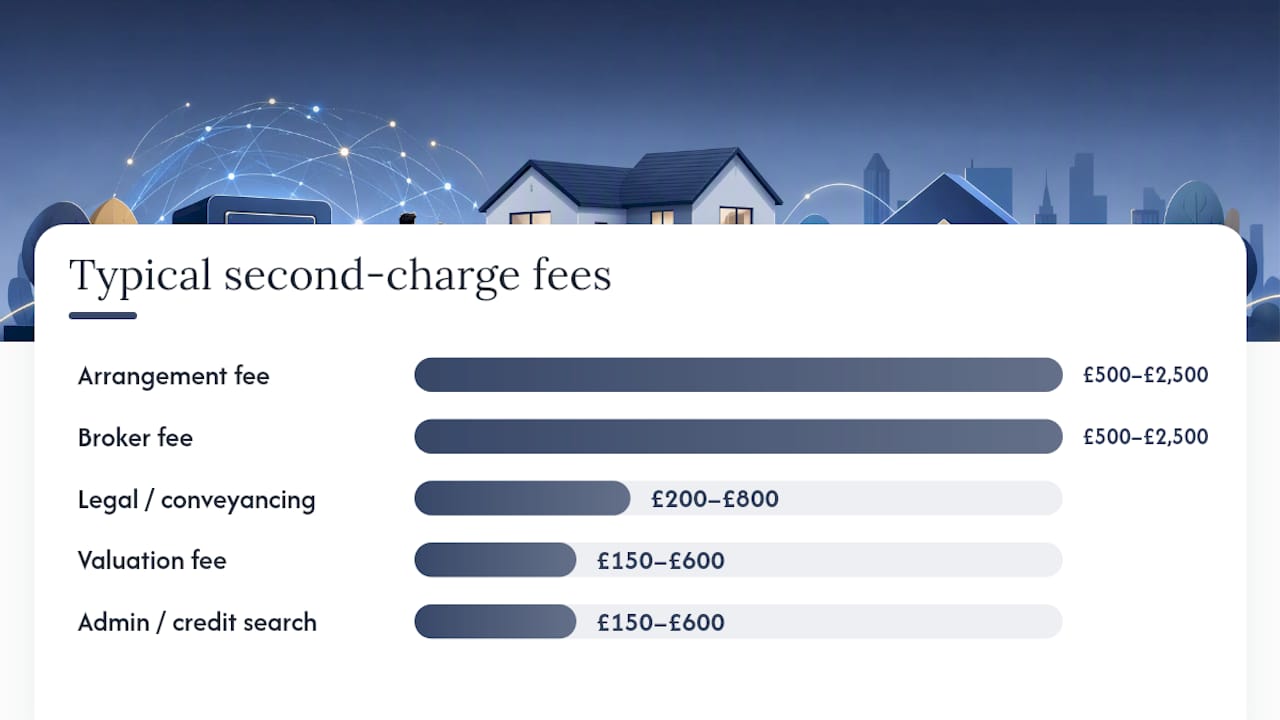
| Fee type | Typical range | Usually added to loan? |
|---|---|---|
| Arrangement fee | £500–£2,500 | Often yes |
| Broker fee | £500–£2,500 | Sometimes |
| Valuation fee | £150–£600 | Rarely |
| Legal/conveyancing | £200–£800 | Rarely |
| Admin/credit search | £150–£600 | No |
These typical fee ranges are widely used in second charge mortgage modelling and illustrate why total upfront costs can reach £5,000 or more on a mid-sized loan before interest is considered.
Broker fees: the FOI figures you should benchmark against. Freedom of Information data reported by Mortgage Solutions shows that around 70% of second charge cases arranged by brokers carried fees of £2,000 or more in 2023, with an average broker fee of £2,831.60. If a broker quotes you significantly above that figure for a straightforward case, ask them to justify it in writing.
On rates, second charge products tend to price higher than standard first-charge remortgage rates, with typical ranges from the high single digits to low double digits depending on LTV, credit profile, and loan size. A fee-free product at a higher rate is not automatically cheaper than a lower-rate product with an arrangement fee. Only the APRC tells you which costs less overall.
Some lenders offer to waive arrangement fees entirely, but the trade-off is almost always a higher interest rate. For larger loans over longer terms, paying the fee and taking the lower rate often works out cheaper. For smaller loans or shorter terms, a fee-free product can win. Model both scenarios using APRC before deciding.
[loanable_borrowing_calculator]
How do fees change the true cost of your loan?
APRC is the right comparison figure because it is regulated under MCOB 10A to include most fees alongside the interest rate. A headline rate comparison alone will mislead you, particularly on smaller loans where fixed fees represent a larger share of the borrowed sum.
A short example makes this concrete:
- Option A: £30,000 loan at 7.5% with a £1,500 arrangement fee added to the loan. Principal becomes £31,500. Over 10 years, total repayable rises materially versus a clean £30,000 at 7.5%.
- Option B: £30,000 loan at 8.2%, no arrangement fee. Higher rate, but the principal stays at £30,000.
The APRC on Option A may still be lower than Option B despite the fee, or it may not. The only way to know is to compare the APRC figures on the formal illustrations, not the headline rates.
Adding fees to the loan also extends the cost of those fees across the full term. Calculators that ignore fees understate the true cost. Always check whether the APRC on any illustration you receive actually includes all intermediary fees, not just the lender’s charges.
When might a second charge be cheaper than remortgaging?
MoneyHelper notes that a second charge can be the better option when your existing mortgage carries a high early repayment charge, and recommends comparing APRC, loan duration, and total repayable across both routes. Use the checklist below to assess your position.
- Large ERC on your first mortgage: If breaking your existing deal costs £3,000–£10,000+, a second charge that leaves it intact may be cheaper even at a higher rate.
- Existing rate worth keeping: If your first mortgage is at a historically low fixed rate, remortgaging resets that rate. A second charge preserves it.
- Loan size: Second charges are often competitive for mid-range borrowing (roughly £10,000–£100,000). For very small sums, an unsecured loan may carry lower total fees. Check your second charge eligibility to understand what your equity supports.
- Combined LTV: Adding a second charge raises your total secured debt. Lenders assess combined LTV, so higher equity gives you access to better rates.
- Term considerations: A shorter second charge term keeps total interest lower but raises monthly payments. Model the full cost of both options, including ERCs in the remortgage calculation, before deciding.
How do you compare quotes and what should you ask?
Request an itemised fee schedule and a formal APRC illustration before providing any further personal data. That one step filters out brokers who are not prepared to be transparent upfront.
- “Please provide a written, itemised breakdown of every fee I will pay and to whom.”
- “Does your fee get added to the loan or paid separately, and what is the APRC either way?”
- “Will you cap your fee for a straightforward case?”
- “Can I see your fee policy and your fair-value assessment?”
- “How many second charge cases like mine do you handle per month?”
Documentation to request: a written fee breakdown, a full mortgage illustration showing APRC, and a copy of the broker’s Initial Disclosure Document (IDD).
Red flags to watch for: fees not published anywhere online; hourly-rate justifications without any task or time metrics; the first mention of a fee appearing only at the recommendation stage. The FCA specifically flagged that firms often cannot substantiate hourly-rate or complexity claims, and that many recommendations were completed within hours despite high fee levels.
Pro Tip: Ask the broker how they would justify their fee if you raised a complaint with the Financial Ombudsman Service. A good broker will answer that question directly and without hesitation.
Understanding the difference between a broker and a lender also matters here. Loanable’s guide on loan broker vs lender explains the fee structures and obligations on each side.
How Loanable approaches second charge fees
Loanable provides an itemised quote and APRC illustration on request, with CeMAP-qualified advisors handling each case. The service addresses the transparency problems the FCA identified directly.
- Written fee breakdown provided before any recommendation is made
- Whole-of-market lender checks to find competitive rates across LTV bands
- Eligibility checks that do not affect your credit score
- Over £53 million in funded loans, with 5-star reviews reflecting consistent client outcomes
- Access to lenders across the credit spectrum, including options for borrowers with challenged credit histories
To get started, check your eligibility with no impact on your credit score.
Loanable: transparent second charge quotes
Loanable gives you a concrete fee figure and APRC before you commit to anything. That is the contrast that matters after reading this guide: no vague “fees apply” language, no figure disclosed only at the point of recommendation.

CeMAP-qualified advisors search across a wide lender panel to find the most competitive deal for your equity position and credit profile. Whether you are borrowing for home improvements, debt consolidation, or another purpose, Loanable handles the comparison work and presents the numbers plainly. With over £53 million funded and 5-star ratings from clients including those with complex credit histories, the track record is there. Visit Loanable’s secured loans page or check your eligibility now to get a written quote with no credit score impact.
The fee transparency problem is worse than most guides admit
Most articles on second charge mortgage fees list the fee types and move on. The harder truth, supported by the FCA’s own findings, is that the market has a structural transparency problem. Firms routinely withhold fee figures until the recommendation stage, at which point many borrowers feel committed to the process and less likely to walk away. That is not accidental. It is a commercial strategy, and the FCA named it as poor practice.
The FOI data reinforces this. An average broker fee of £2,831.60 on a loan that might take a few hours to arrange is a significant charge. The FCA found that many firms could not produce time or cost metrics to justify their fee levels. That means the burden falls entirely on the borrower to ask the right questions early, before any emotional or logistical commitment builds.
The conventional advice to “shop around” is correct but incomplete. Shopping around only works if you can compare like for like, and that requires an APRC illustration from every broker you approach, not just a headline rate and a verbal fee estimate. Collect the written breakdowns first. Compare the APRCs. Then decide.

This article is general information, not a substitute for advice from a qualified financial advisor. Consult a qualified financial professional about your own circumstances before acting on anything here.
Sources
- Second charge mortgages – improving outcomes for consumers | FCA
- Exclusive: Nearly three-quarters of second charge mortgage brokers charge over £2,000 in fees
- Second charge or second mortgages | MoneyHelper
- Second Charge Mortgage Calculator UK 2026