



Most secured loan applications complete in three to four weeks from submission to funds release. The single most effective thing you can do to hit that timeline is simple: have your documents ready and a solicitor instructed before submitting the formal application.
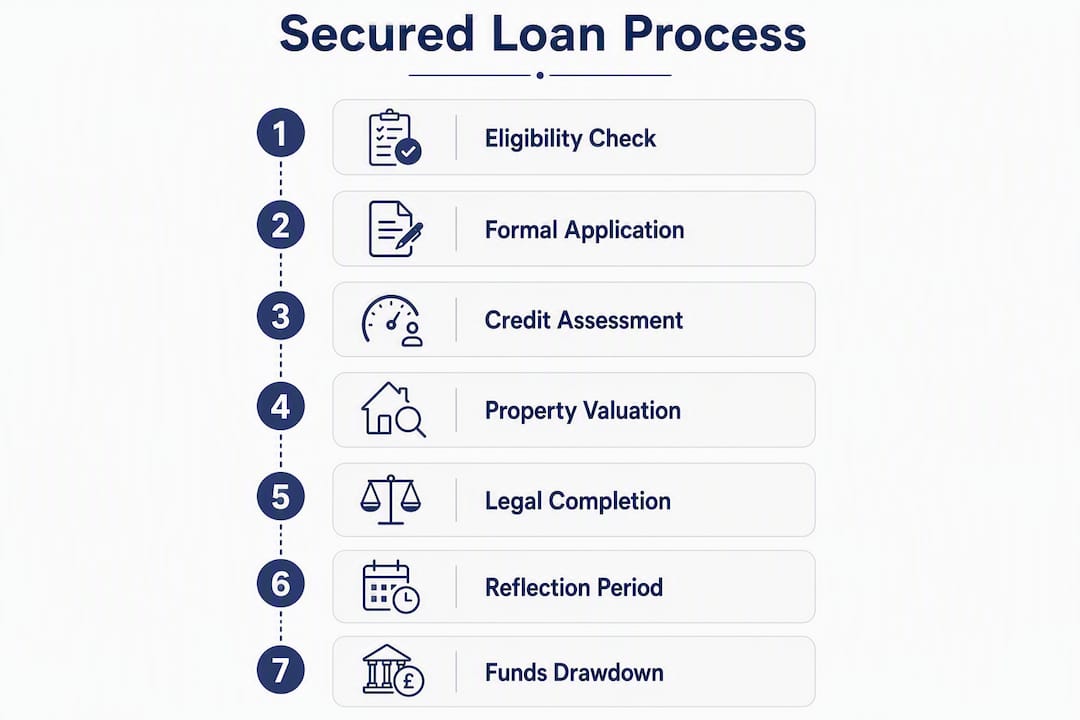
The core stages, in order:
- Pre-application and eligibility check — confirm you have sufficient equity and meet basic lender criteria
- Formal application — submit documents and complete the lender’s forms
- Underwriting and credit checks — the lender assesses affordability, credit history and loan-to-value
- Property valuation — an independent valuer confirms the property’s current market value
- Solicitor and legal completion — charge registration and mortgagee consent (where required)
- Seven-day reflection period — a mandatory, non-negotiable wait after the formal offer is issued, regulated by the Financial Conduct Authority (FCA)
- Funds release — drawdown once the reflection period ends
Loanable has facilitated a substantial amount in secured loans for UK homeowners. The pattern is consistent: borrowers who arrive with complete paperwork and a named solicitor complete faster, with fewer back-and-forth queries.
Table of Contents
- What is a secured loan in the UK?
- How the secured loan process works, step by step
- How long does a secured loan take at each stage?
- Documents you need for a secured loan application
- Who can get a secured loan in the UK?
- What lenders check when assessing your application
- Fees and costs to expect on a secured loan
- What causes delays and how to avoid them
- How to apply for a secured loan: a step-by-step action plan
- Key takeaways
- The part of the process most borrowers underestimate
- How Loanable supports you through the secured loan process
- Useful sources for UK borrowers
What is a secured loan in the UK?
A secured loan is a borrowing product where the debt is secured against a property you own, typically as a second charge on a mortgaged home. The lender holds a legal interest in your property until the loan is repaid.
Because the product is regulated by the FCA, every lender must conduct affordability checks before issuing an offer. That regulation also creates the mandatory reflection period described above.
The core risk is direct: if you miss payments, the lender can ultimately pursue repossession of your property. Check your affordability carefully and consider alternatives before proceeding.
How the secured loan process works, step by step
Step 1: Pre-application eligibility check (Day 1)
Confirm you are a homeowner with usable equity. Run a soft eligibility check that does not affect your credit file. Decide on the loan amount, purpose and approximate term. Instruct a solicitor at this point, not later.
Borrower actions: Run an eligibility check, gather an approximate property value, check your existing mortgage balance.
Typical time: same day.
Step 2: Formal application (Days 1–3)
Complete the lender’s or broker’s application form and submit your full document pack. Accuracy matters here. A single missing document restarts the clock on underwriting.

Borrower actions: Submit ID, proof of address, mortgage statement, income evidence and bank statements. Provide your solicitor’s contact details at this stage.
Typical time: 1–3 days, depending on document readiness.
Step 3: Underwriting and credit checks (Days 3–10)
The lender reviews your application, runs a full credit search and calculates affordability. They also check the loan-to-value (LTV) against the property’s estimated value. For borrowers with previous credit issues, this stage may involve referral to a specialist underwriter.
Borrower actions: Respond promptly to any queries. Provide supplementary documents if requested.
Typical time: 3–7 working days.
Step 4: Property valuation (Days 7–14)
The lender instructs a valuer to confirm the property’s current market value. This is a mortgage valuation, not a full structural survey. Its purpose is to verify the LTV calculation, not to identify defects. Using a market-standard valuer speeds the process.

Borrower actions: Allow access to the property. Be flexible on appointment timing.
Typical time: 1–2 weeks from instruction to report.
Step 5: Solicitor and legal completion (Days 10–21)
Your solicitor handles charge registration and, where applicable, obtains consent from your first-charge mortgagee. Firms with dedicated conveyancing teams experienced in second-charge work complete this stage faster than generalist practices. Digital signing capability also reduces delays.
Borrower actions: Respond to your solicitor’s requests quickly. Confirm any outstanding mortgage details they need.
Typical time: 7–10 working days, though this varies by firm.
Borrowing Calculator
See how much you could potentially borrow against your home, subject to status.
Please enter a property value that's higher than your outstanding mortgage balance.
Based on your figures, the amount available is below our typical minimum loan of £25,000. Get in touch and we'll talk through your options.
Get my free, no-obligation quoteIllustrative only, based on a maximum combined loan-to-value of 75%. This is not a loan offer or a quote, and your actual rate, borrowing amount and monthly payment will depend on your circumstances, credit profile and the lender's criteria. Think carefully before securing other debts against your home. Your home may be repossessed if you do not keep up repayments on your mortgage or any other debt secured on it.
Step 6: Seven-day reflection period and drawdown (Days 21–28+)
Once the lender issues the formal offer, the seven-day reflection period begins. No lender can shorten it. After it ends, you authorise drawdown and funds are released, usually within one to two working days.
Borrower actions: Review the offer carefully during the reflection period. Confirm drawdown instructions once ready.
Typical time: 7 days minimum, fixed by regulation.
How long does a secured loan take at each stage?
Typical completion runs three to four weeks, though straightforward cases with complete documents and a responsive solicitor can complete in under two weeks. Complex cases with title issues or slow mortgagee consent can stretch to eight weeks or more.
| Stage | Fast | Typical | Slow |
|---|---|---|---|
| Application and document submission | 1 day | 2–3 days | 5–7 days |
| Underwriting and credit checks | 2–3 days | 5–7 days | 10–14 days |
| Property valuation | 3–5 days | 7–10 days | 14+ days |
| Solicitor and legal completion | 5 days | 7–10 days | 14–21 days |
| Reflection period | 7 days | 7 days | 7 days |
| Total | ~2 weeks | 3–4 weeks | 8+ weeks |
Three realistic scenarios:
Fast (approximately one to two weeks): Documents submitted in full on day one, valuation booked within two days, solicitor already instructed, no title complications. The reflection period still applies, so the absolute minimum is around ten working days.
Typical (three to four weeks): One or two document queries, valuation booked within a week, solicitor instructed at application stage. This is the most common outcome for straightforward homeowner applications.
Slow (eight weeks or more): Missing documents at submission, valuation delayed by access issues, solicitor not yet instructed, mortgagee consent takes time, or a complex title requires additional legal work. Any one of these can add a week; several together can double the timeline.
The seven-day reflection period is fixed. It applies to every case regardless of how quickly the rest of the process completes.
Documents you need for a secured loan application
Assembling the right paperwork before you apply is the single fastest way to cut completion time. Group your documents as follows.
Identity and address
- Valid passport or UK driving licence (photo ID)
- Two recent utility bills or bank statements as proof of address (dated within three months)
Property and mortgage
- Most recent mortgage statement showing outstanding balance
- Title deeds or Land Registry details (your solicitor can obtain these)
- Buildings insurance schedule
Proof of income — employed applicants
- Last three months’ payslips
- Most recent P60
Proof of income — self-employed applicants
- SA302 tax calculations and HMRC tax year overviews for the last two to three years
- Accountant’s reference letter (accepted by many lenders as supplementary evidence)
- Business bank statements for the last three months
For a detailed breakdown of what self-employed borrowers specifically need, the self-employed secured loan guide covers document requirements and common lender queries in full.
Proof of income — retired applicants
- State pension letter or private pension statements
- Most recent P60 or annuity schedule
Bank statements
- Last three months’ personal bank statements (all accounts used for income and outgoings)
Solicitor details
- Solicitor’s name, firm, address and contact number
Pro Tip: Instruct your solicitor and share their contact details with your broker or lender at the same time you submit your application. Solicitor lead time is one of the most common sources of delay, and pre-instructioning cuts it significantly.
Who can get a secured loan in the UK?
You must be a homeowner with either an existing mortgage or partial ownership of a property. Renters are not eligible. The loan is secured against the equity in your property, so the amount you can borrow depends on how much equity you hold after accounting for any existing mortgage balance.
Common lender expectations:
- Sufficient equity in the property to support the loan at an acceptable LTV ratio
- Minimum age of 18 (some lenders set higher minimums or impose upper age limits at the end of the term)
- Acceptable property type: standard construction residential properties are straightforward; non-standard construction (steel frame, timber frame, thatched) may require specialist lenders
- UK residency
Joint applications: Both applicants must consent and both names appear on the charge. If the property is jointly owned, both owners must be party to the application. For joint borrowing structures and how multiple applicants affect affordability calculations, the three-person mortgage guide offers useful context on how lenders treat combined income.
Past credit issues: Secured loans remain accessible to borrowers with previous defaults, missed payments or county court judgements (CCJs) because the property equity reduces the lender’s risk. The trade-off is pricing: borrowers with stronger credit profiles receive more competitive rates, while those with adverse history are typically placed with specialist lenders at higher rates. Steps to improve your secured loan eligibility before applying can make a material difference to the rate you receive.
What lenders check when assessing your application
Affordability
The lender calculates whether your income, after existing commitments, can comfortably service the new loan. This is a regulatory requirement under FCA rules, not a discretionary check.
Credit search
A full credit search is run at application stage. This leaves a footprint on your credit file. Soft searches (used for eligibility checks) do not. Lenders look at payment history, existing debt levels, CCJs and any previous insolvencies.
Loan-to-value (LTV)
LTV is the combined total of your existing mortgage and the new secured loan expressed as a percentage of the property’s value. Lower LTV ratios generally unlock better rates. Most mainstream lenders have maximum LTV thresholds; specialist lenders may go higher but at a cost.
Property valuation and type
The valuation confirms the property’s current market value for LTV purposes. Non-standard construction, properties above commercial premises, or properties with short leases (typically under 70–85 years remaining) can complicate or restrict lending.
Existing mortgage consent
For a second charge, the first-charge mortgagee (your existing mortgage lender) must consent to the new charge. Most mainstream mortgage lenders grant this routinely, but the process takes time and occasionally raises conditions.
Red flags that commonly cause declines or additional conditions:
- Severe mortgage arrears or recent defaults
- Unregistered title (property not registered at Land Registry)
- Non-standard construction without specialist valuation
- Very short lease on a leasehold property
- Undischarged bankruptcy or active debt relief order
Fees and costs to expect on a secured loan
Fees vary between lenders and brokers, but the main categories are consistent.
| Fee type | Typical range | Notes |
|---|---|---|
| Valuation fee | £500+ | Depends on property value and location |
| Legal/conveyancing fee | — | Charged by your solicitor for charge registration |
| Lender arrangement fee | Up to 2% of loan | Sometimes added to the loan rather than paid upfront |
| Broker fee | Varies | Some brokers charge a percentage; others are fee-free to the borrower |
| Early repayment charge | Varies | Check the terms before accepting any offer |
How fees affect total cost — a worked example:
On a £30,000 secured loan over ten years at 8% APR, the headline monthly payment might appear manageable. Add a £500 arrangement fee, £400 in legal costs and a £200 valuation fee, and the total cost of credit increases by £1,100 before a single monthly payment is made. That changes the effective APR and the true cost comparison between offers.
Always compare offers on total amount repayable, not just the headline rate or monthly payment.
Pro Tip: Ask any lender or broker for a full, line-by-line illustration of all costs before you accept an offer. This is sometimes called a “key facts illustration” (KFI) or European Standardised Information Sheet (ESIS) and is a regulatory requirement. If a lender cannot or will not provide one, do not proceed.
What causes delays and how to avoid them
Most delays fall into a small number of categories. Knowing them in advance lets you act before they become problems.
Missing or incomplete documents are the most common cause of underwriting delays. A lender who receives a partial application will pause the process until the gap is filled. Prepare the full document pack described above before you submit.
Solicitor lead time is the second most common bottleneck. A solicitor who has not yet been instructed, or who is unfamiliar with second-charge conveyancing, can add one to two weeks to completion. Firms that accept digital signing and have dedicated conveyancing teams experienced in second-charge work complete charge registration far faster than generalist practices.
Valuation appointments depend on access to the property and the availability of the valuer. Being flexible on appointment times and confirming access quickly reduces this delay to a minimum.
Mortgagee consent from your existing mortgage lender is usually straightforward but is not instant. Some lenders take five to ten working days to respond. Your broker can often chase this directly.
Complex title issues such as unregistered land, restrictive covenants or boundary disputes require additional legal work and can extend the timeline significantly. These are rarely discovered until the solicitor begins their checks, which is another reason to instruct early.
Pro Tip: Give your broker a single point of contact for all communications and commit to responding to queries within 24 hours. Most delays are compounded by slow responses, not by the process itself.
How to apply for a secured loan: a step-by-step action plan
Work through these steps in order. Each one has a clear action and a timing note.
Run a soft eligibility check — confirm you meet the homeowner and equity requirements without affecting your credit file. Do this first, before anything else.
Gather your documents — use the checklist above. Employed, self-employed and retired applicants have slightly different requirements. Aim to have everything ready before you submit. Allow one to three days.
Instruct a solicitor — choose a firm with second-charge conveyancing experience and digital signing capability. Share their contact details with your broker at application stage. Do this before or at the same time as step 4.
Obtain an indicative property value — use a recent estate agent valuation or Land Registry data as a reference. The lender will commission their own valuation, but having a figure helps you estimate LTV and borrowing capacity. One to two days.
Complete the formal application — submit through your broker or directly to the lender. Double-check every field and attach all documents in the required format. One day if documents are ready.
Track communications actively — check email and phone daily during underwriting. Queries left unanswered for 48 hours can pause the process entirely. Ongoing.
Respond to valuation access requests promptly — confirm the appointment date within 24 hours of the request. As requested.
Accept the formal offer — read the key facts illustration carefully. Check the APR, total amount repayable, all fees and the early repayment charge terms. The seven-day reflection period begins from the date of the offer.
Wait out the reflection period — use this time to confirm drawdown instructions with your solicitor and broker. Do not attempt to accelerate this stage.
Request funds — once the reflection period ends, authorise drawdown. Funds typically arrive within one to two working days.
Compare any offers you receive on total amount repayable, not headline rate. A lower rate with higher fees can cost more overall.
Key takeaways
The secured loan process for UK homeowners typically completes within a few weeks, with document readiness and early solicitor instruction being the two factors most within your control.
| Point | Details |
|---|---|
| Typical timeline | Three to four weeks from application to funds, with a fixed seven-day reflection period at the end. |
| Property at risk | Missed payments can lead to repossession; check affordability before applying. |
| Mandatory reflection | The seven-day reflection period after a formal offer cannot be shortened by any lender. |
| Speed-up action | Instruct a solicitor and prepare all documents before submitting the formal application. |
| Loanable’s role | Loanable’s CeMAP advisers coordinate lenders, solicitors and valuers across the process, having placed over £53 million in secured loans for UK homeowners. |
This article provides general information only, not financial or legal advice. Confirm current rates, eligibility rules and regulatory requirements with a qualified adviser or the FCA before proceeding.
The part of the process most borrowers underestimate
The secured loan timeline is not primarily a lender problem. Lenders move at a fairly predictable pace once they have a complete, accurate application in front of them. The delays that push cases from three weeks to six weeks almost always originate on the borrower’s side or in the solicitor chain.
The most underestimated factor is solicitor selection. Borrowers tend to use whoever handled their house purchase, which is often a generalist firm with no particular experience in second-charge work. A firm that has to research the process, cannot accept digital signatures, or has a conveyancing team already at capacity will add a week or more to completion. Choosing a firm with dedicated second-charge experience is not a minor administrative detail. It is one of the highest-impact decisions in the entire process.
The second underestimated factor is document quality, not just document quantity. A payslip that does not match the bank statement income figure, or an SA302 that covers only one year when the lender wants two, will trigger a query that pauses underwriting. Preparing documents carefully, and checking them against each other before submission, removes most of these queries before they arise.
Broker involvement changes this dynamic. A broker who packages the application fully before submission, coordinates directly with the solicitor and valuer, and manages lender queries as they arise removes most of the friction from the borrower’s side. Some lenders will not accept direct applications at all, requiring broker intermediation. For complex cases, that coordination is not a convenience. It is the difference between a three-week completion and a six-week one.
How Loanable supports you through the secured loan process
Loanable’s secured loan service gives UK homeowners direct access to CeMAP-qualified advisers who manage the process from eligibility check to drawdown. Rather than leaving you to coordinate lenders, solicitors and valuers separately, Loanable handles those relationships directly.

Three things set Loanable apart for borrowers going through this process:
- Over £53 million funded for UK homeowners, including borrowers with complex credit histories
- CeMAP-qualified advisers who understand lender criteria and can match applications to the right lender first time
- 5-star client feedback reflecting consistent outcomes across debt consolidation, home improvement and other purposes
If you are consolidating debt as part of this process, the debt consolidation loans page covers how secured borrowing can reduce monthly outgoings by replacing multiple higher-rate commitments with a single secured payment.
To find out whether you qualify without affecting your credit file, check your eligibility now. An adviser will confirm your options and outline realistic timelines for your specific case.
Loanable may receive a commission from lenders on successful loan introductions. This does not affect the rate you are offered.
Useful sources for UK borrowers
These resources cover regulation, consumer rights and practical guidance on secured borrowing.
Financial Conduct Authority (FCA) — the regulator for secured loan products in the UK. Use this to verify that any lender or broker you deal with is authorised and to understand your consumer rights under the Mortgage Credit Directive.
MoneyHelper — the government-backed guidance service covering affordability, debt and borrowing options. Useful for checking whether a secured loan is the right product for your situation before you apply.
Citizens Advice — free, impartial advice on debt and borrowing. Particularly useful if you are considering a secured loan for debt consolidation and want independent guidance on the risks.
Loanable secured loans — product and eligibility information for UK homeowners, including options for borrowers with adverse credit history.
How long does it take to get a secured loan? — a detailed breakdown of stage-by-stage timelines from a UK mortgage specialist, useful for cross-checking the estimates in this article.